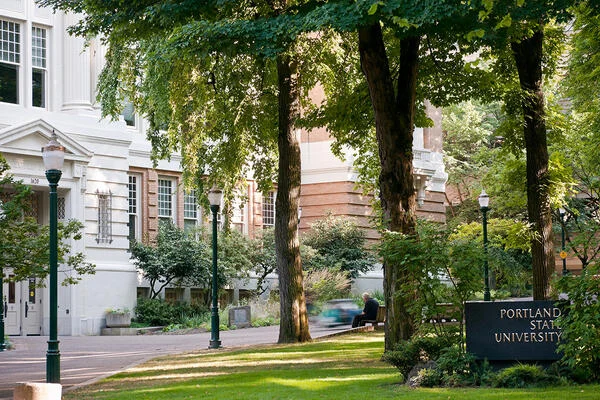
Portland State University is one of several higher education institutions recently announcing major budget deficits.gettyFalling enrollments, federal policy turmoil and rising costs have led to another round of significant university budget cuts involving the termination of faculty and the closure of academic programs.Both public and private institutions have been affected, and in some cases, the budget shortfalls have been so deep that administrators have declared their institution to be in a financial crisis.Here’s a look at five institutions that have recently announced substantial financial deficits and the need for large-scale cutbacks.Portland State UniversityLast week, Portland State University President Ann Cudd announced that the university will begin the formal process of retrenchment, which will likely involve a substantial decrease in academic programs as well as the termination of faculty and staff, as the university tries to cope with a $35 million structural budget deficit. “In order to avoid a financial crisis that would jeopardize the ability of PSU to fulfill its mission, the entire campus has taken a comprehensive evaluation of all its operations to identify efficiencies and potential savings,” Cudd said in a message to university employees.MORE FOR YOUIn that message, she identified three departments that face possible elimination and 16 others that could be reduced in scope or changed as a result of the cuts. In addition, Cudd said she was beginning the formal process required to layoff faculty and staff.Portland State has seen a 23% decline in enrollment since 2019, and the state of Oregon is facing its own significant budget pressures, making an increase in appropriations unlikely. Cudd added that while the institution had been relying on its reserves to fund ongoing operations, that strategy was “not a sustainable financial practice and it is imperative that we balance our budget.” Cudd said she was taking these steps "because after reviewing the results of our work, it has become clear that our financial condition is such that departmental reductions or eliminations may be unavoidable.” The New SchoolThe New School, a historically well-regarded private university in New York City, plans to reduce its work force by about 15% by the end of this academic year, according to an email from the administration obtained by The Chronicle of Higher Education.The institution has been trying to close an ongoing budget deficit that’s now reached about $48 million. Its enrollment has dropped dramatically — from approximately 10,400 students in 2019 to fewer than 9,000 currently.“In certain areas, reductions will primarily affect staff roles; in others, the number of full-time faculty will be adjusted based on closures relating to program scale, demand, and long-term viability,” wrote New School Provost Richard Kessler and Francisco X. Pineda, executive vice president for business and operations.These moves come after previous austerity measures, including offering early retirement packages, pausing Ph.D. admissions, and reducing salaries, failed to save enough money to close the New School’s budget gap sufficiently.University of MaineFaced with what was earlier projected to be an $18 million deficit, the University of Maine is reducing its ongoing budget by $5.6 million. It will also lay off “fewer than 10” staff members, according to an email sent by University of Maine President Joan Ferrini-Mundy last week. In December, University of Maine administrators asked all colleges and units to reduce their expenses by 7%. The layoffs are part of that reduction. In addition, the university will save another $5.7 million through one-time solutions, including through attrition and benefit savings, and the use of gift/grant funding. It will gain $2.3 million in state appropriations, and it also will tap its reserves, as it has ever since FY22.Ferrini-Mundy pointed to “regional demographic pressures, the rapidly changing federal landscape, and rising costs we cannot control” as the primary factors complicating the university’s budget picture.University of DenverThe University of Denver is projecting a $20-30 million budget deficit for the next fiscal year, according to The Denver Clarion, the university’s student newspaper. DU Chancellor Jeremy Haefner cited an “enrollment cliff” as a major reason for the deficit, along with an unusually large graduating senior class, coupled with a small incoming freshman class. He also pointed to a large decline in international student enrollment, blaming the Trump administration’s stricter immigration policies.“Washington is not our friend right now,” said Haefner.The cumulative result of the sagging enrollment is a $50 million decline in tuition revenue over the last four years. Although the university has reduced expenses, those reductions have not been sufficient to offset the loss of revenue. Now, administrators are planning to eliminate recurring costs, which will likely require the closure or consolidation of multiple academic programs. University of North TexasThe University of North Texas is facing a projected $45 million deficit for the current fiscal year, substantially greater than the $31.2 million deficit that was budgeted for in FY 2026. The university blamed the budget shortfall on enrollment decreases — especially among international graduate students — and decreases in state funding for instruction and operations. UNT was considering a number of steps to address the shortfall. In addition to efforts to increase revenue through enrollment and student retention efforts, President Harrison Keller indicated that the necessary cost reductions would include some combination of the following steps:Increasing teaching workloads/minimum class sizeFreezing some faculty and staff vacant linesConsolidating or eliminating courses and programs with low enrollmentReorganizing administrative and academic units and departmentsConverting large enrollment courses to hybrid delivery.Keller said as the university considers its next steps, “our commitment to student success remains paramount. Every UNT student should have clear academic pathways, timely support, and opportunities for career development from their first connection to the university, through graduation, and into their early careers.”
More Universities Hit With Another Round Of Faculty And Program Cuts
Falling enrollment, federal policy turmoil and rising costs have led to a new round of university budget cuts involving faculty termination and academic program closures.
935 words~4 min read