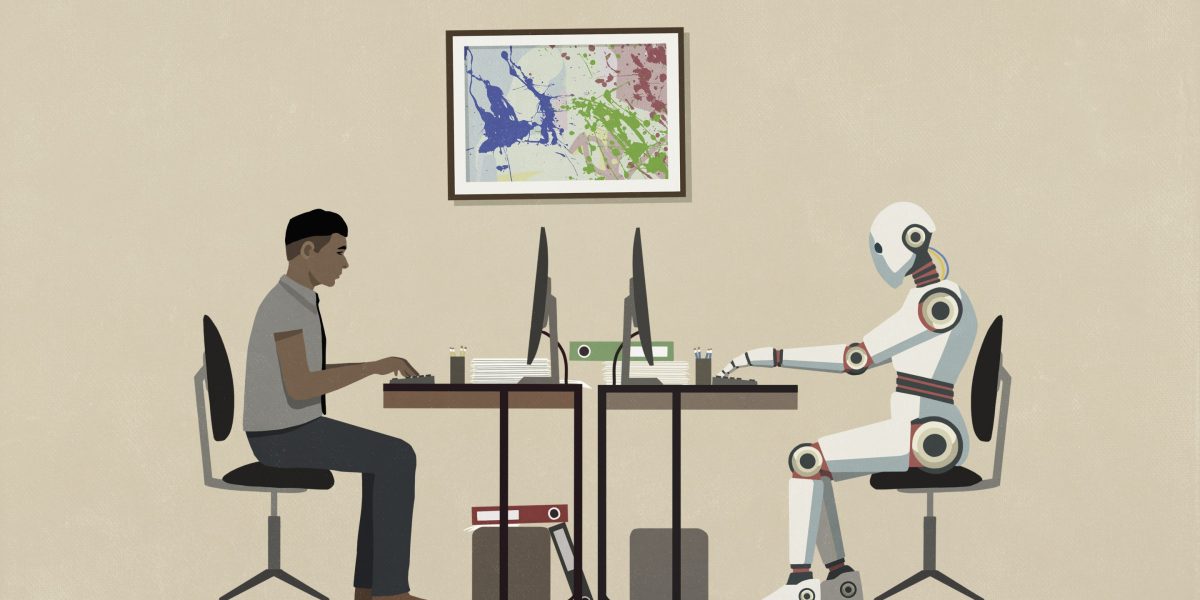
To understand how companies can truly extract value from human-AI collaboration, we conducted a field experiment with 244 consultants using GPT-4 for a complex business problem-solving task. With support from scholars at Harvard Business School, the MIT Sloan School of Management, the Wharton School, and Warwick Business School, the experiment analyzed nearly 5,000 human-AI interactions to answer a critical question: When humans collaborate with GenAI, what are they actually doing—and what should they be doing?
Three hidden patterns of human-AI collaboration
Our experiment’s most striking finding is that professionals working with GenAI naturally sorted themselves into three distinct collaboration styles—each with dramatically different outcomes:
Cyborgs (60% of participants) engaged in what we call “Fused Knowledge Co-Creation”—a continuous, iterative dialogue with AI throughout the entire workflow. They used it for each sub-task in their workflow and in different ways: They assigned personas to the AI, broke complex tasks into modules, pushed back on AI outputs, exposed contradictions, and validated results in a dynamic back-and-forth. For Cyborgs, the boundary between human and AI thinking became deliberately blurred.