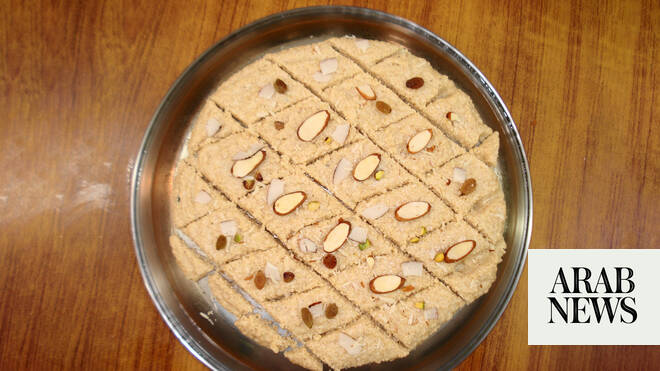
BANNU, Pakistan: Before sunrise, the narrow lane outside Speen Sar, a modest restaurant, fills with customers waiting for halwa, a dense sweet made from wheat starch, sugar and clarified butter, that serves as breakfast for many people in this northwestern city.
Inside the restaurant’s kitchen, the morning air is thick with the scent of caramelized sugar and heated ghee. A chef leans over a large metal vat, dissolving sugar into the hot fat before adding a slurry of flour and water. With rhythmic, heavy strokes, he stirs the mixture until it thickens into a glossy halwa.
He pours the sweet onto a tray and rushes toward the counter, where a crowd of patrons has already gathered. Three cooks work in quick succession to keep pace with demand, turning out batch after batch during the breakfast rush in Bannu, a city in Pakistan’s Khyber Pakhtunkhwa province.
While halwa is widely eaten as a dessert or festival sweet across South and Central Asia and the Middle East, Bannu stands apart for turning it into a morning staple. Across most of Pakistan, breakfast tends to be savory, typically consisting of omelets, parathas or puris, and in some places nihari, a slow-cooked meat stew. Here, however, halwa is not a side dish but the meal itself, eaten plain or with bread before the workday begins.