Supported by
When it came to using her life in her work, the artist Lee Lozano went about as far as a person can go.
By Sasha Weiss
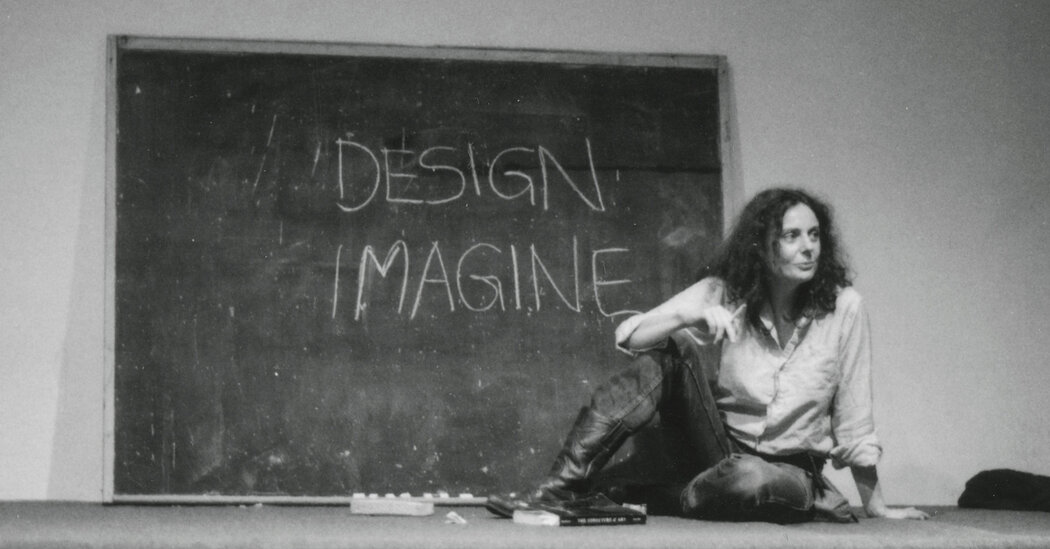
LEE LOZANO CRASHED through New York’s art world between 1960 and 1972, a restless decade during which she went about disrupting all of its conventions. A compatriot and challenger to a cadre of mostly male artists who would become leading figures in post-minimalism and conceptual art (Robert Morris, Dan Graham, Carl Andre and Robert Smithson, among others), she went further than any of them, becoming one of the first artists to commit herself to what the critic Lucy Lippard called “life as art.” In Lozano’s case, it became impossible to tell where one ended and the other began.
Lozano wasn’t the first artist to create art beyond salable objects, or to make her life her material. But for her the practice became all-consuming. In 1969, at the age of 38, just as she was gaining attention for her brawny, abstract paintings, she abandoned the form and initiated her “General Strike Piece,” which involved a gradual withdrawal over a period of several months from the art world’s openings and social events, the first step in a long process of distancing herself from her peers. Lozano wrote that she wanted to create a “total revolution simultaneously personal and public,” her own take on the collective protest movements of the age. Other artists were marching against the Vietnam War and demonstrating against patriarchy, but Lozano disdained such public actions, choosing instead a private, idiosyncratic rebellion. After this, her writing — lists of thoughts, questions, proposals, interactions, offers and invitations she’d turned down — became her work, though it largely went unseen outside of a handful of exhibitions and a small circle of friends with whom she corresponded.