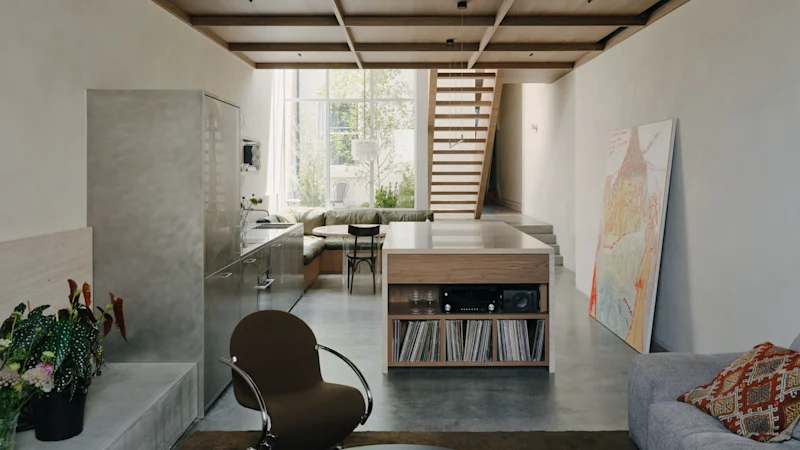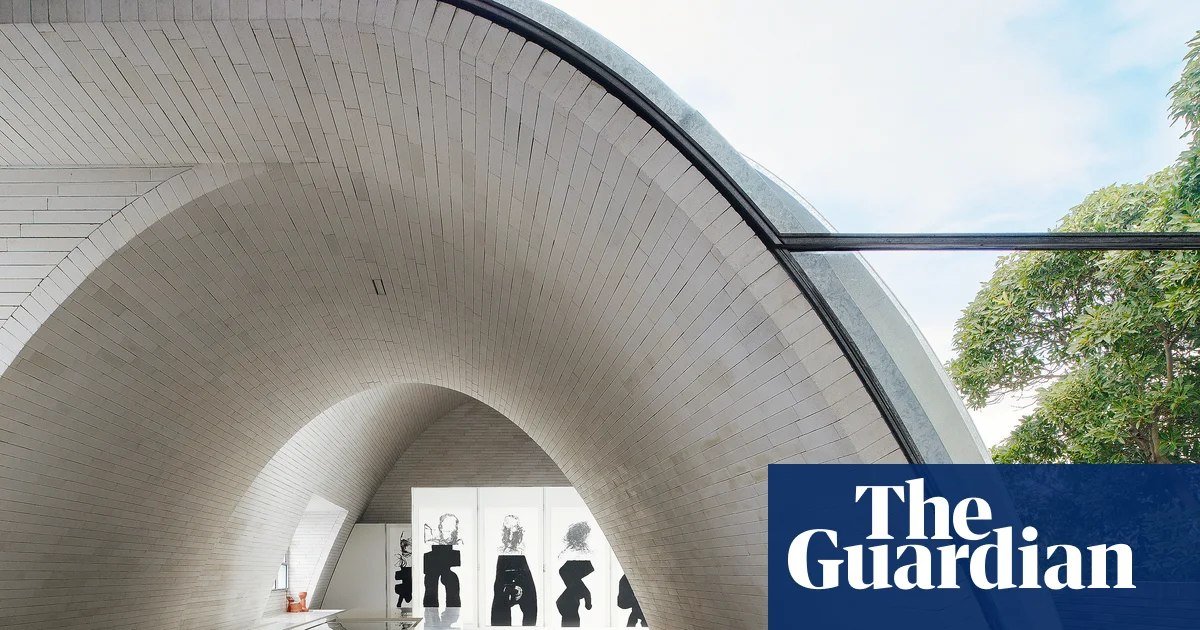
This article is more than 7 months oldWhen architects design their own houses – with no client to please but themselves – the results are clever, creative and considered. In new book The Architect’s House, author Stephen Crafti explores how architects around the world build their homes, featuring swirling staircases, thoughtful interiors and a timber library with a concealed fold-down bedSydney architect William Smart turned a former sweets factory in Alexandria into a home and office. In the kitchen, the brick ceiling mimics the rest of the home’s curved museum-like ceilings. Photograph: Nicole EnglandStephen Crafti and Emma Joyce, photography by Nicole EnglandFri 19 Sep 2025 17.00 CESTDavid Leggett and Paul Loh, Northcote House, MelbourneArchitects and life partners Leggett and Loh have taken a pint-sized block in Melbourne (a mere 4.6 metres wide) and transformed it into an ornate two-storey castle inspired by brutalist architecture. The property’s rear (pictured) is like a ‘veil’ with curvaceous steel poles bending around a portal window to provide privacy and defuse lightDavid Leggett and Paul Loh, Northcote House, Melbourne (continued)Layered with curves inside and out, the two-bedroom house has a warm and cosy snug. At its centre is a swirling plywood balustrade that takes design cues from Loh’s love of fashion designer Issey Miyake’s pleated clothing and ‘a certain Baroque sensibility’, says Loh. Out of shot is a Stuv fireplace with a nine-metre fluteJeff Provan’s Mori House, Mornington Peninsula, VictoriaPortuguese architect Manuel Aires Mateus worked with Provan and local firm MA+Co to design this beach house at Mount Martha. Its self-contained concrete bungalows are linked by courtyards, like the one pictured. Provan and his wife Mariko added mid-century furniture, including bright yellow butterfly chairs for the terraceJeff Provan’s Mori House, Mornington Peninsula, Victoria (continued)The property overlooks Port Phillip Bay. Because it’s a beach house, Provan wanted to create ‘places you want to take your shoes off’, he says. Large paper lanterns suspended over the kitchen table are an example of the relatively simple coastal furnishings used throughoutJeff Provan’s Mori House, Mornington Peninsula, Victoria (continued)Mori means forest in Japanese, which is a connection to Mariko’s heritage. The couple wanted the house to have ‘longevity’ and hope their extended family will use the property for generations to come. Pictured is their dedicated tatami room featuring traditional shoji screensAndrew Piva’s East Malvern Home, MelbournePiva, director of B.E. Architecture, bought a 1930s semi-detached property nine years ago. He built a family home behind it, with slim-lined concrete bricks and oak joinery throughout. Here, in his lounge room, is an L-shaped bank of cupboards housing Piva and his wife Laura’s record collection. He often sits in his Eames chair at the end of the dayAndrew Piva’s East Malvern Home, Melbourne (continued)Family cat Bottas (named after the Formula 1 driver) rests on the stairs that lead down to a multifunctional study/library, which has a fold-down bed concealed behind a timber veneer wallRobert Simeoni’s home, Carlton North, MelbourneOn a street where many of the other late-Victorian houses have undergone deep renovations, this Italianate family home had barely been touched since the 1950s. Architect Simeoni says: ‘There’s a sense of history and layers that run through this place.’Robert Simeoni’s home, Carlton North, Melbourne (continued)Simeoni kept the home’s original floor plan. ‘I felt it was complete as soon as I first walked in,’ he says. In the living and dining rooms, ceiling to floorboard sheer curtains conceal the busy inner-city suburb outsideThe Architect’s House book cover (Quadrille; A$65, NZ$75)
Inside the homes of six prominent Australian architects – in pictures
From swirling spiral staircases to a timber library concealing a fold-down bed, a new book explores the creative ways architects design their own houses
575 words~3 min read