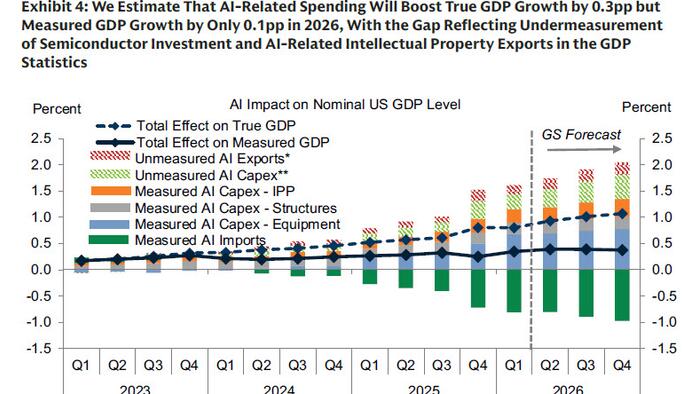
Elsie Peng, Joseph Briggs, and Sarah Dong, from the team of chief economist Jan Hatzius, explain in a Sept. 13 research note the “measured impact” on GDP from AI is an “intermediate impact” from the Bureau of Economic Analysis (BEA), so it only counts toward final demand when a final product is sold. For example, a semiconductor only shows up in GDP when, say, a laptop is purchased. This means billions of dollars in AI-enabled economic activity isn’t being measured, Peng, Briggs, and Dong argue.
Since the launch of ChatGPT in 2022, they calculate, the dramatic surge in revenues attributed to AI infrastructure has boosted “true GDP” by a staggering $160 billion. This figure highlights AI’s transformative role as a growth engine—but underscores a confounding gap in official government statistics. According to Goldman Sachs, most of AI’s real economic contributions have remained largely invisible in U.S. GDP numbers to date.
The research draws on company reports and government data, revealing spending on AI infrastructure by U.S. firms has soared, a $400 billion increase since 2022. A notable chunk of this spending has been focused on information processing equipment, which spiked at a 39% annualized rate in the first half of 2025.