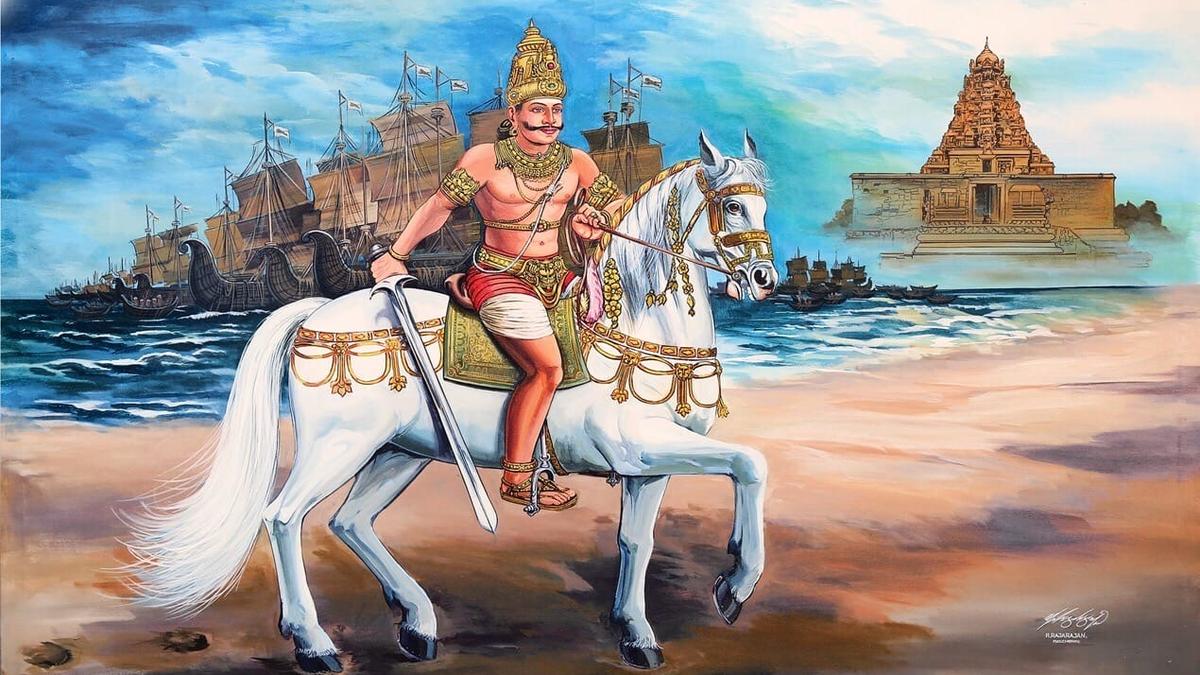
Naval supremacy drove the Chola empire to the height of glory. Under the dynamic leadership of Rajendra Chola I, who ascended the throne in 1012 CE, the Chola navy reached the zenith of its power. With nearly the entire southern peninsula of India under their dominion, the Cholas commanded an unobstructed access to the seas, which they turned into a theatre of unprecedented political expansion.
Rajendra’s reign marked the most assertive phase of Chola overseas ambition. The naval campaigns launched during this period led to the annexation of Sri Lanka and an audacious expedition across the Bay of Bengal to the distant shores of the Malay Peninsula. The defeat of Malay Peninsula earned Rajendra the title Kadaram Kondan (the Conqueror of Kadaram).
Well-organised fleet
Historians pointed to the existence of a well-organised fleet of ships and boats of various grades in Chola’s navy, serving both commercial and military purposes. K. A. Nilakanta Sastri, in his book The Cōlas, offered a detailed account of Rajendra’s naval campaigns, particularly those targeting Eelamandalam (Sri Lanka) and Kadaram, the strategic stronghold in the Kingdom of Srivijaya. In 1017 CE, Rajendra launched a decisive campaign against Sri Lanka. This was the fifth year of his reign, and it marked the culmination of the efforts initiated by his father, Raja Raja Chola I. According to inscriptions and the Ceylonese chronicle Mahavamsa, the Chola conquest coincided with the thirty-sixth regnal year of the Sinhalese ruler Mahinda V, also dated to 1017 CE. Sastri noted that the campaign was timed with precision, with political instability in the island kingdom factored in.