Home
Storia in 1 fonti
The Arctic Ocean keeps permafrost carbon firmly locked
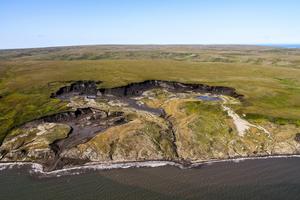
Permafrost in the Arctic stores large quantities of organic carbon. When the frozen ground thaws or coastal sections erode, this carbon can enter the sea, where microorganisms can break it down and convert it into climate-damaging greenhouse gases. The extent to which this carbon actually enters the atmosphere, however, and how much remains in the ocean has hardly been quantified to date. Researchers from the Alfred Wegener Institute and MARUM – Centre for Marine Environmental Sciences at the University of Bremen have now been able to answer this question for the first time for the permafrost coast of Qikiqtaruk (Herschel Island) in Canada. With the help of sediment cores, they discovered that considerable amounts of terrestrial carbon are stored in the seabed. It also became apparent that microorganisms are particular gourmets who decidedly prefer fresh marine carbon. The researchers published their findings in the journal Nature Geoscience.
Raccontata da eurekalert.org