Home
Storia in 1 fonti
Large-scale crystals could revolutionize future OLED displays
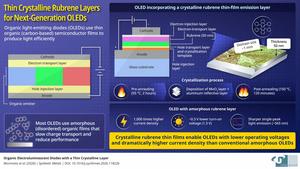
Crystalline organic semiconductors offer excellent charge transport but have been difficult to incorporate into practical OLEDs. Researchers from the University of Toyama developed the first OLED using a non-epitaxial crystalline rubrene thin film. Using a two-step annealing process, they achieved 1,000-fold higher current density and a turn-on voltage of just 1.33 V. This breakthrough demonstrates that crystalline organic semiconductors can be integrated into practical OLEDs, paving the way for a "crystalline generation" of displays.
Raccontata da eurekalert.org