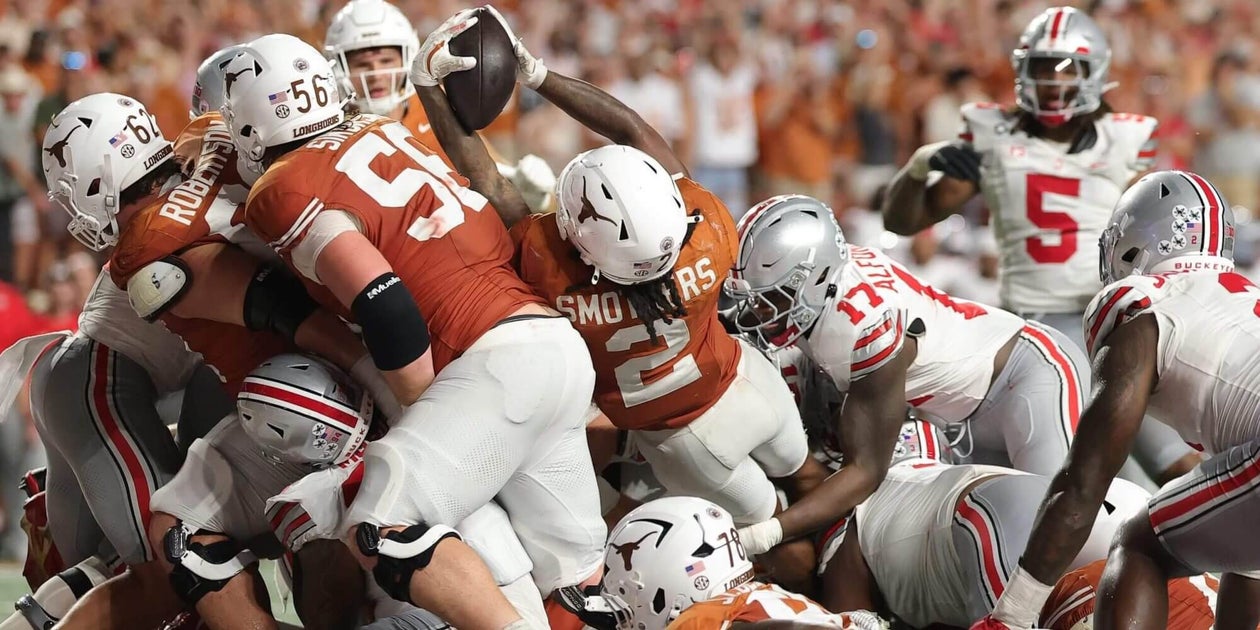
Finding any pollster who didn’t put Texas in the No. 1 position in just about any college football rankings system after its comeback win against Ohio State is almost impossible, but the ESPN computer-based predictive ratings system was one such exception.Never shy about courting controversy in how and where it ranks college football teams in any given week, the Football Power Index model once again drew criticism from fans when it put the Buckeyes into pole position ahead of the Longhorns team they just lost to.Not only that – the ESPN algorithm already had Texas as the No. 1 team in the country going into Saturday’s matchup against Ohio State, and went to the trouble of demoting it back to No. 2 even after winning that game head-to-head. What gives?Why Put the Buckeyes Ahead of Texas Now?USA TODAY Network via Reuters ConnectFor one thing, the power index model is not specifically a pure rankings system in the way the Coaches Poll or the AP Top 25 are. Instead, the FPI brands itself as a predictive system, built almost to act like a betting line, forecasting by how many points a given team would win or lose against an average opponent on a neutral field.Basically, it doesn’t care who you beat, or who beat you, last week, or even what your record is. It cares who it thinks will win if you play tomorrow.How the Rankings Are MadeEvery team is given an offensive, defensive, and special teams score based on expected points added (EPA), and the final rating apparently shows how many points better or worse than an average FBS team you are.The model uses past scores, recent team performance, returning starters, and recruiting data as baseline priors before the ratings are compiled. The system recalculates every day using new game data and scores, running the remainder of a team’s season through a computer simulation 20,000 times to project win totals and playoff chances.So Why Did Texas Get Docked?IMAGN IMAGES via Reuters ConnectIt feels backward to human logic and ranking convention, but the power index flipped Ohio State to No. 1 and dropped Texas to No. 2 because its formula prioritizes per-play efficiency and venue context over who actually won the game.Basically, the model thought that because Texas was only a 1.5 point favorite at home, and because home teams generally get a 3 point advantage just by being at home, that a neutral observer viewed Ohio State as slightly stronger than not.Winning by one point at home, the model technically thinks that Texas underperformed its expectations, while Ohio State outperformed what was expected of it on the road.Computers look at down-by-down efficiency rather than simply the outcome or final score, and Ohio State finished by averaging 5.9 yards per play, compared to Texas’ 4.3 ypp average, so the math told the computer that the Buckeyes moved the ball more effectively overall.Computers Think Differently Than Humans DoUSA TODAY Network via Reuters ConnectTo us watching the game, Ohio State suffered an epic fourth quarter meltdown, losing a 20-point lead, surrendered 21 unanswered points, missed a field goal, and had a game-losing interception.To a computer, the core data concluded that if these two teams played 100 times on a neutral field based on its efficiency data, Ohio State would win a razor-thin majority of those games.But they lost the one that counts, and it will be that result that College Football Playoff selectors take into account this December.Add us as a preferred source on GoogleFollow
Ohio State Stays at No. 1 Over Texas in College Football Rankings Despite Loss
Finding any pollster who didn’t put Texas in the No. 1 position in just about any college football rankings system after its comeback win against Ohio State is
582 words~3 min read