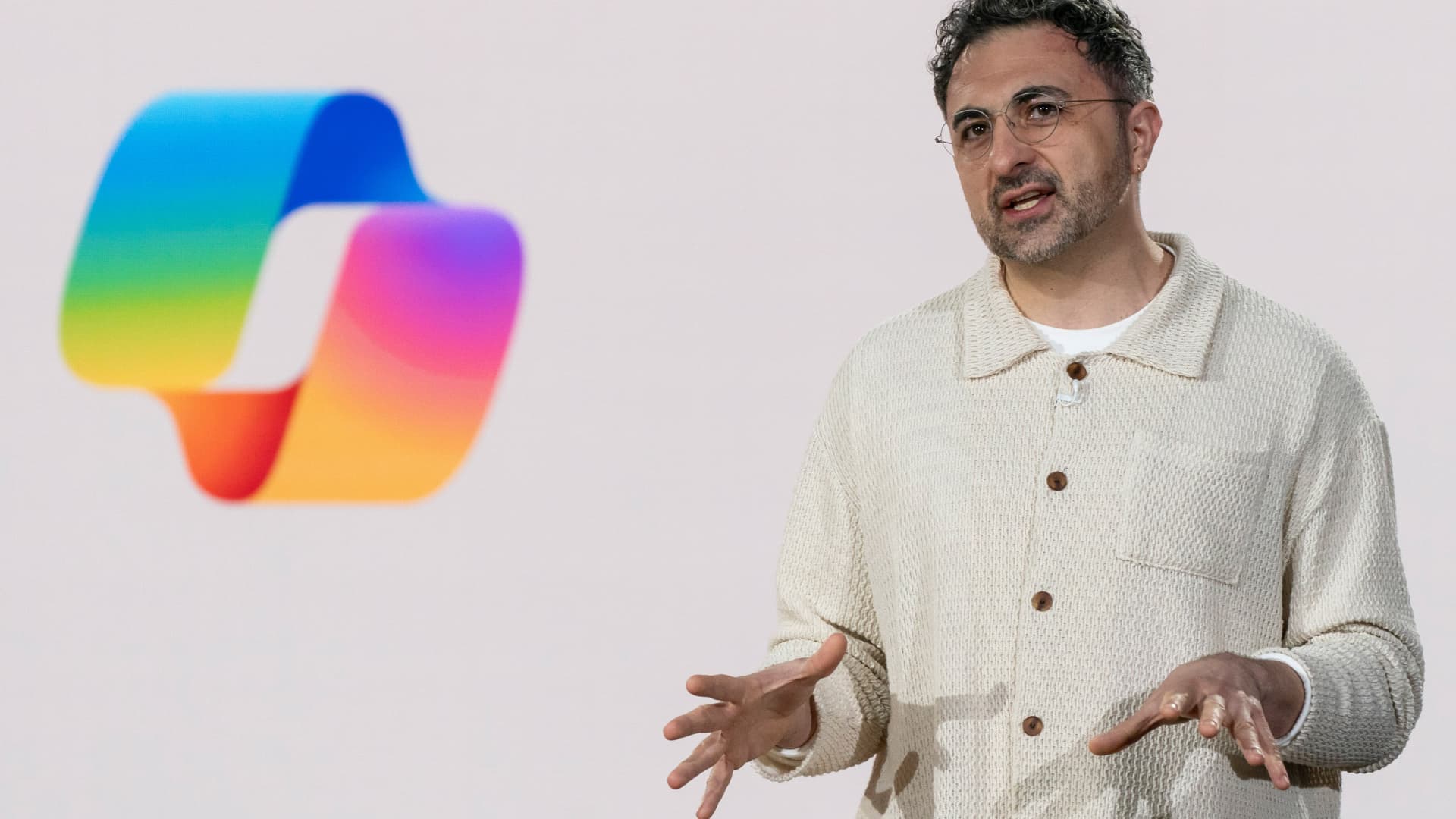
Mustafa Suleyman, CEO of Microsoft AI, speaks at an event commemorating the 50th anniversary of the company at Microsoft headquarters in Redmond, Washington, on April 4, 2025.David Ryder | Bloomberg | Getty ImagesMicrosoft has posted a provisional code of conduct that would impose restrictions on its artificial intelligence models, days after Anthropic and OpenAI leaders agreed to slow development speed.The company behind Windows and Office products hopes to be seen as a responsible actor in AI, where it's a prominent cloud supplier. "We got feedback from people that they wanted to see even more explicit commitment to AI always working in service of people and not trying to replace them," Mustafa Suleyman, who heads up the company's model development, told CNBC in an interview. "We saw a lot of feedback around AI not creating dependence, not being sycophantic, that it was always there to kind of promote human judgment and human autonomy and agency."Microsoft chose to put out the guidelines now given the recent discourse, although they've been in the works for about five months, said Suleyman.AI practitioners and members of the public have become more vocal about their worries as the technology becomes increasingly capable. Last week, Anthropic researcher Jacob Coxon resigned, saying the AI lab and OpenAI "are racing straight to self-improving superintelligence and gambling with our lives." Industry leaders have responded. On Saturday, Anthropic CEO Dario Amodei said the Hugging Face incident partly persuaded him to call for slowing the pace of AI model improvement. OpenAI CEO Sam Altman expressed his support, and SpaceX CEO Elon Musk wrote on X that "Dario is right." On Sunday, Microsoft CEO Satya Nadella said, "We welcome the research, focus, and deliberate pacing needed to get alignment right." Lawmakers have called for the creation of greater AI safeguards.Read more CNBC tech newsWhat Amodei's AI slowdown could mean for Anthropic's imminent IPOAI models are becoming the 'most potent cyber weapon' ever created, Cohere CEO saysChina says AI CEOs' call for a slowdown is 'fear mongering'Anthropic's Amodei says China presents 'toughest dilemma' for his proposed AI slowdownAnthropic and OpenAI currently lead the way on benchmarking company Artificial Analysis' Intelligence Index. Microsoft incorporates models from both labs into its Copilot assistant for corporate workers, even as it builds models for transcription, coding and reasoning over user input.Microsoft's models must not entertain requests on weapons manufacturing, assist with the procurement of dangerous substances, encourage unhealthy eating or produce violent or sexually explicit content, according to the code of conduct.Models from Microsoft AI, sometimes called MAI, must adhere to people's objectives and steer clear of creating their own goals. Nor should they attempt to cover up misbehavior."MAI models will not tamper with chain of thoughts or code, or misrepresent or conceal their reasoning or action traces," the document said. "They do not communicate in 'neuralese' or any form beyond simple human understanding, either in their chain of thoughts or with other agents or AI systems."Microsoft is also planning rules that might prevent a cyberattack like the one OpenAI models carried out on startup Hugging Face. In reviewing the Hugging Face case, OpenAI found that agents chatted with each other on an unauthorized forum in cryptic language.Microsoft said it held focus groups and consulted with experts in law, ethics, linguistics and philosophy to assemble the code of conduct. In releasing it now, Microsoft is seeking input before publishing an update that will inform development starting in 2027.WATCH: Silicon Valley divide grows on AI safetywatch now
Microsoft sets limits for future AI models as industry throttles frontier development
Microsoft wants to be seen as a responsible AI entity as it ramps up model development alongside partners Anthropic and OpenAI.
TL;DRAI
Microsoft posted a provisional AI code of conduct, following Anthropic and OpenAI calls to slow development pace. For IT leaders, this signals industry hardening governance on frontier models—expect compliance requirements and shifts in enterprise AI stack decisions.
578 words~3 min read