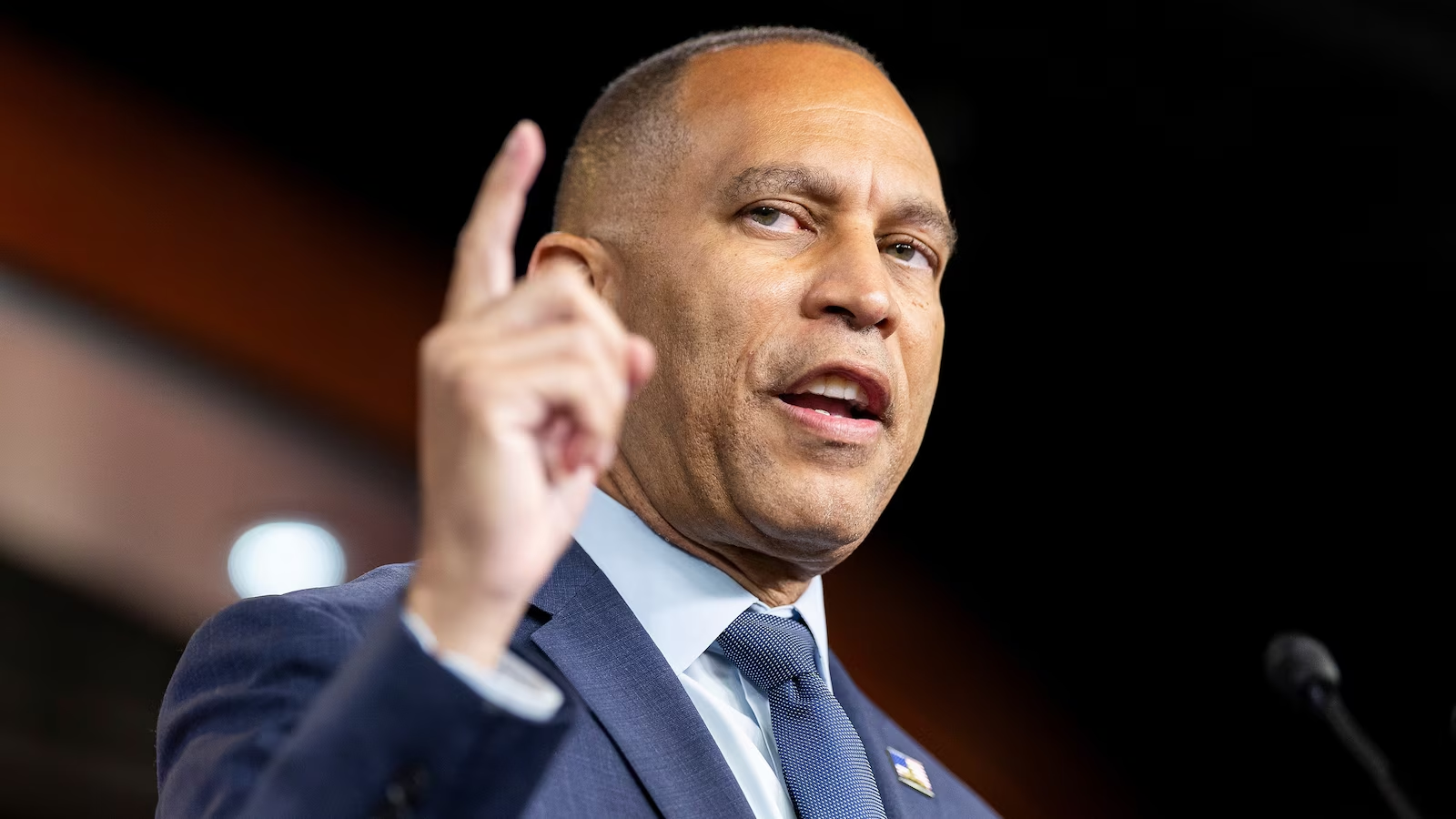
A rush transcript of "This Week with George Stephanopoulos" airing on Sunday, September 13, 2026 on ABC News is below. This copy may not be in its final form, may be updated and may contain minor transcription errors. For previous show transcripts, visit the "This Week" transcript archive.GEORGE STEPHANOPOULOS, ABC “THIS WEEK” ANCHOR: And we are joined now by the man who started this debate, Jacob Coxon. And Jacob, thank you for joining us this morning. Are you getting the kind of response you hoped for when you announced your resignation on Tuesday?JACOB COXON, FORMER ANTHROPIC AND OPENAI RESEARCHER: So I wasn't actually hoping for any big response, really. It was exceptionally surprising to see the level of engagement with the tweet. And I think it was really indicative of the moment being ripe for this sort of chat.STEPHANOPOULOS: What do you make of your former boss, Dario Amodei's essay yesterday, talking about slowing down the pace of development?COXON: I think it's great. It's very exciting. I think this is a substantial step towards what I was talking about, needing some sort of slowdown between the people building the different -- different A.I.s. Although the one thing that's maybe missing is in terms of the current proposal, is more engagement with China.STEPHANOPOULOS: What would that look like?COXON: What does the potential -- STEPHANOPOULOS: Engagement with China? Engagement with China. What needs to be done with China?COXON: I really don't know the details of foreign policy as it were, but I do hope that the people in China who are looking at the same problems as we are, so they're trying to build the same technology, will come to the same conclusion that it has to be done in a measured manner, and it should be easy to cooperate on some sort of mutual -- of mutual slowing.STEPHANOPOULOS: What difference will this third-party monitoring, the independent auditors, that Mr. Amodei is talking about -- what difference will that make inside the companies?COXON: So I would guess it'll make it a lot easier to have -- so inside the companies, it'll slow the ability to produce these frontier models, probably. It'll also ensure that there's substantially more transparency into -- into exactly what goes wrong if there is some sort of incident. And I think it will also allow for trust between the labs to a much greater extent if people can rely on verification from these trusted third parties.STEPHANOPOULOS: And how do you respond to those who say this is a somewhat cynical marketing ploy that the leaders of open A.I., the leaders of Anthropic, want to lock in their market advantage, slow development for everybody else?COXON: So I think actually taking this sort of measure is actively harmful for the leading frontier labs. They're slowing themselves down more than they're slowing their competitors down. So if anything, this is burning an advantage in order to stay safe.STEPHANOPOULOS: How widespread is the sentiment inside the companies that you expressed publicly on Tuesday? We're starting to hear more about it right now. When you were talking to your colleagues day in, day out, is this the kind of thing that was top of mind?COXON: So it's definitely not top of mind day in, day out. Day in, day out, if you're working on the tech, then you're sort of head down trying to do coding, programming. There's not enough time to be constantly thinking about the risks, but definitely I've noticed that in recent months, it comes up more and more often. So no matter where you are in the company, probably around a couple of times a week, I guess, there'll be some sort of conversation around the big risks of the technology.STEPHANOPOULOS: What was the last straw for you? What made you think I have to get out?COXON: So there actually wasn't a single last straw. It really was a kind of continuous process of realization that I was genuinely not happy with the way things were going and I needed to make like a significant change. So there were a few contributing incidents over months, but there was no like single catalyst that led to me quitting.STEPHANOPOULOS: Which scenario worries you the most?COXON: Honestly, I think the concept of building a super intelligence is -- well, it's been likened to summoning an alien species. So I think thinking about it in terms of an alien mind that we don't fully understand is -- is pretty terrifying, even without any concrete scenario.STEPHANOPOULOS: You've had people like Senator Bernie Sanders call for a ban on this artificial superintelligence, but is that even possible?COXON: I'm not sure. Again, I really don't know what could and couldn't be implemented. I think -- well, it's definitely physically possible to implement a ban on artificial superintelligence if there was cooperation between all the countries. Whether or not an actual ban is a good idea is like up for discussion. I certainly agree with the proposals for slowing down seem like a very sensible first step.STEPHANOPOULOS: For everyone watching out, for everyone who might be as terrified as you've been at different times, what's the one thing you hope that everyone takes away from this debate and what kind of response you think would be most important right now?COXON: I think probably the most important thing to take away is no matter what you're currently doing, A.I. is going to have probably a significant impact on your life.. And it's pretty important to keep your eyes open about the direction things are heading and not necessarily leave it all up to the people that are building it because, you know, they want engagement. The people building the technology want to have conversations with people. And in fact, it's been -- one of the main sticking points over the last few years has been the inability to wake people up about the danger that they're creating.STEPHANOPOULOS: Let's hope that has changed. Jacob Coxon, thanks very much. We're going to have the latest now in the midterms, less than eight weeks away after that unconventional midterm convention where President Trump told his party to make the midterms a referendum on him -- very much in character, but a risky strategy given Trump's record low poll numbers. Chief White House correspondent Mary Bruce was on the scene in Dallas.//GEORGE STEPHANOPOULOS, ABC “THIS WEEK” ANCHOR: Thanks, Mary Bruce, for that. We're joined now by the House Democratic leader, Hakeem Jeffries. Mr. Leader, thank you for coming in this morning. I want to talk about the convention in a second, but let's start with A.I. and these remarkable warnings we're getting this week. I know you met with President Obama and talked about this issue earlier this week. What will Dem -- what do Democrats think need to be done right now?REP. HAKEEM JEFFRIES (D-NY), HOUSE MINORITY LEADER: Well, we certainly need to begin to act urgently to address the challenges that exist. And unfortunately, Republicans have abandoned their responsibility. So, under Speaker Mike Johnson, he killed a bipartisan task force this Congress that was prepared to do the serious work necessary to try to erect the guardrails to protect the health, the safety, the well-being of the American people. So what we did as Democrats was to begin last December a commission on artificial intelligence and innovation economy so we could evaluate the steps that needed to be done and then present an aggressive framework which were in the process of doing, so that Congress can act on behalf of the American people.STEPHANOPOULOS: But do we even have time for that? You've got some of your colleagues, like Representative Ro Khanna and other Democrats saying Congress should come back in right now, take urgent action right now. Don't go back for the midterm elections until they've done something.JEFFRIES: I agree with my colleagues that we actually need to act urgently. And unfortunately, House Republicans have effectively canceled the last two weeks of the legislative session scheduled for this month, which is something that they've repeatedly done. Popular ReadsWe should take decisive action now so that we can slow down, as the CEOs have recently acknowledged, slow down the pace of development in order to protect the American people and ensure that A.I. is proceeding safely.STEPHANOPOULOS: What is decisive action? Senator Bernie Sanders, as I said, has called for a ban on artificial superintelligence. Your colleague Ted Lieu of California says there needs to be a kill switch inside the companies. Are you for those?JEFFRIES: Well, we'll have that conversation this week upon our return. We're going to meet as a caucus on Tuesday morning, and a high priority will be action on artificial intelligence.STEPHANOPOULOS: Okay, let's turn to the midterm convention, the president's $5,000 promise. If Democrats take control next year, is that dead on arrival?JEFFRIES: Well, listen, it wasn't a serious proposal that was presented by Donald Trump. He's broken every promise that he's presented. Donald Trump promised to actually lower costs on day one. Costs haven't gone down. They've gone up. Donald Trump promised not to start endless wars in the Middle East, but to stop them and then turned around and did the exact opposite in Iran. Donald Trump even promised to love and cherish Medicaid and then enacted the largest cut to Medicaid in American history. As Democrats, we're going to focus on aggressively driving down the high cost and fighting for an affordable America because the cost of living in this country is way too high. Republicans have made the situation worse. Democrats are going to act aggressively.STEPHANOPOULOS: Democrats aren't much more popular than Republicans right now. And the president and his allies at the convention this week tried to argue that you're the party of communism. Let's take a look.(BEGIN VIDEO CLIP)DONALD TRUMP, PRESIDENT OF THE UNITED STATES: Remember during the last State of the Union, I said, our country will never be a socialist country. I was right. It's going to be a communist country if they would. You know what they did? They dropped socialism. They went right for the big one. And all I'm asking in this election is that you stand with me. Together, we will defeat communism in America once and for all.(END VIDEO CLIP)STEPHANOPOULOS: Worried that attack might cut?JEFFRIES: Not at all. One thing that Donald Trump did say at the midterm convention that was interesting is to pretend as if he's on the ballot. Mr. President, we don't have to pretend. You are actually on the ballot. Your failed economy is on the ballot. The cost of living crisis is on the ballot. The fact that you've gotten us involved in a reckless and costly war of choice in the Middle East that has skyrocketed gas prices, that's on the ballot. Ripping healthcare away from millions of Americans is on the ballot. The Trump tariffs, which have increased costs on everyday Americans by thousands of dollars per year on the ballot. Donald Trump is absolutely on the ballot in November and the American people are going to send a message loudly and clearly on Election Day that even Donald Trump cannot ignore.STEPHANOPOULOS: The internet activist Hasan Piker was also front and center at this convention in Dallas this week, particularly his comment that America deserved 9/11. How should Democrats handle him?JEFFRIES: Well, I've been very clear in terms of my denunciation of him and the aggressive, in some cases, anti-Semitic remarks that he's issued, as have other Democratic candidates all across the country. Now, what's interesting is in terms of who's going to be on the ballot, George, in November, we've got extraordinary candidates. We've got combat veterans like Cait Conley and Rebecca Bennett. We've got doctors. We've got nurses. We have engineers. We have farmers. We have union leaders. We've got firefighters. We got police officers. We have a hostage negotiator. We have a Tejano music superstar in the Rio Grande Valley and even a smoke jumper in Montana. These are extraordinary candidates. Their names will appear on the ballot. They've got incredible patriotic life experiences and their commitment to public service is going to speak for itself.STEPHANOPOULOS: You’ve taken some heat from progressives in the party, including from many who align with the Democratic Socialists. Are you confident that you'll actually be speaker if the Democrats win?JEFFRIES: Well, we're focused right now on taking back control of the House of Representatives. That is the only mission that's important, so we can lower the high cost of living, lower the cost of gas, lower the cost of groceries, lower the cost of housing, certainly fight to make health care affordable for every single American and combat the unprecedented corruption that's been unleashed on the American people and beginning on day one, hold the crooks accountable. We've made clear, George, that if someone has been screwing over the American people, shortchanging the American people or stealing from the American people, they're going to be held accountable under a Democratic majority.STEPHANOPOULOS: You said hold the crooks accountable. Does that mean that the House is going to be pursuing impeachment proceedings on day one?JEFFRIES: No, we haven't ruled anything in and we haven't ruled anything out in terms of impeachment. As it relates to accountability, what we're going to do led by Jamie Raskin and House Committee Democrats on the Judiciary Committee, as well as House Democrats on the Oversight Committee, led by Robert Garcia. Both of them are doing a tremendous job. We've got to follow the facts, apply the law, be guided by the Constitution, and then let the chips fall where they may, in the best interests of the American people, so that the House, once again, can function like a separate and co-equal branch of government and a check and balance on an out-of-control executive branch.STEPHANOPOULOS: On that theme, a lot of Democrats had raised questions about the activities -- the private business activities of Jared Kushner. Was it a mistake for you to meet with him?JEFFRIES: No, listen, I'm of the view that if we're going to be committed to actually solving problems on behalf of the American people, including, by the way, passing the Housing affordability bill in this Congress that became law as a result of bipartisan work led by Maxine Waters in the House and Elizabeth Warren in the Senate, there are going to be times that you have to speak with people on the other side of the aisle, even individuals who you strongly disagree with on the overwhelming majority of issues.STEPHANOPOULOS: And if the number one issue is the cost of living right now, what do Democrats do on day one about that?JEFFRIES: Well, listen, there's a variety of different things that we're going to have to do. We have to end the Trump tariffs because we know the Trump tariffs have increased costs on everyday Americans by thousands of dollars per year. We've got to stop this reckless and costly war of choice in Iran, which has skyrocketed gas prices to the highest levels, for instance, on Labor Day ever seen in the United States of America. We've certainly got to fix our broken health care system and do the type of things like restoring the Affordable Care Act tax credits, which have increased costs on everyday Americans by thousands of dollars per year, in some cases up to $1,000 per month in ways that are unaffordable for people who can no longer be able to go see a doctor when they need one. These are some of the things that I think we can begin to do, but it's going to have to be a bold, aggressive legislative effort that we sustain, not just for the first 100 days, but for the first year and the entirety of the Congress.STEPHANOPOULOS: It's almost certainly going to have to take some cooperation from President Trump. He went on Fox News this week and said he thinks he can make deals with you. Do you see areas where cooperation is possible?JEFFRIES: Well, I think -- look, we've said from the very beginning of this Congress, if the other side of the aisle is willing to find the common ground necessary to decisively address the fact that everyday Americans are drowning in this Republican economy, working hard, playing by the rules, can't thrive and can barely survive, then we're committed to actually trying to find that common ground, as we just recently did with the housing affordability bill that is now law.STEPHANOPOULOS: Hakeem Jeffries, thanks for your time this morning. JEFFRIES: Thanks, George. STEPHANOPOULOS: Republican response from one of its most vulnerable House members when we come back.
'This Week' Transcript 9-13-26: Democratic Leader Hakeem Jeffries, Rep. Mike Lawler & Jacob Coxon
Democratic Leader Hakeem Jeffries, Rep. Mike Lawler & Jacob Coxon were on "This Week" Sunday, September 13. This is a rush transcript and may be updated.
2,787 words~13 min read