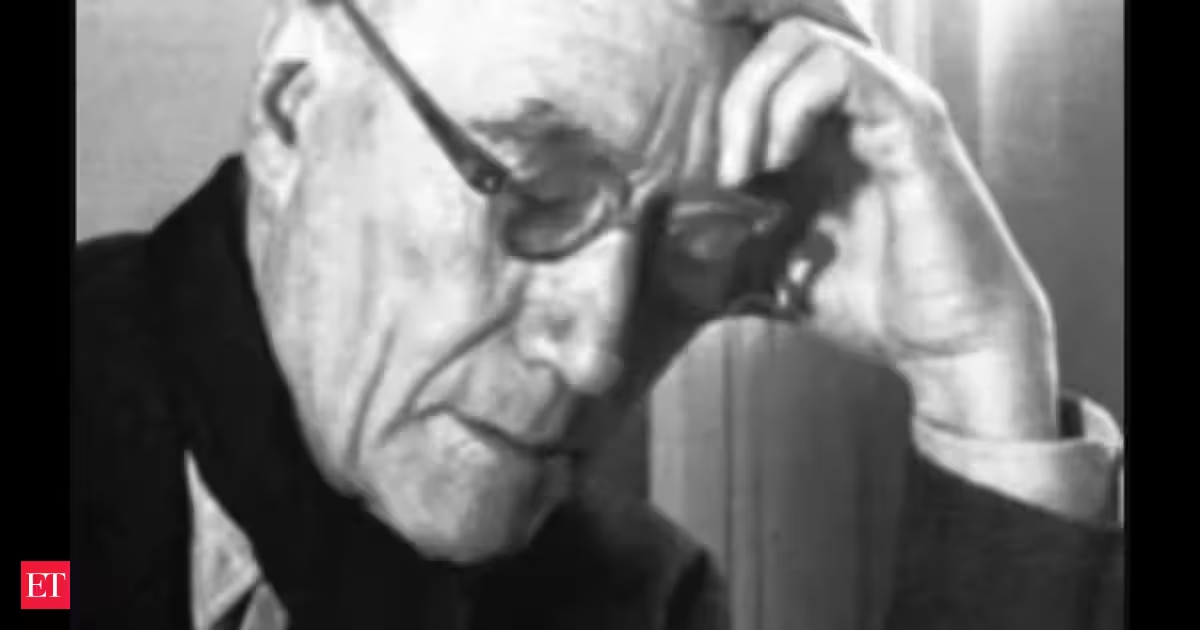
You notice an old friend sharing photos from an amazing vacation, purchasing a new house, or marking a promotion that you wished for yourself. For a brief moment, you might ask yourself why their life appears to be progressing while yours seems to be at a standstill. Yet even if you could swap lives with them, would their version of happiness genuinely suit the life you desire?That uneasy sensation is something many people know well. Social media makes it particularly simple to measure our own lives against someone else's finest moments. When someone else succeeds, our own accomplishments can seem less significant, and another person's joy can occasionally make us question why we lack the same thing.The French writer André Gide examined this paradox in a provocative manner. His insight invites us to ask whether we really grasp what we are envious of, and whether obtaining someone else's form of happiness would, in fact, bring us happiness.Quote of the Day by André Gide: “Envying another man's happiness is madness; you wouldn't know what to do with it if you had it.”Also Read: Quote of the Day by Maria Shriver: ‘No matter what your age, no matter what your income, no matter what life has thrown your way, your mind will be your best ally in moving you forward. And the truth is…’Why André Gide’s quote on happiness matters todayComparing ourselves to others has turned into a normal feature of contemporary life. A coworker earns the promotion, a friend ties the knot, someone purchases a home, and yet another person seems to live a flawless life online. It is often hard to resist judging our own progress by theirs.That tendency is precisely what Gide's words call into question. Something that seems appealing from afar might not be what we truly desire. We witness the outcome, yet seldom the duties, trade-offs or hardships that accompany someone else's life. As a result, envy can push us to pursue a kind of happiness that was never truly ours to begin with.What André Gide’s quote means in real lifePicture longing for a friend's career because they make more money and appear more successful. You might think that holding their position would fix your difficulties. Yet if you were handed it overnight, you would likewise take on its pressures, long hours, expectations and obligations. What you envied was merely one visible piece of a far larger life.This holds true for relationships, wealth, popularity or social standing as well. We frequently crave what someone else possesses without knowing whether it would fit us. Gide's argument is that happiness cannot simply be taken from another person. It must align with your own life, values and situation.Who was André Gide?André Gide was a French author, born in 1869 to a family of Huguenots and recent Catholic converts. As a child he was frequently sick, and his schooling was broken up by extended stays in the South, where private tutors instructed him. His first significant work, The Notebooks of André Walter, was published in 1891 and introduced him to the literary circles of the Symbolist movement. In 1947, Gide was awarded the Nobel Prize in Literature.A trip to Algeria in his early years proved to be a major turning point. A serious illness brought him near death and helped lead him to reject the puritanical upbringing in which he had been raised. A great deal of his later writing examined the conflict between rigid moral discipline, artistic freedom and the wish to live without constraint.André Gide's legacyGide grew into a prominent yet contentious presence in French literature. He helped establish La Nouvelle Revue Française and produced work in a range of genres, among them novels, plays, criticism, autobiography and diaries. Among his writings were Fruits of the Earth, The Counterfeiters and The Immoralist.His impact reached well past the world of literature. Gide journeyed extensively and authored a critical account of economic exploitation by French firms in the Congo, which helped bring about reforms. He translated works by Shakespeare, Walt Whitman, Joseph Conrad and Rainer Maria Rilke, and wrote at length about authors such as Fyodor Dostoevsky. He passed away in 1951, leaving a body of work noted for defying social, moral and artistic conventions.
Quote of the Day by André Gide: ‘Envying another man's happiness is madness, you wouldn't know what to do with it if you had it’ - lessons on envy, happiness, desire and self-worth and why another person’s life may not be what you truly want from the French writer known for The Immoralist
Quote of the Day: Social media has a way of igniting envy as we compare our lives to others. André Gide challenges us to rethink our desires, reminding us that what seems appealing from a distance may not fit our reality. Authentic happiness comes from seeking goals that reflect our values, rather than chasing after a happiness that belongs to someone else.
704 words~3 min read