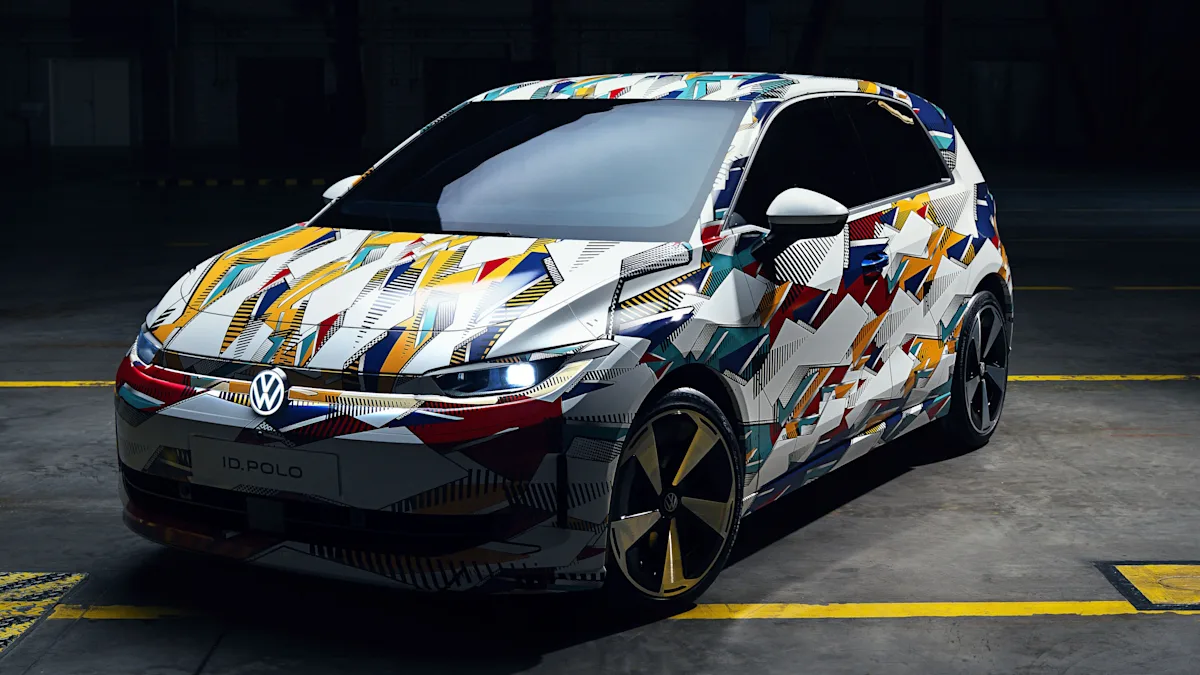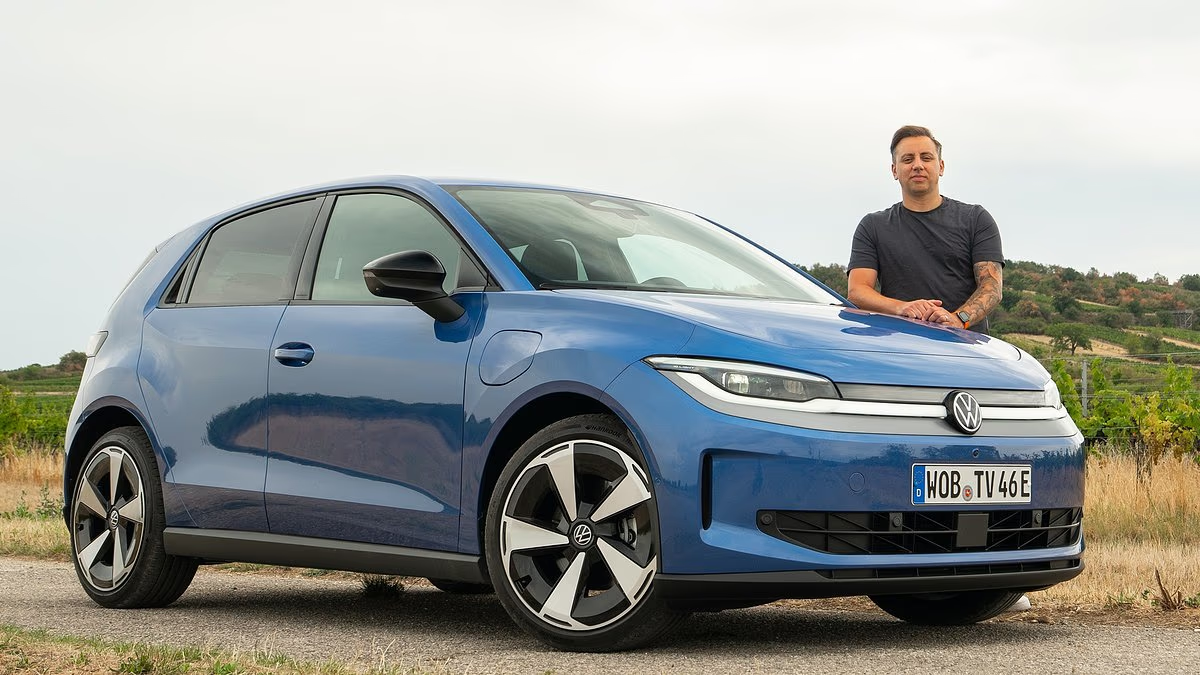
Since Volkswagen launched its 'ID' range of electric cars in 2019, the German manufacturer has seemed reluctant to attach any of its familiar nameplates to its new breed of EVs.That's why we have the ID.3 rather than the ID.Golf. The ID.7 instead of the ID.Passat. And the ID.4, not an ID.Tiguan.VW bosses would argue they wanted a clear distinction between their long-established combustion-engine models and clean-sheet electric cars.But there's always been a sneaking suspicion that they didn't quite believe EV technology was ready to carry the weight of one of the company's legacy names. Until now.I've been in Austria driving the new ID.Polo – the first ID-badged electric car to use one of Volkswagen's longest serving names we all know so well.With half a century of heritage to uphold, can this EV really capture the essence of one of the best-selling superminis in history?VW ID.Polo: This is the first electric 'ID' car Volkswagen has entrusted with one of its legacy nameplates? So, is it capable of transporting the Polo into an electric era?Extending a 50-year bloodlineIt was 1976 when the Polo first arrived on UK roads.That year, Britain endured a summer heatwave and a drought not unlike the one we're experiencing now. But that's about where the similarities end.Back in '76, inflation was peaking at 24 per cent, The Muppet Show debuted on our TVs, and the UK was still popular enough with its neighbours that Brotherhood of Man won Eurovision with Save Your Kisses for Me. Fast forward 50 years and its 'Nul Points'!But Volkswagen's evergreen supermini has endured the test of time, spanning six generations and amassing global sales of more than 20 million units. In Britain, it's the sixth most common model on the road with some 715,000 examples on driveways.Those are some big boots, or wheels, to fill for the ID.Polo - a car that's mechanically worlds apart from the motors whose tyre tracks paved its way.But Volkswagen believes the timing is right to usher the Polo into a new era.At the unveiling of the ID.Polo earlier this year, VW chief executive Thomas Schäfer said it would 'bring a Volkswagen bestseller into the electric age'.He added: 'For decades, the Polo has been part of people’s everyday lives. With the ID.Polo, we are making electric mobility accessible to many more people.'Even so, Volkswagen is not entirely convinced buyers are ready to abandon petrol power just yet. That's why the current combustion engined Polo will remain on sale for the time being. Volkswagen's evergreen supermini launched in the UK in 1976 and has endured the test of time. It has spanned six generations and amassing global sales of more than 20 million units There's always been a sneaking suspicion that VW execs didn't quite believe EV technology was ready to carry the weight of one of the company's best-selling names. Until now...VW ID.Polo - the factsThe ID.Polo shares Volkswagen Group's MEB+ platform with the Cupra Raval. That's a great starting point, given how brilliantly its sporty Spanish sibling drives.The VW will be offered with a choice of two battery sizes and three power outputs. Importantly, all versions send power to the front wheels rather than the rear, which has been the norm for Volkswagen's ID models until now.The lower-powered variants, producing 114bhp and 133bhp respectively, use a 37kWh lithium iron phosphate battery. This delivers a maximum range of 206 miles and can charge at speeds of up to 90kW.However, most customers are - unsurprisingly - expected to opt for the larger battery. This 52kWh nickel manganese cobalt pack is paired with a 208bhp electric motor, offering a range of up to 281 miles and charging speeds of up to 105kW.Volkswagen says a 10-to-80 per cent DC rapid charge takes 27 minutes for the smaller battery and 24 minutes for the larger pack. Charge at home with a standard 7kW wallbox and zero-100 per cent will take around seven and half hours. From 10-to-80 per cent will be five and three quarter hours.Top speed is limited to 99mph, and that's across the board. ‹ Slide me › The ID.Polo (left) is just 2cm shorter than the current Mk6 petrol Polo (right). But the EV is 5cm wider and almost 8cm taller, so it should - on paper - be roomier Volkswagen hasn't been modest about the EV's practicality. It says it has created a genuine five-seat cabin and makes the ID.Polo 'more of an all-rounder than any of its predecessors'Put away the tape measure, too, because the ID.Polo's dimensions are remarkably close to those of its combustion-engined namesake.It is just 2cm shorter than the current Mk6 petrol Polo but 5cm wider and almost 8cm taller. The electric version also has a wheelbase that is 5cm longer, increasing the distance between the front and rear axles.But its boot is 25 per cent larger than the combustion Polos. In fact, with its handy under-floor storage space, the 441 litres available is more than you get in the current Golf - though you need to be handy at Tetris to exhaust its full capacity.Volkswagen says the ID.Polo is now a genuine five-seater and 'more of an all-rounder than any of its predecessors'. Prices start from just under £25,500 for the smaller battery variants. But the longer-range cars everyone will want cost from around £27k, with the Government EV grant at playHow much does it cost? Prices start from £23,395 for the entry-level 37kWh ID.Polo Life. The larger 52kWh version gets a little financial bump from the Government's lower-tier £1,500 EV grant, reducing its starting price to just under £27,000.That puts it on a collision course with rivals including the Renault 5, Mini Cooper and Ford Puma Gen-E in one of the most hotly-contested corners of the EV market.But, arguably more importantly, the base model is around just £2,000 more than the traditional Polo. If you choose a fancier R-Line automatic petrol Polo, the price is about on par with the bigger-battery ID variant.In other words, buyers can choose between petrol and electric power without cost heavily swaying the decision. So, let the best Polo win... You're not going to be wanting for kit. As standard you get 17in alloy wheels, front and rear parking sensors, and a rearview camera Inside, you get single-zone climate control, automatic high-beam assist and a pair of digital screens with wireless phone connection and charging VW ID.Polo: Specs at a glance On sale: NowFirst UK deliveries: Q4 2026Price: from £23,385Price of car tested: £32,265 (Style Launch Edition in Celestial Blue)DIMENSIONSLength: 4,053mmWidth: 1,816mmHeight: 1,530mmWheelbase: 2,600mmKerb weight: 1,568kg - 1,576kg (depending on battery)Boot capacity: 441 litres (up to 1,243 litres with rear backrests down)PERFORMANCEBattery: 2x options: 37kWh or 52kWhPower: 85kW (114bhp) - 155kW (208bhp)Drive: Front wheel driveTransmission: Single speed auto0-62mph: 7.1 secs (52kWh) to 10.6 secs (slowest 37kWh)Top speed: 99mphRange: 206 - 281 miles CHARGING Max DC charging speed: 90kW - 105kW 10-80% recharge: 27 mins for 37kWh battery and 24 mins for 52kWh battery Is it well equipped?In entry-level Life trim, equipment levels are generous for a car of this size.Seventeen-inch alloy wheels, single-zone climate control, automatic high-beam assist (which prevents you from dazzling oncoming traffic at night), front and rear parking sensors, and a rearview camera all come as standard.Also included are a digital instrument cluster and a 12.9-inch infotainment touchscreen with wireless Apple CarPlay and Android Auto connectivity. Wireless phone charging is standard, too.Step up to the Style specification and the kit list grows further, adding 18-inch alloys, Volkswagen's ultra-bright LED Matrix headlights, dual-zone climate control, and heated front seats and steering wheel. You also get gimmicky play and pause icons on the throttle and brake pedals.For a limited time only, VW will offer special 'Launch Edition' versions of both trims.The Style Launch Edition, priced £1,250 above the standard Style model, adds a panoramic glass roof, electrically adjustable front seats with massage function, a bird's-eye-view camera and a detachable towbar.The latter allows the ID.Polo to tow up to 1,200kg on an 8 per cent gradient, making it capable of hauling a small caravan.It also comes with Travel Assist 3.0 - a feature I'll return to shortly - and Park Assist Pro, meaning it can squeeze itself into a space while you're stood outside monitoring its movements from your smartphone. Rob says the styling is grown up, if not a little subdued: 'Think of it as a timeless black frock rather than a glitzy sequin cocktail dress'Does it still look and feel like a Polo?Substance over style has always been the Polo's way, and the electric variant isn't trying too hard to make a grand entrance either.That said, it still borrows some familiar Volkswagen design cues. The boomerang-shaped C-pillar (the section behind the rear side windows) is inspired by the original Golf, while the cupped headlights and LED light signature stretching across the nose are a modern take on the current Polo's face.Its a car that wants to shrink into the background undetected, not scream: 'LOOK AT ME!'Think of it as a timeless black frock on the red carpet rather than a glitzy sequin cocktail dress.If I had to compare it with a Polo from the past, it would be the third-generation model sold in the late Nineties. It's boxy, understated and perhaps a little bland but undeniably practical and functional. ‹ Slide me › The Polo's styling has been evolutionary for half a century, and the VW ID.Polo keeps with tradition. Rob says the look reminds him most of the Mk3 Polo sold from 1994-2001 (right) It's a similar story inside.The cabin is modest and monochrome, but neatly laid out, with some clever design touches. Like the hollowed-out door panels. They might save only a few millimetres, but they punch well above their weight when it comes to creating a greater sense of space and comfort up front.It all feels remarkably grown up for such a compact car and, sticking to the Polo's long-established recipe, doesn't rely on bright colours, glossy trim panels or fancy stitching to stand out.Volkswagen has also corrected some of the major mistakes made in earlier ID models.Most notably, it has reverted to physical steering wheel buttons instead of the infuriating haptic touch controls in some of its other electric models that were nothing short of abysmal to operate on the move.There are proper controls for the heating and ventilation functions, too, located in a row beneath the infotainment screen for easy access.The cabin designers have seen sense and even restored a traditional knob for adjusting the volume and switching between tracks and radio stations. Hallelujah.All the switchgear feels solid and durable, certainly not lightweight and chintzy like you can find in some cars in this segment. Nothing feels as though it's about to fall off, which is exactly what we've come to expect from Polos over the years.The touchscreen is crisp and responsive, while a brilliant retro instrument display recreates the square fonts and analogue needles of the Mk1 Golf's clocks. It even transforms the central screen into a digital tape deck, a feature I don't think I'd ever tire of. One of the ID.Polo's party pieces is its retro mode, which digitally produces the classic clocks ans rev counter of the Mk1 Golf There are clever touches inside, too. Like the hollowed-out door panels, which provide a few milimetres extra elbow room There's adequate space in the back for a car in this class. The flat floor means more foot room, though taller occupants will notice their eyeline is higher than the top of the door framesMy Style Launch Edition also came equipped with the ID.Light system, a light strip that runs across the dashboard and front doors. It even reacts to navigation instructions, signalling the direction of the next turning you need to take. While this initially felt like a clever feature, the novelty soon wore off and I found myself diving through sub-menus in search of the off switch.Moving to the second row of seats, there's the amount of rear space you'd expect from a car in this class.The major EV benefit is its flat floor, providing more room for passengers to put their feet, including under the front chairs.There is an electric compromise, though. Because the battery pack is spread across the footprint of the car, the seats are perched higher than they would be in a conventionally engined model. That's not too bad in the front where there's ample adjustment, but in the back, taller occupants will find their eyeline is above the top of the window frame next to their head, which will feel claustrophobic on longer journeys. Rob was impressed with how grown up the ID.Polo drives. It has the power in reserve and ride quality of a car from a segment above With all 208bhp sent to the front wheels, the larger-battery ID.Polo charges along with plenty of punchHow does it drive?Behind the wheel, the ID.Polo behaves like a much bigger car than its dimensions should lead you to believe.Even with its cost-effective suspension setup (MacPherson struts at the front and a torsion bar doing the work at the rear) it feels plush and composed, which is largely thanks to some engineering trickery with the damping to polish the ride comfort.With all 208bhp sent to the front wheels, the larger-battery ID.Polo charges along with plenty of punch.While a 0-62mph time of 7.1 seconds is hardly remarkable by modern EV standards (the comparable Renault 5 manages the sprint in 7.8 seconds for reference), it's the effortless way the power is delivered that really impresses.Given it needs to shift a not-inconsiderable 1,576kg of mass, it feels more than capable of keeping pace with much larger - more potent - cars with an extra oomph of power still lurking in the background if needed. The steering is beautifully weighted and again reinforces the impression of driving something from a class above. Yet it also turns eagerly into corners, responding precisely to driver inputs.With Volkswagen set to introduce a 223bhp ID.Polo GTI in the near future, there is clearly scope for the firm's performance division to mould this into a genuinely convincing hot hatch.The brakes are strong and progressive, while the regenerative braking system can be adjusted to suit individual preferences. Wind it up to its strongest setting and one-pedal driving becomes entirely feasible.But it's not just the driving experience that feels sophisticated by supermini standards. Some of the technology does too.Range topping models get Travel Assist 3.0 - a semi-autonomous driving position that used 'swarm data' collected from other VWs to position you in the centre of a laneMy Style Launch Edition test car came equipped with Travel Assist 3.0, VW's latest version of its semi-autonomous driving system.Using 'swarm data' collected from other Volkswagen vehicles and stored in the brand's digital cloud, it learns from other cars to maintain its lane positioning on rural roads, even when white lines are absent.On motorways, it combines adaptive cruise control and lane-keeping assistance to execute lane changes. Simply indicate, and the car gradually guides itself across.It can also detect red traffic lights and automatically bring the ID.Polo to a stop. I can confirm it works, although it takes a leap of faith to trust the system completely when your licence points - and the lives of pedestrians - are potentially on the line.While the suite of tech performs exactly as intended, it's the sort of feature I'd typically expect to find in a six-figure executive Mercedes, not a low-cost small car. Systems like this add money, and might explain why the ID.Polo I drove range in at an eye-watering £32,000, which is the same as a mid-spec Golf.Does it live up to its range claims?After 150 miles of driving on a mix of roads, from crawling through central Vienna to spirited B-road runs and high-speed motorway stretches, with the climate control running throughout, my ID.Polo returned an average efficiency of 4.3 miles per kWh.Based on that figure, a full charge would deliver a real-world range of around 224 miles.That's 57 miles, or 20 per cent, short of Volkswagen's claimed 281-mile range. But this is broadly in line with what I'd expect when driving in varied real-world conditions.And, in truth, it's rare for a supermini owner to regularly undertake journeys of more than 200 miles, making that range more than adequate for the vast majority of drivers. The ID.Polo has successfully navigated a 50-year-old nameplate into the EV era. It feels more mature than most of its rivals. And that's been Polo's winning formula since 1976The Cars & Motoring VerdictFor decades, the Polo has been the classy choice in a competitive supermini segment. It's always been smart, not showy. Grown up without feeling boring. But consistently one of the best.And that's the exact same balance the ID.Polo delivers.It's not a car that's going to knock your socks off with how it looks, feels or drives. But it's an exceedingly comfortable place to be, has performance in reserve and heaps of practicality.Where it stands out against rivals is its big-car feel, especially in terms of the cabin quality, ride comfort and suite of tech.With plenty of drivers still on the fence about going electric, you could question whether Volkswagen could have deviated from its sensible formula to tempt buyers out of petrol models. But then it wouldn't feel like a Polo, would it?Without question, the ID.Polo has successfully transported one of Volkswagen's heralded names into the electric age. CARS & MOTORING: ON TEST
VW ID.Polo driven: Its first EV to carry a legacy name we know so well
With half a century of heritage to uphold, can this small EV really capture the essence of one of the best-selling superminis in history? Daily Mail motoring editor Rob Hull finds out.
2,902 words~13 min read