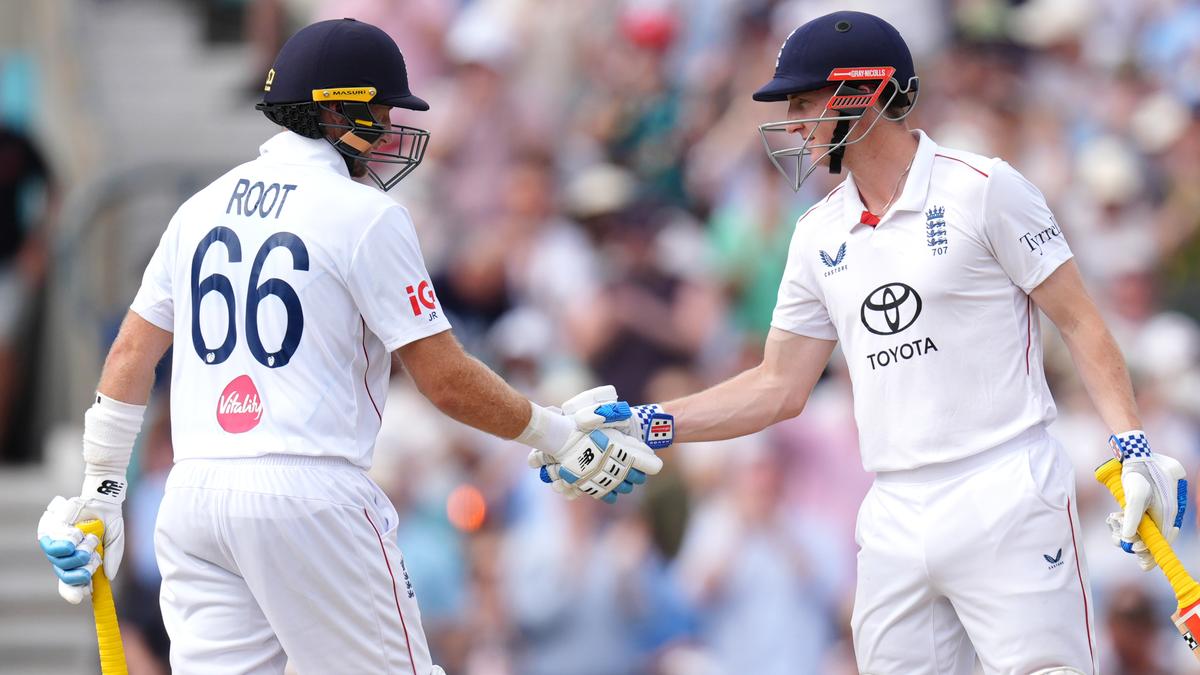
In the glorious annals of Test cricket, which will ring in its 150th anniversary next year, some numbers have acquired permanence over time.Sir Don Bradman’s otherworldly Test average of 99.94 will forever be iconic. Sunil Gavaskar’s 10,122 runs, on account of the Indian being the first in the world to cross 10K, is epochal. The mild-mannered Sri Lankan off-spinner Muttiah Muralitharan’s 800 scalps, snared with a ferocious snap of his right arm, is another monumental figure.The magic figureMore broadly, in sync with the sport’s tendency to set benchmarks through statistics, a career average of 50 has long been the magic figure for batters in white flannels. Operating in another stratosphere without doubt was Bradman, whose average over 52 Tests from 1928 to 1948 is an insurmountable peak of the kind unlikely to be witnessed again in all of sport.Moreover, Bradman’s influence extended beyond the field, with his runs acting as a balm to hordes of Australians suffering the grim consequences of the Great Depression.For the rest, who cannot reach such dizzy heights, averaging half as much as the pre-eminent Australian over a reasonably lengthy career is a measure of bona fide greatness. To do so, a batter must be able to straddle different worlds, ranging from the fast and bouncy surfaces of Australia and South Africa in the southern hemisphere to the dusty, spin-friendly decks of the subcontinent.ALSO READ | Is Tilak Varma ready for a tryst with Tests?But in a landscape where so much of the Test game is undergoing transformation, there is perhaps a change unfolding here as well.Among those with a minimum of 2000 runs starting January 1, 2020, only three have achieved the gold standard of 50 — the recently retired Kane Williamson of New Zealand and a pair of Englishmen in Joe Root and Harry Brook. The corresponding data for preceding decades point to a perceptible shift: 11 batters had a 50-plus average from 2010 to 2019, and as many as 19 from 2000 to 2009.A multitude of factorsIt isn’t by happenstance that the beginning of this shift coincides with the introduction of the World Test Championship (WTC) in 2019. Ever since teams have been incentivised to pursue silverware at the end of every two-year cycle, they have prioritised optimising home advantage by looking to win as many games as possible in familiar climes.The chance to bag 12 points for a victory in the WTC, as opposed to four for a draw, encourages the pushing of the envelope. Result-oriented surfaces, where ball dominates bat, have thus become common.The venues in Australia offer a striking example. In years gone by, most pitches Down Under had sharp pace and steep bounce, but they were also eminently favourable to batters who relished the cut and pull. Once the new Kookaburra ball lost its lustre, the willow-wielders were in prime position to make hay under the baking sun.Chart-topper: New Zealand’s Kane Williamson, who recently retired, leads the list by averaging 60.3 in 32 Tests since January 1, 2020
Analysis: Why a 50-plus Test batting average is becoming rarer
A 50-plus Test batting average is becoming increasingly rare. Decoding how the WTC, tougher pitches, modern batting approaches and improved bowling have changed Test cricket.
1,188 words~5 min read