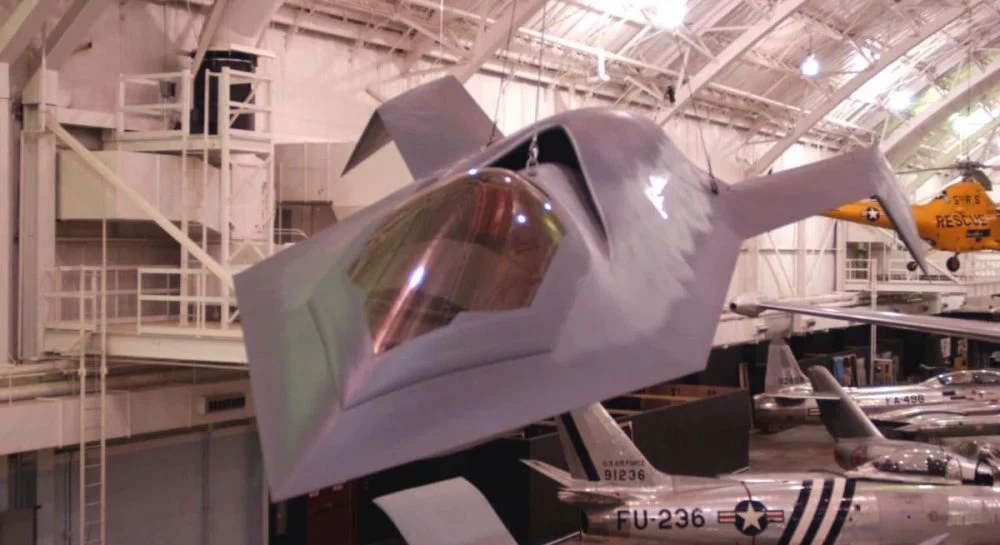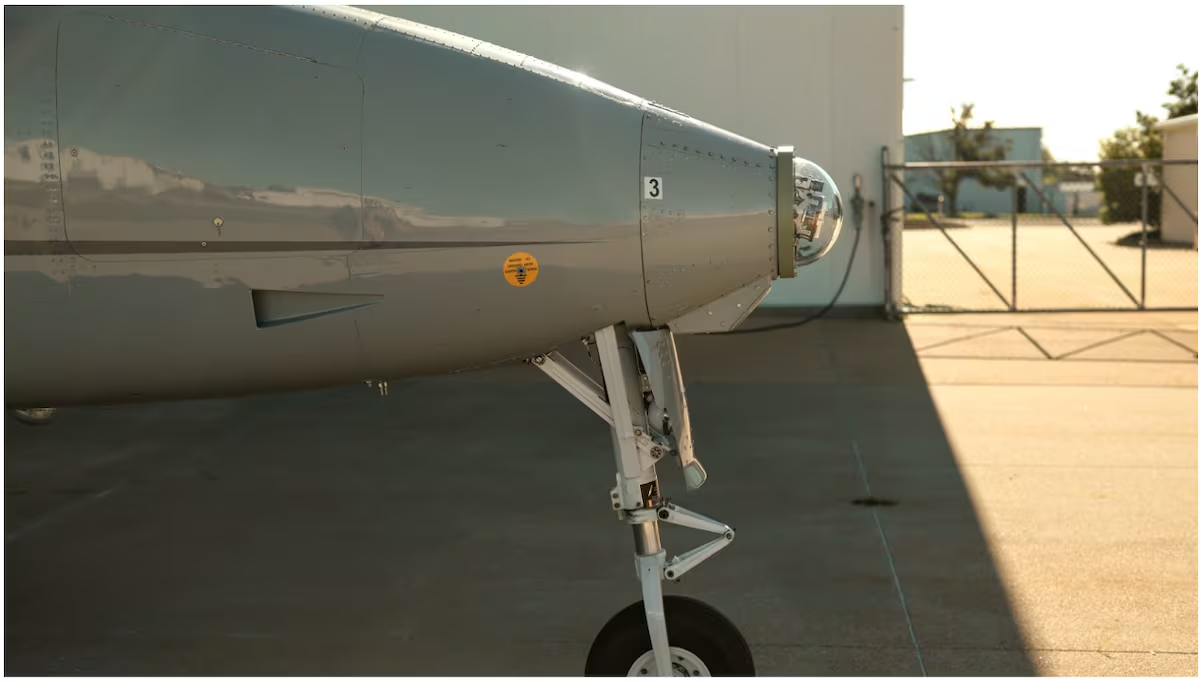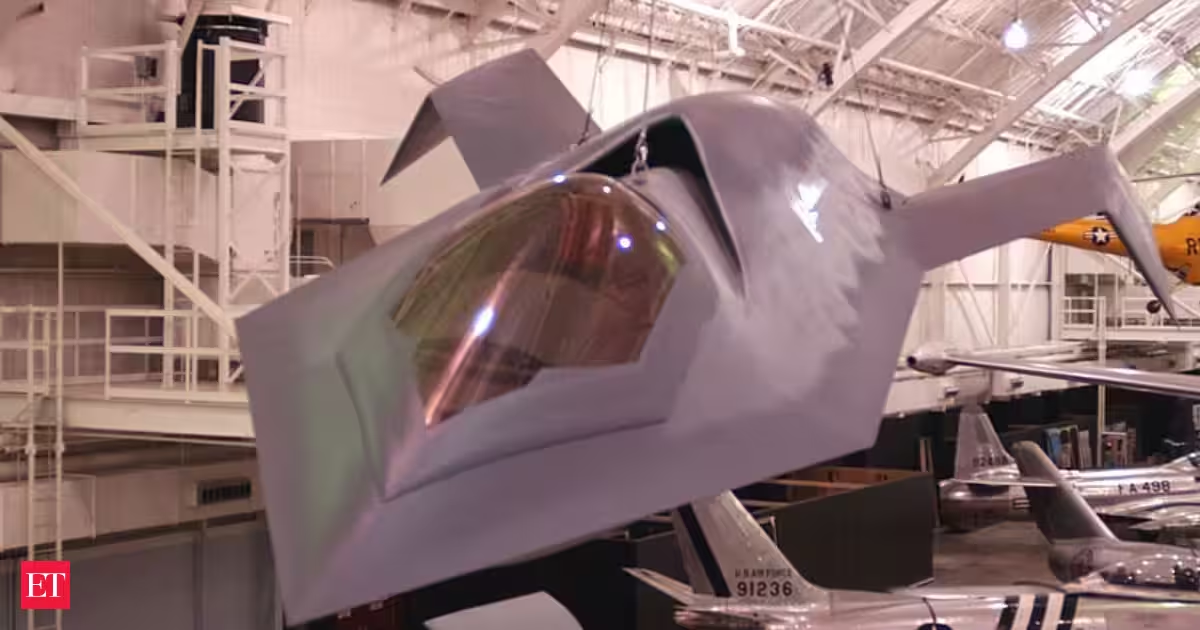
Boeing spent about $67 million of its own money developing one of the most weird-looking aircraft in history. Named as the YF-118G “Bird of Prey”, it had tiny wings and an unusual beak-like nose. Developed as a stealth technology demonstrator, the Bird of Prey eventually made just 38 test flights between 1996 and 1999, operating from the highly secretive Area 51 facility in Nevada.A stealth aircraft that looked deliberately strangeThe Bird of Prey was named after the Klingon spacecraft featured in Star Trek. Its fuselage blended into its small wings, while prominent chines along the body helped generate lift and contributed to its radar signature. The engine intake was positioned on the top of the fuselage rather than in a conventional location, helping shield the engine from radar and other forms of detection. Its control surfaces were designed without the conventional gaps and protruding features that could produce radar reflections.The aircraft also used large single-piece composite structures. Rather than assembling a conventional airframe from numerous individual components, Boeing sought to reduce seams, joints and other discontinuities that could compromise its low-observable characteristics. The approach was as much about manufacturing as it was about stealth.Boeing used parts from other aircraft to keep costs downOne of the most unusual aspects of the project was how much the Bird of Prey relied on existing technology. Since the aircraft was a technology demonstrator rather than an operational fighter, there was little reason to spend money developing specialized components for every part of it.Its landing gear, for example, was adapted from Beech King Air and Queen Air aircraft. The aircraft's single Pratt & Whitney JT15D-5C turbofan was a commercially available business-jet engine rather than a powerful military engine developed specifically for the project. Even the ejection seat reportedly came from a Harrier. The approach allowed engineers to concentrate their resources on the features that actually mattered to the experiment: stealth shaping, composite construction, computerized design and rapid manufacturing.It was not built to be fastThe Bird of Prey was never intended to dogfight with an enemy fighter or race across hostile airspace at supersonic speed. Its purpose was to explore how an aircraft could remain difficult to detect. It was powered by the JT15D-5C and had a cruising speed of around 300 mph, while its operational ceiling was approximately 20,000 feet.The tiny wings and unusual fuselage were not compromises made because Boeing lacked the ability to build a conventional aircraft. They were part of an experiment in balancing aerodynamic performance with a very small radar signature.The economical experiment While the $67 million cost of Bird of Prey may sound exorbitant, but was reportedly less than the cost of two Boeing 737s at the time. More importantly, it was a fraction of what a conventional major military aircraft development program could require.Boeing financed the program as a private venture, using its own money to develop and demonstrate technologies that could later be applied to larger military programs. Rather than relying entirely on traditional aircraft-development methods, engineers used computerized design techniques and what Boeing described as “virtual reality” tools. They also experimented with disposable tooling and large composite structures, seeking to reduce the time and labor required to turn an aircraft design into a flying machine.The result was a 47-foot-long aircraft with a wingspan of about 23 feet and a weight of roughly 7,400 pounds. It was a relatively small machine, but it was intended to demonstrate ideas that could eventually be applied to much more sophisticated aircraft.The aircraft stayed secret for yearsThe secrecy surrounding the Bird of Prey was just as important as its engineering. The program was conducted between 1992 and 1999, with flight testing beginning in 1996. Its association with Area 51 helped keep the aircraft away from public view while Boeing and the U.S. government evaluated its technologies.The aircraft completed only 38 flights before the program ended. According to the U.S. Air Force, those flights were used to test methods for making aircraft less observable both visually and to radar, while also validating new approaches to aircraft design and construction.The limited number of flights also meant that very few people had an opportunity to see the aircraft during its development. By the time Boeing finally acknowledged the program publicly in 2002, much of the technology it had been created to explore was already being incorporated into other projects.That timing was significant. There was little strategic value in keeping the Bird of Prey secret once its underlying design and manufacturing techniques were already moving into subsequent aircraft programs.
Boeing spent $67,000,000 of its own money on the YF-118G Bird of Prey stealth aircraft with borrowed landing gear and ejection seat. It flew just 38 times
The YF-118G Bird of Prey, an aircraft secretly designed by Boeing, was pivotal in testing stealth technology. This innovative project delved into new designs and manufacturing techniques for better low visibility. By reusing existing parts, it minimized both costs and development time, completing 38 test flights at Area 51 during 1996-1999. Boeing disclosed the program in 2002 once its technologies were applied to other projects.
753 words~3 min read