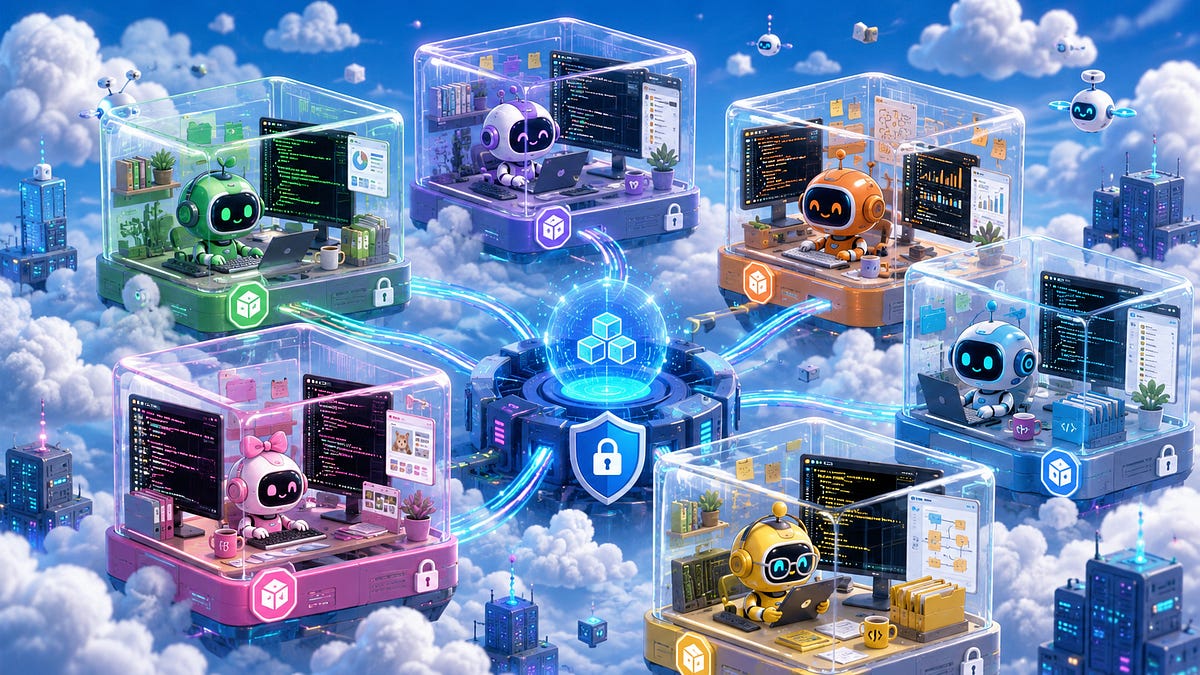
I think it’s 1997 for agents.They are showing up on message boards, making requests across the internet, acquiring identities, and exchanging information. On one forum built for them, twelve days produced 20,040 posts and 192,410 comments. Some of it is useful. Some of it is ridiculous. A lot of it looks like people experimenting with something before anyone has worked out what the durable version should be.We’ve been through this before.The part I keep coming back to is what happens when this growing population needs somewhere to work. Agents need processing power, files, tools, memory, and ways to communicate. They need environments where they can keep working after the person who gave them a job closes a laptop. As they do more, the design of those environments becomes consequential.At the same time, agents are changing how easily we can build the interfaces that humans use. More of what used to require a product team, a roadmap, and a market large enough to justify the effort can now begin with someone describing what they want.Those two developments meet in Omarchy, a Linux desktop assembled by David Heinemeier Hansson, the creator of Ruby on Rails. It gives you a complete, deliberately designed computer environment and makes agents part of changing that environment. On first boot, you choose an agent. The project provides tools and instructions for asking it to help shape the system. Omarchy’s own introduction makes that ambition explicit — it calls itself “the malleable OS for the age of agents.”My prior is that something like 1% of people will want to live at the far end of the flexibility Omarchy represents. The other 99% will keep using more predictable operating systems. Those numbers describe my expectation, not a market forecast with a spreadsheet behind it.And I think Omarchy can matter enormously even if that expectation is right.I’ll be opening a Mac or a Windows laptop every morning too. What our agents open is the part that’s about to change.Here’s what’s inside:Why the audience for a software change can be one person. A dad built two different screen-time systems for two different kids, and neither one is a product anybody would have shipped.The Omarchy curve. How much flexibility you actually get for the effort you are willing to spend, and why that curve is bending.What the other 99% will experience. Apple’s September announcement shows how most of this arrives — as convenience inside a product you already know.Why agents are going to need their own computers. Cloudflare is already selling exactly that, and human desktop market share tells you nothing about how many there will be.The guide: what to change on your Mac or PC. Concrete changes on the machine you already own, the five rungs of access an agent can ask for, and the three ways to try Omarchy itself.What happens when changing the decisions built into your computer becomes cheap enough to be ordinary, and when an increasing share of the entities using computers can make the changes themselves?
How much of your computer should an AI agent be allowed to touch? (+ my guide: five levels, and the way back from each)
AI is making interfaces cheaper to imagine and build. A growing population of agents will need computers of its own. Enter Omarchy.
TL;DRAI
Omarchy (Hansson) is the Linux desktop enabling AI agents to autonomously modify the operating system. For IT managers, the critical issue emerges: defining agent access levels becomes a core architectural decision impacting security and governance.
500 words~2 min read