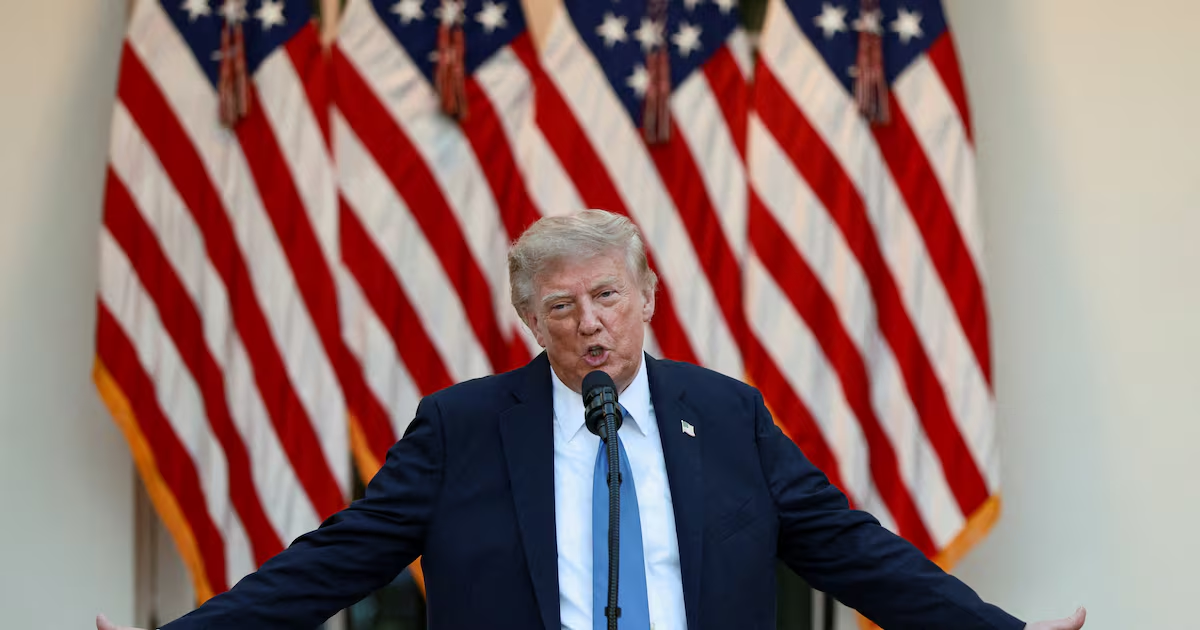
Regardless of US President Donald Trump’s decision to extend the African Growth and Opportunity Act (Agoa) by two years, South African farmers must continue to expect an environment of uncertainty and prepare to navigate it.This is according to the sector executive for agriculture at Absa AgriBusiness, Loffie Brandt. He spoke to TimesLIVE on the sidelines of Nampo Cape in Bredasdorp, Western Cape on Thursday. The Nampo harvest day is the largest open-air agriculture sector gathering in the southern hemisphere.“The first thing is that one must accept that there are some industries that are more exposed to that mixed market and others that are less exposed. Some of them can access other markets as well. I do think, however, the one thing that we need to understand is the fact that the environment in which we operate has become uncertain.”Trump extended Agoa — which affords favourable trade conditions and US consumer market access to goods from the African continent — by two years. While positive for South Africa and other African economies, it remains a far cry from the 15-year extension that Pretoria lobbied aggressively for.On the other hand, Trump has taken an increasingly antagonistic approach to one of the most important strategic trade partners of the US — Canada. He announced tariffs on Canadian exports, and Canada’s Mark Carney administration retaliated in kind.Trade fragmentation riskBrandt said South African farmers should be more intentional about shielding their products from trade fragmentation and uncertainty more broadly, rather than fixating on any single announcement on trade and tariffs, and the environment itself is increasingly uncertain.“The fact that suddenly tariffs are up and then [the next moment they are] down, and then they extend Agoa, all cause uncertainty. I think the important thing for South African farmers is to figure out how to navigate this uncertainty.”He said the export value chain is facing several challenges and advised against a fixation on pivoting away from the US market over temporary and political decisions, unless such a pivot is unavoidable for farmers.“What do you have available that can limit your exposure to the instability? Not necessarily limiting your exposure to the US market, but limiting your exposure to instability and limiting your exposure to instability might mean that you change markets or the timing of your product.”James Booth, head of revenue at Verto, said the era of relying on unilateral trade preferences is ending. While any extension of Agoa is a welcome relief for the 500,000 South African jobs linked to this agreement, a one-year window is a signal, not a solution, he warned.“This abbreviated extension perpetuates uncertainty, making long-term investment difficult. For South African businesses, the 30% ‘America First’ tariffs already in place have effectively neutralised many of the duty-free benefits Agoa once provided. We are now in a ‘bridge year’, and the message to businesses is clear: diversify or face significant exposure.”Wandile Sihlobo, agricultural economist at the Agricultural Business Chamber of SA (AgBiz), said that while the renewal of Agoa will benefit the farmers, the broader challenges pervading the political relationship between Pretoria and Washington lingered.“Zooming into South Africa’s farming sector alone, I must emphasise that the US remains an important market. The US accounted for approximately 4% of South Africa’s total agricultural exports, valued at $13.7bn in 2024,” he said.“The exports were also strong in the first two quarters of 2025. Even after the Liberation Day Tariffs were announced, some exporters took advantage of the 90-day pause on the higher tariffs and exported more volume than usual. In fact, in the second quarter of 2025, South Africa’s agricultural exports to the US increased by 26% to $161m.”He said South Africa’s agricultural exports to the US decreased by 11% in the third quarter of 2025, compared to the same period a year before, at $144m.Business Times
Agricultural uncertainty endures despite Agoa extension, analyst says
The export value chain faces several challenges, and SA must not be fixated on pivoting away from the US over temporary and political decisions
632 words~3 min read