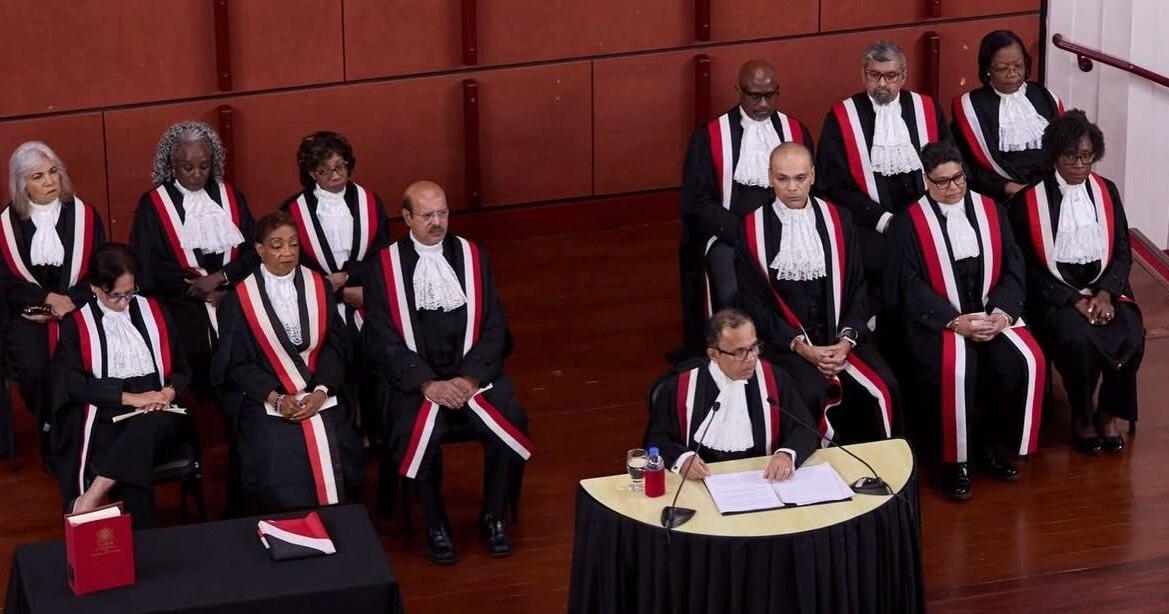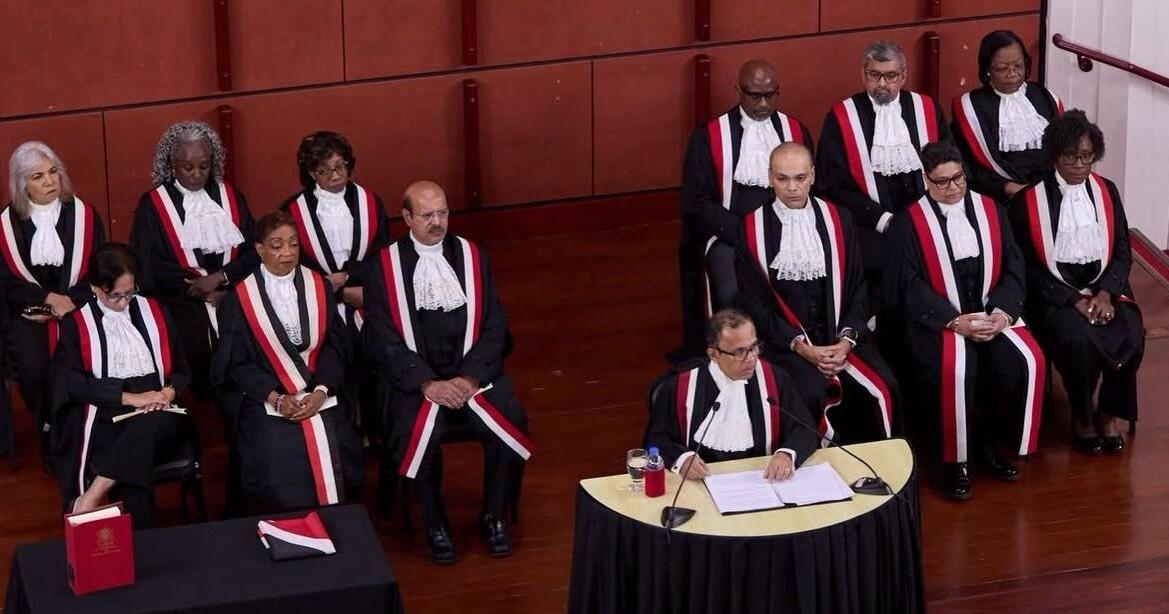
Chief Justice Ronnie Boodoosingh says the Judiciary has to address unacceptable delays in the hearing and determination of cases, as he yesterday announced measures to reduce the criminal case backlog and increase court capacity.He was delivering the feature address during the opening of the 2026-2027 law term at Convocation Hall, Hall of Justice, Port of Spain.Yesterday’s law term opening was Boodoosingh’s first as Chief Justice. He was appointed in October last year.Boodoosingh said his assessment of the Judiciary after assuming office had identified serious problems with infrastructure, case management and staffing.He determined that the physical infrastructure was in major need of overhaul, as the San Fernando Supreme Court Building had been effectively closed since the pandemic, removing 16 courtrooms and staff accommodation from the system.The Hall of Justice and Tobago Hall of Justice were also underutilised, while almost all Magistrates’ Court buildings required maintenance, renovation or remedial work.He said the Judiciary had continued to operate largely online after the pandemic, unlike the rest of the public service and school system, and that members of the public did not always have in-person access to staff.The most significant finding, he said, was the backlog in the listing, hearing and determination of cases, particularly in the Criminal and Family Court systems.The backlog in the Magistrates’ Court had also continued to mount after Covid-19, despite changes to preliminary enquiries and the traffic system.Boodoosingh said the Judiciary’s response had to be based on what the public expected when dealing with the courts.“The public wants good service,” he said, adding that people involved in traffic cases, family matters, criminal cases or civil disputes wanted a “short, simple process”.“We do not, as an organisation, intentionally set out to delay cases or frustrate people or put obstacles in their way,” he said.However, he acknowledged that resource constraints limited what the Judiciary could do and how quickly it could do it.“That is not an excuse for us not doing all that we can reasonably do to deliver an effective justice system,” he said. “Where our systems are not working as well as they can be, our job is to fix them.”He said the Judiciary’s standard of six months for most judgments had been established many years ago and reiterated by former chief justice Ivor Archie in 2025. He was seeking to ensure compliance with that standard.Boodoosingh said judicial officers were now required to report monthly to his office on sitting times, cases completed and outstanding judgments, providing data on which performance could be monitored.Cases in the system for decades He said the Judiciary had also established a Criminal Justice Board, which had been meeting monthly since April to identify problems and solutions.A targeted backlog reduction plan was being used to identify the oldest cases and prepare them for hearing or completion.“Some of the cases in the system for decades, are for all intents, dead cases with no chance of a trial,” he said. “We have been working to clear these away.”He expected that by the end of the law term, the oldest cases would be determined and removed from the system.A major change in the criminal courts was the increase in available courtroom space.Boodoosingh said 15 Criminal Jury High Court rooms had been functional since the beginning of September, compared with approximately eight jury courtrooms previously available to judges.He said judges were now being assigned to particular courtrooms, with cases to manage and try, rather than operating under the previous docket assignment system.The Registrar and the Chief Justice had also met with Director of Public Prosecutions Roger Gaspard, SC, who had committed to assigning prosecutors to all 15 courts on a continuous basis.The Judiciary was also working with the Public Defender’s Department to ensure that its lawyers could also be assigned to each court.Boodoosingh said the Public Defender’s Department needed more lawyers and joined its call for additional staff. He said the Judicial and Legal Service Commission was working with the DPP’s office to fill vacancies.He said the Judiciary also had to increase sitting hours and reduce downtime in the criminal justice system.“We have to ensure that there is as little downtime in the criminal justice system as is possible,” he said.In-person hearings The Chief Justice also announced plans to restore full court hearings in the magistrates’ courts throughout the country by the end of 2027, through a gradual and phased transition.He said almost 100% of magistrates’ court hearings had been conducted virtually since Covid, but that the system had not been as effective as in-person hearings in completing cases.The Judiciary’s statistical reports showed that completion rates between 2006 and 2016 had ranged from about 65% to 120% of filings per year.The completion rate for the last year was 44%.Boodoosingh said 15,994 matters had been completed in 2025/2026, compared with 11,065 in 2024/2025 and 10,746 in 2023/2024.By comparison, 115,491 cases had been disposed of in 2016/2017; and 82,841 in 2017/2018.He said a sample comparison of cases completed before and after 2020 showed that the raw disposition numbers for online hearings were less than 20% of those disposed of through in-person hearings.“While online hearings may be more convenient for many persons, including for lawyers, magistrates and police officers, as far as the magistrates’ courts are concerned, they have not been as effective as in-person hearings in getting cases completed and getting them completed in a timely manner,” he said.
CJ moves to tackle court backlog
Chief Justice Ronnie Boodoosingh says the Judiciary has to address unacceptable delays in the hearing and determination of cases, as he yesterday announced measures to reduce the criminal case backlog
889 words~4 min read