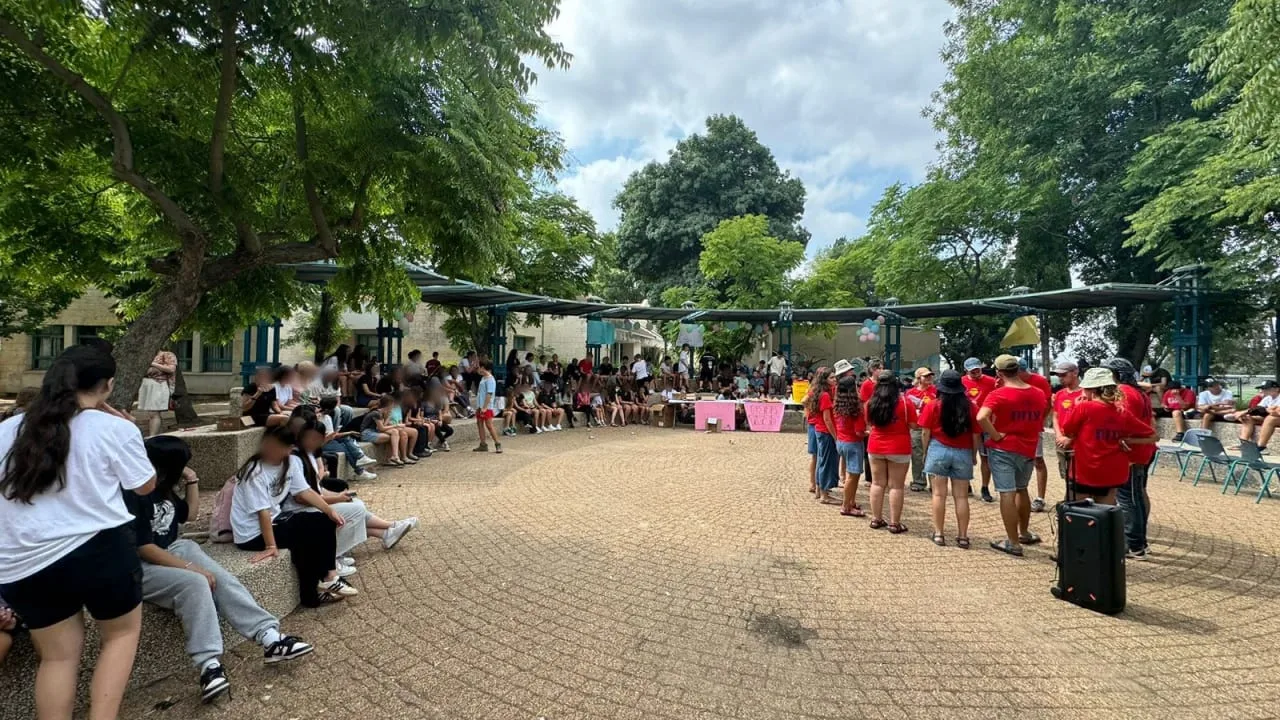
ByNOAM BEDEINSEPTEMBER 10, 2026 15:00Every year before Rosh Hashanah, the Jewish world turns inward for heshbon nefesh, an accounting of the soul. We examine our roots, our heritage, and the complicated cords that bind us as a people.For decades, the relationship between Israel and the Diaspora has too often settled into a familiar pattern: Israel as the military and cultural center, the Diaspora as its financial supporter. Israelis went abroad as emissaries and educators; Jewish communities abroad sent money and support home.There is another way to understand this relationship, and one of the best places to discover it is a Jewish summer camp.For Jewish communities abroad, camp is often the defining Jewish experience of the year: an immersive world where Jewish identity, Zionism, friendship, and leadership are lived rather than simply taught.The Jewish Agency partners with North American camps and Jewish federations to provide Israeli teens with a respite from the war. (credit: Jennifer Roman/Jewish Agency for Israel)As Israel struggles with the trauma left by the October 7 massacre and the war that followed, there is something profound to learn from that culture of warmth, belonging, and peer-to-peer leadership.This summer, at Hadassah Youth Neurim Village in Beit Yanai, that lesson came alive at Hallelujah Summer Camp, a flagship initiative of Netaim, the organization carrying forward the vision of the late Ofir Libstein alongside Shiri Madar, Netaim’s CEO.The program works with what Libstein and Madar called the “periphery of the Diaspora”: more than 150 Jewish communities around the world with fewer than 2,000 members.Ami Magen, manager of the youth village, puts the purpose simply: “For me, the key is helping our youth rewrite their story, changing their narrative from victim to hero, from survivor to leader.“When a teenager realizes that even from the lowest point they have experienced, they still have something of value to give to someone else, that is the ultimate empowerment.”At Hallelujah, Israeli teenagers – many from the war-torn Gaza border communities – encountered young Jewish leaders from Brazil, Argentina, Australia, Uruguay, Romania, and Bulgaria.They arrived not as donors or rescuers, but as counselors, friends, and role models.Camp director Tomer Revivo and project initiator Doron Moshe deliberately built Hallelujah around a different leadership culture.Moshe had spent years as a Habonim Dror emissary in South Africa, where he encountered a looser, warmer approach to youth leadership.“I would prefer a thousand times that the campers are 10 minutes late, or that a scheduled activity falls apart entirely,” Revivo said, “as long as we do things with warmth, coloring, and genuine human connection. We wanted to build an organizational culture of smiling and unconditional embrace.”That philosophy was tested almost immediately.One camper from the Gaza border communities, grieving relatives murdered on October 7, began isolating himself and lashing out. His Argentinian counselors asked Revivo to let them keep him rather than send him home.They took personal responsibility for him, walking with him and listening. By the end of the summer, he returned home with a notebook filled with handwritten messages of love from counselors who had refused to give up on him.Lior Avril, an Israeli coordinator from Ashdod, watched foreign counselors give up their own breaks to sit with campers at lunch, sometimes communicating in limited Hebrew.During an ecology lesson, counselors from Brazil, Argentina, and Australia painted themselves blue and turned the subject into a Smurfs-themed sing-along.Then came a harder moment. An Israeli camper directed a racial slur at a Black Brazilian counselor. Rather than demand punishment, the counselor sat with the boy for two and a half hours, discussing racism and the weight of words.By that night’s talent show, the two were dancing together on stage.Opening up the Israel-Diaspora relationshipHallelujah's phone-free week created another unexpected transformation.“On the first day, you see children who are completely lost, sitting in corners, unsettled because they can’t take photos or check social media,” Avril said.“But by the second and third day, something beautiful happens. They open up. They start talking to the person next to them at the table. They start singing, laughing, and spontaneously dancing.”For Moshe, this represents something larger than a successful camp. It reverses the traditional direction of the Israel-Diaspora relationship.“Historically, major communities like Geneva or Glasgow were used to a very specific, patron-recipient relationship,” he explained.“They expected us to bring traumatized delegations from the Gaza border communities so they could fundraise for them, put them in hotels, and give them a respite park as their contribution to Israel’s rehabilitation. We flipped that script entirely.”Instead, Netaim told those communities: “Our youth are coming to volunteer, they are coming to work, and they are coming to contribute to you.”The exchange continues after camp. Israeli graduates can go on to volunteer in Jewish communities such as Geneva, Barcelona, and Glasgow, bringing their own energy and connection to Israel back to communities that have given so much to Israel.The mirror works in both directions.Boris, 19, from Curitiba, Brazil, said Israel taught him something about his own Jewish identity. “In the Diaspora, we have to actively be Jewish,” he said. “We have to actively practice and celebrate so we don’t forget, so we keep connected.”Israeli teenagers, meanwhile, heard what antisemitism looks like when it is not a chapter in a history book.Lali, from Perth, described hiding her Star of David necklace and locking her community center’s doors during hostile protests. Pedro, from Rio de Janeiro, recalled a Jewish friend who opened his lunchbox at school to find a swastika drawn in ketchup.Then there is Dora, 18, from Bulgaria. She first came to Hallelujah as a shy 14-year-old camper. This summer she returned as a counselor. Her mother told her she had come home transformed.Her school in Sofia later nominated her to represent Bulgarian youth at the World Zionist Congress, and she now runs social media campaigns against online antisemitism.“The Jewish world cannot survive without Israel at its center, but Israel also needs the strength of the Diaspora,” Dora said. “Hallelujah showed me that we are one family, and we must protect Western values together.”As we dip apples in honey this Rosh Hashanah, Hallelujah offers a powerful lesson about the Jewish people: our strength is held across borders, generations, and cultures.“The rope of the Jewish people is held from both ends,” Moshe said. “They help us when we need it, and we must help and strengthen them.”Perhaps that is the mirror Israel needs now. To heal its young people, it may need to look outward and rediscover what Jewish communities abroad have been practicing all along: the power of belonging, warmth, chosen identity, and one another.Shana Tova.The writer is a travel photojournalist, explorer, and Israeli storyteller who has led NGOs on the frontlines and brought Israel’s most pressing stories to international audiences.Follow us on Google
How global Jewish warmth is healing Israel’s war-weary youth | The Jerusalem Post
For Jewish communities abroad, camp is often the defining Jewish experience of the year: an immersive world where Jewish identity, Zionism, friendship, and leadership are lived rather than taught.
1,118 words~5 min read