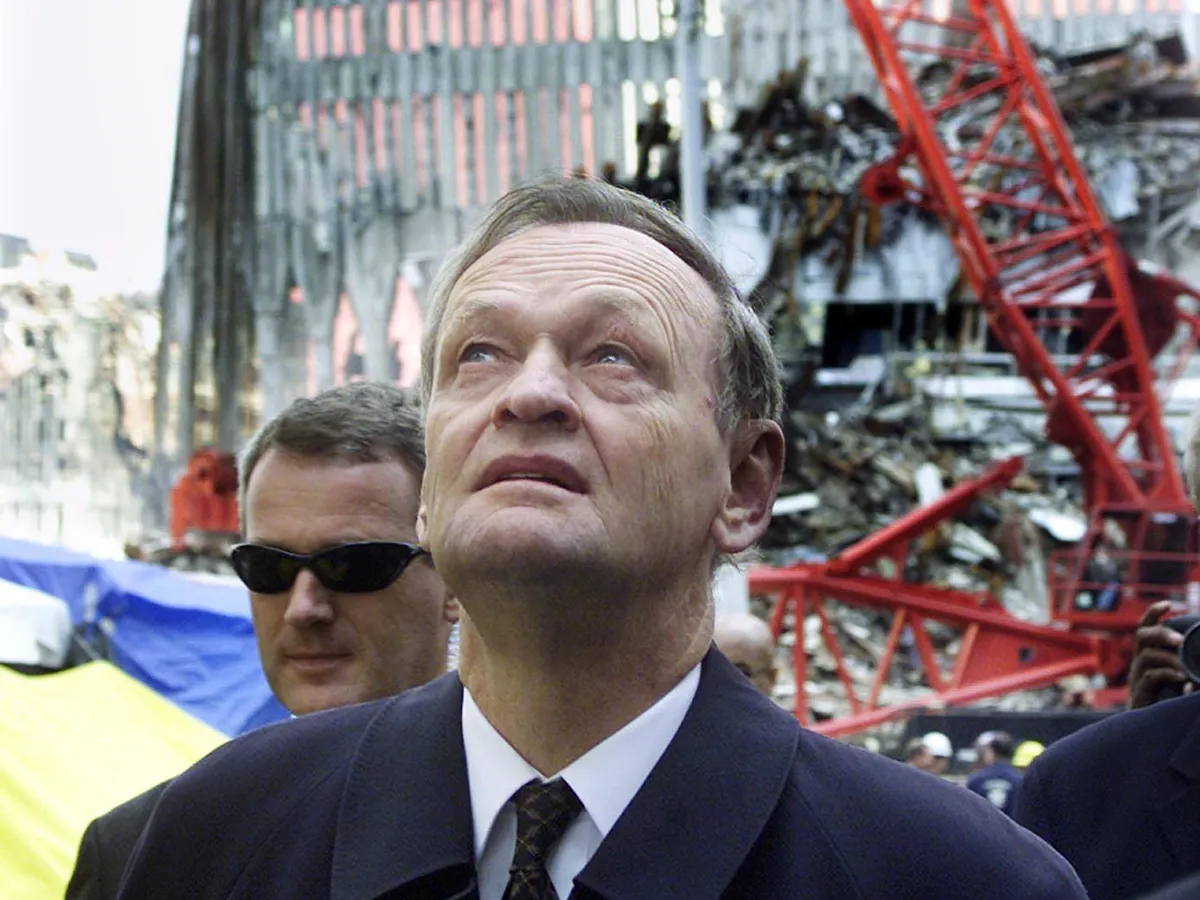
Skip to Content Subscribe My Account Manage My Subscriptions FAQ Newsletters Canada Canadian True Crime Canadian Politics Health World Israel & Middle East Financial Post NP Comment Longreads Puzzmo Diversions Comics NP News Quiz New York Times Crossword Horoscopes Modern Life Eating & Drinking Style Sponsored Play for Ontario Travel Travel Canada Travel USA Travel International Cruises Travel Essentials Culture Books Celebrity Movies Music Theatre Television Business Essentials Advice Lives Told Tails Told Shopping Buy Canadian Home Living Outdoor Living Kitchen & Dining Tech Style & Beauty Personal Care Entertainment & Hobbies Gift Guide Travel Guide Deals Savings National Post Store More Sports Hockey Baseball Basketball Football Soccer Golf Tennis Driving Vehicle Research Reviews News Gear Guide Obituaries Place an Obituary Place an In Memoriam Classifieds Place an Ad Celebrations Working Business Ads Archives Healthing Epaper Manage Print Subscription Profile Settings My Subscriptions My Offers Newsletters Customer Service FAQ Newsletters Canada World Financial Post NP Comment Longreads Puzzmo Diversions Modern Life Shopping Epaper Manage Print Subscription HomeLongreadsNewsCanadaCanadian Politics'THERE'S BEEN A TRAGEDY': The untold history of Canada's 9/11 responseExclusive book excerpt: A minute-by-minute investigation of how senior leaders scrambled -- and fretted -- as the U.S. diverted its planesLast updated 1 hour ago Prime minister Jean Chrétien views the damage at ground zero of the World Trade Center terror attacks in New York on Sept. 29, 2001. Photo by JEFF CHRISTENSEN/AFP/Getty ImagesThis is an excerpt from Ash and Honor: The Untold 368 Minutes of 9/11, by American author Jeffrey Robinson. The book tells the story of the official response to 9/11 by North American authorities. This excerpt, drawn from multiple chapters, focuses on senior Canadian officials.Enjoy the latest local, national and international news.Exclusive articles by Conrad Black, Barbara Kay and others. Plus, special edition NP Platformed and First Reading newsletters and virtual events.Unlimited online access to National Post.National Post ePaper, an electronic replica of the print edition to view on any device, share and comment on.Daily puzzles including the New York Times Crossword.Support local journalism.Enjoy the latest local, national and international news.Exclusive articles by Conrad Black, Barbara Kay and others. Plus, special edition NP Platformed and First Reading newsletters and virtual events.Unlimited online access to National Post.National Post ePaper, an electronic replica of the print edition to view on any device, share and comment on.Daily puzzles including the New York Times Crossword.Support local journalism.Create an account or sign in to continue with your reading experience.Access articles from across Canada with one account.Share your thoughts and join the conversation in the comments.Enjoy additional articles per month.Get email updates from your favourite authors.Create an account or sign in to continue with your reading experience.Access articles from across Canada with one accountShare your thoughts and join the conversation in the commentsEnjoy additional articles per monthGet email updates from your favourite authorsSign In or Create an AccountorJean Chrétien, the 67-year-old Canadian prime minister who’d led his Liberal Party to a parliamentary victory in 1993, lived at 24 Sussex Drive in Ottawa, Canada’s equivalent of the White House. Built in 1866, the 35-room mansion was set on four acres in the fashionable New Edinburgh neighborhood, overlooking the Ottawa River.With Parliament in recess, and all of his ministers out of town, he was working from home that morning.Having suffered Bell’s palsy at the age of 12, making the left side of his face weaker than the right side, Chrétien spoke in a very distinct lopsided way out of the left side of his mouth, with a heavy accent in both French and English. It gave him a quality of being authentic, a tough, straightforward yet self-deprecating man who didn’t put on the airs of the intellectual lawyer and avid reader that he actually was.He was also a man with deep political instincts. For example, he dealt with President Clinton by playing golf. And he dealt with President Bush by talking about baseball.Coming downstairs from the residence just before 8:30 a.m., he walked into the ground-floor living room to greet the new premier of Saskatchewan, Lorne Calvert. They’d never met and were scheduled to talk about farm aid. But after the usual pleasantries, their meeting was cut short by an aide coming into the room to tell Chrétien that a plane had just crashed into the World Trade Center in New York.Like so many people that morning, Chrétien thought, it must have been a small plane flown by a pilot who didn’t know what he was doing.Then the second plane hit.Calvert made his exit and Chrétien went to his ground-floor office to assess the situation. He and his aides sat and watched CNN, until he decided he was going to phone George Bush to express Canada’s sympathy and support.His aides talked him out of it.They convinced Chrétien there would be time for that tomorrow.Right now, they said, the president is busy. Your call will only get in the way.Chrétien agreed and, instead, tried to reach the U.S. ambassador to Canada, Paul Cellucci. He’d been governor of Massachusetts when George Bush sent him to Ottawa. But that morning, Cellucci was on a plane heading back to Ottawa from Winnipeg.The prime minister eventually got the deputy chief of mission on the phone and assured him that Canada was prepared to do whatever needed to be done.The American diplomat was grateful.When they hung up, Chrétien admitted that while the offer stood, there actually wasn’t much Canada could do.Little did he know.Reaching his cabinet wasn’t easy. They were spread out across the country, with some outside the country, in an era when email and smartphones weren’t plentiful.Chrétien and his staff had mobile phones, clumsy early versions that, they often complained, didn’t work very well. So for the rest of the morning they stayed where they were, contacting the few people they could while watching on television as events unfolded in the States.The one constant interruption was his Royal Canadian Mounted Police (RCMP) security detail. They kept trying to convince Chrétien to leave the residence and go to a safer place.Chrétien refused.They tried again a little while later.He refused a second time, and then a third.The Mounties pressed him whenever they could, genuinely concerned that he might not be safe. After all, no one knew if the terrorists were heading north of the border.Or, worse, if they were already in Canada. Smoke spews from a tower of the World Trade Center after two hijacked airplanes hit the twin towers in a terrorist attack on New York City on Sept. 11, 2001. Photo by Mario Tama/Getty ImagesWhat Chrétien didn’t mention to his security detail, or anyone else at the time, was that he worried about the same thing.One terrorist in particular concerned him greatly.Now he began phoning everyone he could think of to ask if anyone knew about any possible ties between the terrorists in New York and the one that worried him, Ahmed Ressam.If it turned out that Ressam had somehow been involved, this would not just be Jean Chrétien’s worst nightmare, it could be Canada’s as well.—–David Collenette, Canada’s minister of transport, got up that morning at five o’clock to fly with two members of his staff from Toronto to Montreal, where he was giving the welcome address to a conference held by Airports Council International.This was the international trade group for all the world’s airport managers, which meant that everybody who was anybody in the airport business — more than 2,000 people from all over the world — would be there.That included the airport managers from Montreal, Toronto, Vancouver, Winnipeg, Calgary, Gander, Goose Bay, Halifax, St. John’s, Moncton, Charlottetown, Thunder Bay, Sault Ste. Marie, and smaller airports all over Canada. All of whom would soon be needed home. Most of whom would not be able to get there.Collenette was introduced to the crowd in the Palais de Congrès just after 8:30 and had only spoken for six minutes before he became aware of murmuring at the back of the auditorium.He thought, am I that bad a speaker or are these guys just rude?The best thing, he knew from experience, was to ignore them.But the murmuring increased and began to spread throughout the audience. That’s when one of his officials came up to him, on stage — which visibly ticked him off — and put a note in front of him with eight words written in large caps: WIND UP YOUR SPEECH THERE’S BEEN A TRAGEDY.Not knowing anything more than that, he excused himself and quickly left the stage.One of the organizers replaced him at the microphone to announce they were suspending proceedings because there’d been an aviation incident.Backstage, Collenette was met by his two aides, who tried to fill him in on what they knew, plus a press scrum demanding comments about what had happened in New York. Federal transportation minister David Collenette leaves a news conference in Halifax on Sept. 20, 2001. Photo by Paul Darrow/The Halifax Daily NewsAfter nearly 18 years in Parliament, and having served three of those years as defense minister before coming to this post, he had considerable experience with press scrums. He was known, and appreciated by the media, as someone who would always speak his mind. This morning, though, he’d been caught off guard and the best he could come up with was, a small plane has crashed into the North Tower of the World Trade Center in New York. That’s all I know.He did not say what he suspected. This sounded to him like a terrorist incident.His aides tried to get him out of the building and into a car for the airport. They rushed him down an escalator. Reporters followed on his heels.One of his aides, on the phone with their office in Ottawa, informed him there was a second plane and that the South Tower had been hit.Worried that they might not be able to fly back, Collenette announced, we’ll drive.The 125-mile trip would take over two hours.He and his aides hurried into one of his department’s black vans. He told the driver, we’ve got to get back to Ottawa right away.But the driver didn’t speak English.The driver explained in French, I don’t know how to get to Ottawa.Collenette wrote out the directions for him.On the way, his deputy minister, Margaret Bloodworth, called to say that all U.S. airspace had been shut down. That the secretary of transportation, Norman Mineta, had closed America’s skies.But no one had bothered to tell the Canadians.Long before Collenette’s car reached the Ontario border, he’d checked with his department’s lawyer and was told that he had the authority to do what he wanted to do, which was to close Canada’s skies.So he pushed that button and now air traffic in both countries was turned off.For Collenette, that was the easiest part of the trip home.Much tougher was figuring out, what the hell are we going to do with all the planes that can’t land in the States and are being dumped into Canada? Grounded planes at St. John’s International Airport in Newfoundland and Labrador as a result of the Sept. 11, 2001 terrorist attacks on the United States. Photo by Joe Gibbons/The TelegramHe didn’t know it then, but the final total would be 239 flights diverted to 17 Canadian airports with an estimated 33,000 displaced and sometimes very unhappy passengers.What he did know was that, however many planes and passengers were on their way, they’d have to land somewhere. But all the airport managers Collenette needed to help make this happen were stuck inside the Palais de Congrès in Montreal and could be for days.Sitting in the rear seat of that van, with a driver who didn’t know the way to Ottawa, David Collenette realized he didn’t have much time to figure this out.—–John Manley, Canada’s minister of foreign affairs, was returning from a conference, flying with a small staff from Frankfurt, Germany, to Ottawa in the upstairs first-class cabin of an Air Canada 747.Happy to be coming home, he was reading a book when one of the flight attendants approached him and asked that he follow her into the rear galley. Once they were out of earshot of the other passengers, she told him what little she knew about planes hitting the World Trade Center.Manley asked if he could speak to the pilot. She escorted him to the flight deck, where, given a headset, he listened to a live broadcast by Britain’s BBC World Service Radio.The more he listened, the more queasy he became.Sitting there, hearing what was happening in the United States, the name that kept running through his mind was Ahmed Ressam.—-Richard Clarke had been warning of an al-Qaeda attack for years.He told President Clinton in December 1998 that al-Qaeda was preparing several attacks against America, which included hijacking aircraft. He claimed the attacks were being orchestrated by Osama bin Laden and his second-in-command, Ayman Al-Zawahiri.He predicted that the attacks would happen around the millennium.The Central Intelligence Agency concurred, separately and in unison, that bin Laden was turning his attention to the United States.They were right.With the millennium in mind, an attack was planned against Los Angeles International Airport. Mistakenly believing that the millennium began on January 1, 2000 — in fact, the actual date was one year later — an Algerian-born, al-Qaeda-trained militant set in motion a plan to blow up the airport on New Year’s Eve 1999.He came to be known as the Millennium Bomber.Arriving in Montreal in 1994 with a counterfeit French passport, he sought political asylum, was awarded the right to remain in Canada, committed benefit fraud, got thrown out, and came back and stayed illegally, committing petty crimes unhindered to finance himself while he plotted the attack. He flew to Vancouver, loaded a rental car with explosives, and, on December 14, 1999, took the ferry from Victoria, British Columbia, to Port Angeles, Washington.He was stopped there by a keenly alert U.S. customs inspector, Diana Dean, who didn’t like the fact that the man seemed unusually nervous. He avoided eye contact with her, and when she asked what he was doing there and where he was going, his answers were evasive and inconsistent. Ahmed Ressam, also known as the Millennium Bomber. Photo by FBIShe ordered him into secondary inspection and found his trunk packed with explosives. And when he tried to escape, he was stopped.In May 2001, he pleaded guilty to conspiracy to bomb a U.S. airport, possession of explosives, and membership in al-Qaeda.After agreeing to cooperate with the government, he received a sentence of 22 years. When his cooperation suddenly stopped, that was increased to 37 years.Dean was the hero who foiled the plot. But, unbeknownst to her, such an attack had been on the CIA’s radar for years.Concerned about the idea that al-Qaeda was planning a series of attacks against U.S. targets, the agency’s Counterterrorism Center had frequently sent out alerts calling for heightened vigilance.Based on those warnings, former agency managers maintain that several attacks had been thwarted. But one constant concern — reinforced by what they came to know about the Millennium Bomber — was just how long and undefended the U.S.–Canada border was.The Millennium Bomber’s name was Ahmed Ressam.—-At 24 Sussex Drive, Jean Chrétien’s security detail, made up of specially trained officers from the RCMP, wanted to move him to a secure secret location.Chrétien refused.They insisted.He refused again.Eventually, he spoke with the head of the RCMP, Commissioner Giuliano Zaccardelli.For the man widely known simply as Zac, this was an extremely busy time, shifting the RCMP from a national policing agency to becoming the primary source of national security.It was Zac who raised the national threat posture and oversaw RCMP headquarters’ coordination with provincial divisions and other police forces, in addition to establishing an intelligence liaison with the FBI, the CIA, and other U.S. law enforcement.At the same time, he strengthened the Mounties’ presence at Parliament Hill, the U.S. embassy in Ottawa, and the seven U.S. consulates spread out across the country. He helped to secure nuclear facilities, military bases, key bridges, tunnels, and the nation’s energy infrastructure.Chrétien told him the Mounties wanted him to leave the residence.Zac agreed it would be prudent.Chrétien restated that he would not be moving.After a while, he asked Zac if he’d found any connection between the 9/11 hijackers and Ahmed Ressam.Zac eventually came back to the PM to say no.Chrétien spoke with John Manley as soon as he’d made his way home from Europe. What about Ahmed Ressam?Manley said he couldn’t find a 9/11 connection.He spoke with his justice minister, Anne McLellan.What about Ressam?Nothing.He spoke with his solicitor general, Lawrence MacAulay.What about Ressam?Nothing. Prime minister Jean Chrétien speaks to reporters in Ottawa on Sept. 12, 2001. Photo by Julie Oliver/Ottawa CitizenOne of the most experienced politicians in the world, Jean Chrétien didn’t have to be reminded that if a connection was found, the public response would be ugly.Especially the response that would be coming from the Americans.What’s more, even his staunchest denials of a connection would trigger calls of cover-ups.Many people around Chrétien quickly rallied to his side.In a classified cable to him from an overseas ambassador, he was warned that both the Canadian and American press would use the Ressam case to create a Canadian connection to 9/11, and that he had to get out in front of it.The cable advised: Now is the time to put out quick, decisive messages to key U.S. media on the extensive network of cooperation that exists between Canadian and U.S. security, immigration, and customs authorities and the ways in which those already strong ties have been further reinforced since Ressam.Even Chrétien’s Privy Council secretly warned that he needed to take control of the news cycles that were associating Canada with Ressam and the 9/11 hijackers. Not just in the States but also in Canada.Chrétien knew that was necessary, but almost as soon as the second plane hit the South Tower, he also knew there would be politicians in the States, and the media in both nations, who would rush to link Canada, Ressam, and 9/11, no matter what the truth.Representative Lamar Smith, the Republican chair of a House immigration subcommittee, labeled Canada a Club Med for terrorists.Janet Napolitano, who would later serve as President Obama’s secretary of homeland security and was at the time U.S. attorney for the district of Arizona, implied that some terrorists were known to have entered the U.S. from Canada.However, when she was specifically pressed about the 9/11 hijackers, she backed down, admitting that her previous comment was not correct.But the worst of them was Senator John McCain, who would not back down.In one of the greatest fabrications of 9/11 — of which there were all too many — he stated, categorically, that some of the 9/11 hijackers did come through Canada.Leading the charge against McCain from Canada was none other than Giuliano Zaccardelli, who quickly became the public face of Canadian security cooperation with the United States. He openly, loudly, and categorically rejected any and all claims that some of the hijackers had entered the U.S. from Canada.Adding insult to injury, when Chrétien finally got George Bush on the phone to express his condolences and offer any help Canada could give him, Bush didn’t bother to say thank you for taking in all those diverted planes and passengers.—-Sitting in the back seat of the van racing back to Ottawa, David Collenette knew that if a jet crashed into the tallest building in New York, it was not an accident. That if a pilot was in trouble, he could either get back to an airport or ditch in the water surrounding the island of Manhattan. So for the next two hours, most of it on Highway 417, he was on his phone, understanding that he needed to make decisions that might put one part of his country in potential danger in order to protect the other part.It was his deputy, Margaret Bloodworth, who announced the news to him that the FAA had halted all flight operations in the States. That they’d ordered all aircraft out of the sky.He was angry.That the Americans did this without consulting the Canadians, he couldn’t believe the disrespect.That was a problem.Bloodworth now suggested that all aircraft in Canadian airspace should also be ordered to land.This had never been done before. It was never even an option in any emergency planning scenario. No one at Transport Canada knew how to manage this.He dialed Chrétien to consult with him before he ordered the Canadian skies shut.Chrétien told him that he didn’t need to be consulted; what Collenette was doing was absolutely right.Collenette thought, maybe the Americans should have consulted with us before shutting everything down.As far as he knew, the Americans had never done this before.What’s more, he told himself, they almost certainly had no idea how to manage it. After all, it’s one thing to clear the skies of nearly 5,000 planes. It’s another thing to know where to land them. Especially planes coming across the Atlantic bound for U.S. cities. Heavily-armed police patrol in Toronto’s Pearson International Airport on Sept. 12, 2001 in response to terrorist attacks in the United States the day before. Photo by J.P. Moczulski/AFP via Getty ImagesHe and Bloodworth were in agreement that in closing U.S. airspace, the FAA clearly hadn’t stopped to think what that meant to Canada.Or to all those planes crossing the North Atlantic.Or to all those passengers in those planes whose lives were going to be disrupted.Or to the many airports in Canada that would have to figure out what to do with all these people.That’s when he heard that a third hijacked plane had crashed into the Pentagon.No one could say how many planes had been, or were about to be, hijacked. Nobody could say when the attacks might end.The Americans ordered pilots in hundreds of planes over the North Atlantic, if they had the fuel, to turn around and go back to Europe.But that still left something like 260 planes that didn’t have the fuel, or were already close to North American landfall.They had to land somewhere. And with U.S. airspace closed — and the American authorities warning that any plane violating U.S. airspace could be shot down — Collenette realized they needed to land in Canada.Compounding his worries, Collenette had no idea if any of those planes landing in Canada had been hijacked, or could be hijacked. He had no idea who was on any of those planes. He had no idea where a potential attack might be coming from.He and Bloodworth decided they had to assume there were problems in at least some of the planes coming to Canada.—–Throughout his drive back to Ottawa, David Collenette coordinated with his deputy Margaret Bloodworth.They decided that the obvious spots for planes coming from Europe were East Coast airports, and that those planes needed to be grounded as quickly as possible. They also needed to keep planes away from Canada’s most populated areas, not just Montreal and Toronto but also the big cities of central Canada.They agreed that after attacks in New York and Washington, other cities would be likely. That the terrorists wouldn’t go back to New York, they’d target other population centers, which could include Toronto and Montreal. Because they’d attacked Washington, it couldn’t be ruled out that they might target Ottawa.Collenette worried that, even if Toronto and Montreal weren’t their targets, if a plane coming across the Atlantic and into Canadian airspace was carrying hijackers and they could somehow reach Toronto, it wasn’t very far in a large airliner from there to Rochester or Buffalo. Same for Montreal. From there, hijackers could get to Boston.They decided they needed to put planes down as far away as they could and settled on Gander, St. John’s, Stephenville, and Goose Bay. Planes could also be brought into Halifax because the airport was far enough away from the city center. Grounded airplanes at Gander airport in Newfoundland and Labrador a day after the Sept. 11, 2001 attacks. Photo by Bruce BestBut with that plan came a giant headache. There wasn’t much room at those smaller airports to park wide-bodied planes, and the runways would quickly turn into giant parking lots.They calculated that 226 wide-bodied jets needed to land, and as big a landmass as Canada was, it just didn’t have enough runway and taxi room for all those planes.But those were the cards they’d been dealt by the Americans, and those were the cards they had to play.They had to figure out how to get enough customs and immigration officers to those airports, and maybe even medical people, because 33,000 unexpected guests were landing in Canada.And they needed to be treated as guests. Even if nobody knew who those people actually were.Collenette made the decision that once a plane landed in Canada, the passengers could not be let off. At least, not until they were properly screened. Then they’d have to leave their checked baggage on the plane. Once they were allowed off, if they were allowed off, they would be permitted to take one carry-on item.After all, they didn’t know whether terrorists and hijackers were flying in. Collenette and Bloodworth had to believe that some people arriving on those planes might be.And they had to be prepared for the real possibility that some of them were.—-By the time Dave Collenette made it back to his office in Ottawa, Margaret Bloodworth had fully manned the SitCen — Situation Center — and it was busier than he’d ever seen it.The ministry’s hub for managing emergencies and coordinating with airports, air traffic control centers, and other federal agencies during a transportation crisis was a windowless, secure room on the 14th floor of the ministry’s office block. On a normal day, there might be seven people manning the room.Now 20, 30, sometimes 40 were in there.The room consisted of six desks, each with multiple computer screens. At the back was the aviation desk, next to that the Marine desk, and then the land desk. In the middle of the room was the SitCen director’s desk. In front of him was the flight communications desk and the security communications desks.Facing them, on the front wall, were large screens showing flight tracking, other maps, real-time data, and news feeds.Because there were so many people coming in and out, he and Bloodworth created a separate path system to control who could be there.And it was still overcrowded.It was the SitCen that coordinated airspace closures, worked on where diverted planes would be landed, and coordinated with agencies that were now vital for all this to happen, such as the RCMP, NAV CANADA, and other federal ministries.It was also, somewhere in the SitCen, where someone came up with a name for the diversion of those planes and the handling of those passengers.They called it Operation Yellow Ribbon.—–Jean Chrétien said he wanted to go to Parliament and address the Canadian people.His staff agreed that would be a good idea and said they would work on a statement right away.Chrétien said no, don’t worry, I know what I want to say.He was not going to minimize what was happening in the States, but he felt his immediate role was to reassure Canadians. He had to be careful not to create any panic. That meant he wouldn’t say too much. That meant he would be measured and just right.He went over it with his staff in the car to Parliament Hill.When they got there, he was surprised to find it roped off.A car with a package in the front seat was illegally parked and the police were going to blow it up.Chrétien looked at it from far away and thought about the consequences of blowing it up — talk about sending a panic signal to the country — and felt intuitively that someone had made a mistake about parking.The police insisted they needed to be prudent.Chrétien said, leave it alone.It turned out that he was right. A tourist had parked in the wrong place and the package in the front seat was a souvenir of Ottawa. From left, Governor General Adrienne Clarkson, prime minister Jean Chrétien and U.S. ambassador to Canada Paul Cellucci bow their heads during a ceremony for the victims of the 9/11 terrorist attacks, on Parliament Hill in Ottawa, Sept. 14, 2001. Photo by Julie Oliver/Ottawa CitizenIn his brief comments, Chrétien expressed condolences and sorrow; said that Canada stood with the United States; said that his government was working with communities to accommodate travelers stranded in Canada with food, shelter, and care; offered his full cooperation with America; and added that no one yet knew the identities of the attackers.That last part wasn’t true. But there was so much uncertainty about what was happening in the States that even his staunchest political opponents let that one slide.And while his political allies felt he’d gotten it just right, especially in his not wanting to spread any fears and worries, those opponents would say that his remarks were too brief and not substantial enough.In the weeks to come, they were not about to give him a pass.Especially if it involved Ahmed Ressam.Media coverage would zero in on Ressam, using that to challenge Chrétien on immigration and refugee policies, and on national security.How did Ressam get into the country with a false passport? How did he maintain his refugee status after getting arrested so many times for petty crimes? How did he get back into Canada after being thrown out? What about his associates who were still in Canada? What did Canadian intelligence and the Mounties and the local police in Montreal know, and when did they know it? What did they know now about other extremist networks in Canada? How vulnerable was Canada to foreign terror cells?Ressam was in jail on 9/11 and had been for nearly two years.But what about his association with any of the terrorists who’d blown up the United States?Who else was still in Canada waiting to do the next 9/11?—–Yellow Ribbon took off slowly.David Collenette and Margaret Bloodworth had agreed that all the incoming planes would be sent to the most remote airports, landing them as quickly as possible and keeping them far away from Canada’s most populated areas, such as Montreal and Toronto, and the capital, Ottawa.After all, if hijackers on planes coming to Canada assumed they’d lost their primary target in the United States, what was stopping them from finding a new target in Canada?But landing all these diverted planes in remote airports was a double-edged sword.The more remote the airport, the fewer people there to handle this influx of passengers. There weren’t enough customs agents to process 33,000 passengers spread out over eastern and northern Canada. Nor were there anywhere near enough immigration agents.Without those people in place, they couldn’t let passengers off the planes.Then, what about food? And personal items like medicines?And clothes? If passengers couldn’t get their luggage, and they were stuck for several days, what were they going to do?And what about accommodations? There weren’t enough hotels.They all needed someplace to sleep. They needed cots and blankets. Many needed prescription drugs. Babies needed diapers and formula. They all needed food. And they would all want to use computers and cellphones to get in touch with loved ones.Every airport would also eventually need enough fuel to get all those planes back in the air again and on their way home. Flags fly a half staff during memorial ceremony at Gander Airport marking the first anniversary of the events of Sept. 11 2001. Photo by Peter Redman/National PostThen, what were these people stranded at these remote airports supposed to do all day? They weren’t prisoners. They needed to be treated like guests. Could the local authorities provide tours and entertainment and things to keep these people from going stir-crazy?This was a nightmare in the making.But the SitCen, together with the entirety of Transport Canada, Canadian Forces, Canada Customs, Canada Immigration, the RCMP, local law enforcement and emergency services, the prime minister’s office and his cabinet, hundreds of local airport officials, and literally hundreds of local community authorities all pulled together, working overtime to provide everything anyone imagined the passengers would need.It all came down to this: How do you care for and feed 33,000 people from 238 planes when you don’t have enough resources already in place and those people don’t want to be where they are?Operation Yellow Ribbon took off slowly, but once it began, it flew.—-Canadians called what they did that day Operation Yellow Ribbon, evoking a welcoming sense of safety, care, and compassion.Perhaps understandably, in Ottawa, both Jean Chrétien and David Collenette thought that at some point George Bush might publicly say thank you for stepping up, for taking in all those planes and caring for all those passengers.It never happened.That bothered Collenette.The way he put it, when the world came calling on Canada, we opened our doors.From Ash and Honor: The Untold 368 Minutes of 9/11 by Jeffrey Robinson. Copyright © 2026 by the author and reprinted by permission of St. Martin’s Publishing Group.Our website is the place for the latest breaking news, exclusive scoops, longreads and provocative commentary. Please bookmark nationalpost.com and sign up for our newsletters here. Join the Conversation This website uses cookies to personalize your content (including ads), and allows us to analyze our traffic. Read more about cookies here. By continuing to use our site, you agree to our Terms of Use and Privacy Policy.
'THERE'S BEEN A TRAGEDY': The untold history of Canada's 9/11 response
Exclusive book excerpt: A minute-by-minute investigation of how senior leaders scrambled -- and fretted -- as the U.S. diverted its planes.
5,558 words~25 min read