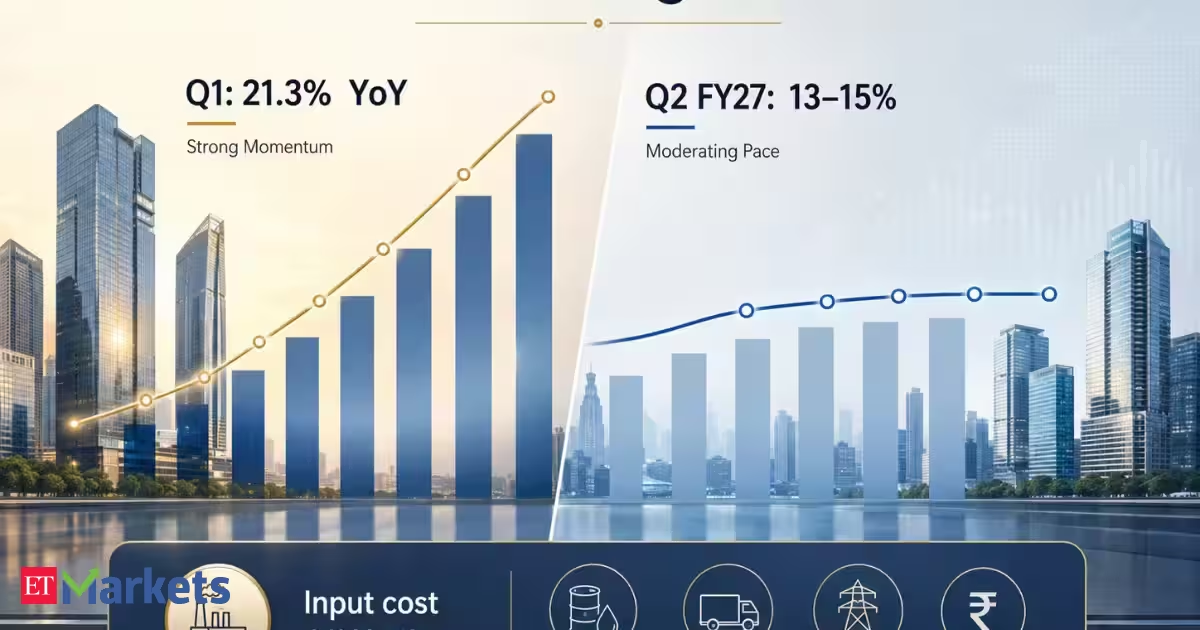
SynopsisProjected revenue growth in the organized apparel retail market is expected to reach between twelve and thirteen percent this fiscal year. This growth will be fueled by demand for value fashion and geographical expansion into smaller urban areas. Operating margins may decrease to approximately fourteen percent due to rising costs, prompting retailers to focus on inventory discipline and aware expansion strategies to maintain stable credit profiles.ANIIndia apparel retail growth seen at 12-13% in FY27 as value fashion takes centre stage: CrisilAn analysis of 41 organised apparel retailers, accounting for around 28% of the organised apparel market, by Crisil Ratings shows that India's organised apparel retail sector’s revenue growth is expected to remain healthy this fiscal, though slightly lower than the 15% recorded last fiscal, as consumers increasingly diversify discretionary spending beyond apparel. Nevertheless, strong traction in value fashion, the expansion of organised retail beyond large cities and sustained demand for branded apparel should support growth.Rising cotton prices and elevated operating costs are expected to be only partially passed through due to high competitive intensity resulting in likely compression of operating margins by about 100 basis points to ~14% this fiscal. However, credit profiles should remain stable because retailers are pursuing calibrated expansion strategies in larger cities which do not strain balance sheets. Further, expansion in smaller cities requires relatively lower capital outlay.The value-fashion/fast-fashion and mid-premium segments, which are largely priced below Rs 2,500, account for around two-thirds of sector revenue.The festive season, which has recently commenced, will be crucial to the sector's growth outlook because festive spending typically accounts for nearly 35% of annual apparel sales. Revenue growth has been broadly steady so far, in the high single digits between April and August 2026, but has largely been driven by the value-fashion segment.Says Anuj Sethi, Senior Director, Crisil Ratings, “Value fashion has emerged as the key growth driver for organized retailers, growing more than twice as fast as the other segments over the past three fiscals and increasing its share of revenue to 46% from 39%. The shift reflects increasing share of aspirational consumption by price-conscious consumers, wider choice at lower price points and increasing penetration into smaller cities. While value fashion will continue to support volume growth, the rising share of lower-priced apparel is expected to moderate organized apparel retail revenue growth to 12-13% this fiscal.”Changing consumer shopping patterns are also increasing the importance of omnichannel strategies. As shoppers move seamlessly between online and offline channels, brands are investing in digital capabilities to strengthen customer engagement and attract new customers. Although online sales account for only about 10% of total retail sales, the growing influence of e-commerce platforms is making a strong digital presence increasingly important.Even so, physical stores continue to account for the majority of apparel sales and remain the primary growth driver. Retailers are therefore expanding their footprint in underpenetrated tier-II and tier-III cities, with value-fashion players leading store additions. As these networks expand, revenue per square foot and same-store sales growth will remain key indicators of how effectively new stores are translating into revenue growth.Says Poonam Upadhyay, Director, Crisil Ratings, “Revenue per square foot has remained largely flat at around Rs 11,000 over the past three fiscals and is unlikely to improve meaningfully this fiscal because same-store sales growth remains subdued. Growth continues to be driven primarily by new store additions and the increasing share of the value-fashion segment. With rising cotton prices and elevated operating costs likely to lower operating margins somewhat to around 14% this fiscal, maintaining the balance between growth and profitability will remain critical.”As retailers expand, inventory discipline is becoming increasingly important. The rapid growth of value fashion and faster product-refresh cycles are prompting retailers to focus on quicker replenishment and more responsive sourcing. This is helping limit stock obsolescence and write-offs while supporting growth without materially increasing working-capital requirements.This, along with calibrated expansion, should support credit profiles. Capital expenditure is expected to remain around Rs 2,500 crore this fiscal, broadly in line with last fiscal, as retailers expand into newer and smaller cities. Lower store set-up costs and operating expenses in these markets should help keep debt levels in control. For our rated apparel retailers, while average gearing is expected to be range bound at ~ 1.3 times by the end of this fiscal, interest cover is likely to remain healthy at ~ 8 times during this fiscal.Key factors to watch will be the strength of festive-season demand, retailers' ability to sustain momentum in value fashion and the trajectory of cotton prices.Read More News on...moreless
India’s organised apparel retail revenue to grow 12-13% in FY27, margins may shrink: Crisil
Projected revenue growth in the organized apparel retail market is expected to reach between twelve and thirteen percent this fiscal year. This growth will be fueled by demand for value fashion and geographical expansion into smaller urban areas. Operating margins may decrease to approximately fourteen percent due to rising costs, prompting retailers to focus on inventory discipline and aware expansion strategies to maintain stable credit profiles.
754 words~3 min read