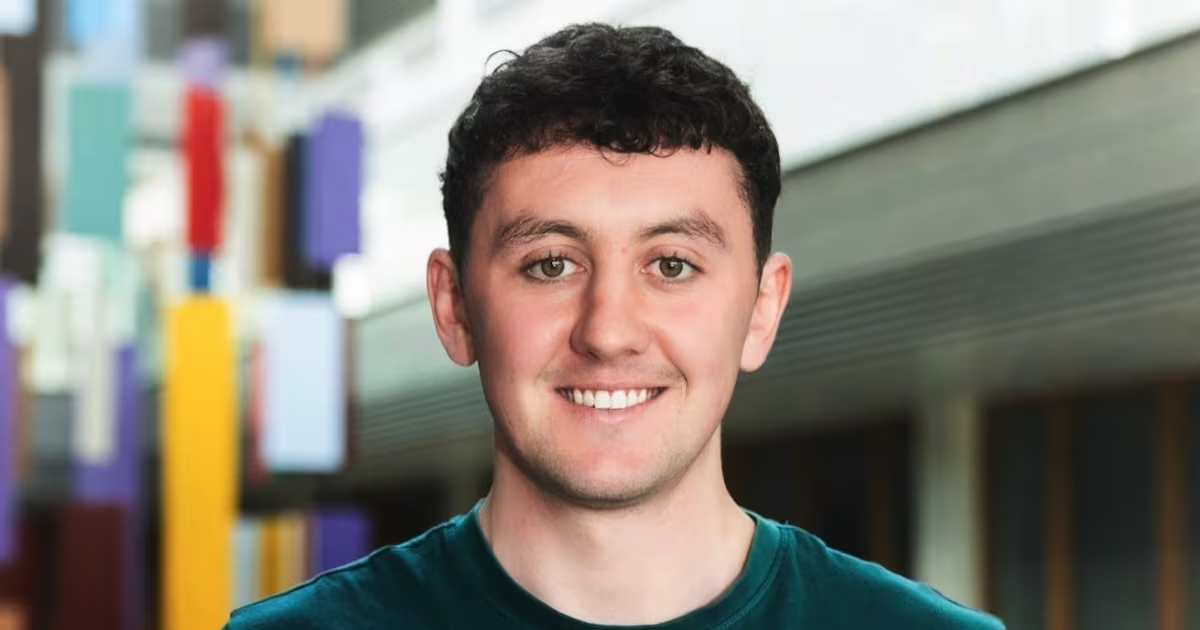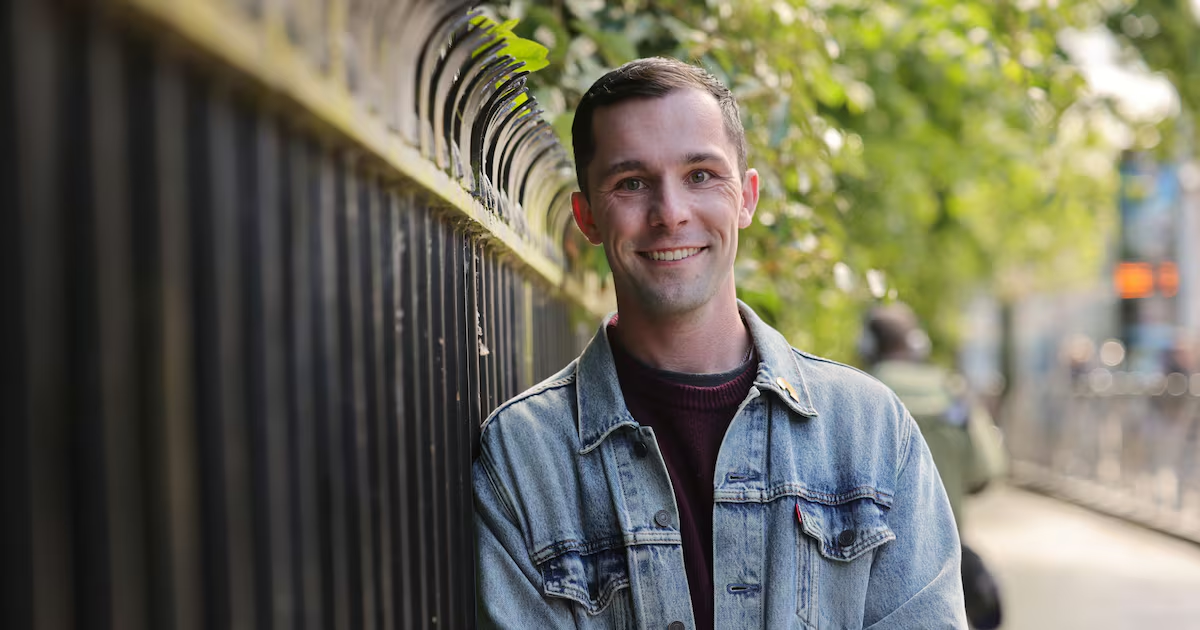
For years we’ve lamented Irish graduates who then pursue a career elsewhere in the world, either by choice and in pursuit of adventure, or by circumstance and in pursuit of opportunity.But what about the graduates from around the globe who choose to leave their home country and pursue a graduate career here in Ireland. Is life adventure-filled and rosy on the flip side of the coin?Love brought Brazilian Tomás Gonçalves Grieser to Ireland. The translation and interpretation graduate says moving to Europe was always in his sights. “It was always my plan to move away from Brazil and work, especially in Europe, given the better quality of life, especially for people who want to work in languages,” he explains.Gonçalves Grieser met his Irish partner while studying in Germany. “We are an Erasmus couple,” he says. “We’ve been together nearly six years now and I moved to Ireland to be closer to him. But also Ireland really spoke to me because, and I always say this to people, the Irish are the Brazilians of Europe ... our cultures are very similar.“Jokingly, I always pin it back to the Catholic trauma, but I just believe that there are unspoken rules of kindness, of politeness, of humility that are mimicked here better than they are in other Latin countries in Europe. “Brazilians, although we are a tad bit more direct than the Irish, we tip-toe around impolite things more so than the Portuguese, the Spanish, the French and the Italians would. I believe also, having been both colonised nations, we have a shared history of oppression, a theft of culture and identity.”Moving to Ireland was never something he planned. “I was firmly under the impression that – I did my degree in Germany and spent five years in total there – I would stay in Germany for the rest of my life. Germany is in the centre of Europe, so I always assumed that I’d find better work there.“I am part of generation in Brazil that has grown up with such a struggling economy that it is almost embedded into us from an early age, that opportunities are by default better outside of Brazil, and Europe first and foremost.”Tomás Gonçalves Grieser moved to Ireland to be closer to his partner and now works as a recruiter Gonçalves Grieser moved to Ireland last year, at the age of 25.At first, he took whatever job was available while searching for one in line with his qualifications. He works as a recruiter now “where I can more actively make use of all my languages”, he explains. “I also do some literary translation on the side, and am a freelance interpreter.”He’s very settled here, and sees his future in Ireland. “I am very happy here,” he says, though he acknowledges some of its challenges. “The recent announcement that the transportation bus fares and Luas fares would rise for example, and the quality isn’t there to be seen. There’s loads of things you could complain about, but I haven’t been this happy, outside of Brazil, with a nation ever since I moved away.”Mayank Tiwari says working in Ireland has allowed him to explore Europe Mayank Tiwari studied for his bachelor and master’s computer science degrees at home in India, where he worked for four years following his seven-year long studies, before deciding to take his graduate qualifications and pursue a career abroad.“I was mostly looking for opportunities in Europe, I’ll be honest. And mainly I was looking for something in Amsterdam – my best friend was in Amsterdam. I stumbled upon this opportunity in Microsoft, and I applied for it ... to my luck they reached out to me.”Of the opportunity to start his career in Ireland, he says, “I would call it sheer luck.”He didn’t know a lot about Ireland before the move. “I think the only exposure I had to Ireland was towards the cricket team, because I follow cricket,” he says. “I have always been quite interested in politics or religion and those kind of things.[ The Irish graduate jobs most affected by AIOpens in new window ]“So when I landed here, I started talking to a lot of people and attending meet-ups. And even though people are not usually open to talking about those things, when they are drunk they probably share more on those topics. I got to know a lot once I arrived here.”Tiwari says he was interested in learning about Ireland’s colonisation. “There is a shared history in those aspects,” he says.Tiwari travelled to Ireland alone. His parents, sibling and nephew are back in India. He met his partner since arriving, and they now live together. “It was through a Harry Potter meet-up. She is one of the co-organisers.” His partner works “indirectly” for Microsoft, he says. “She is a vendor for Microsoft.”The pandemic helped in hiring terms, Tiwari says. “After Covid there was a lot of hiring going on in software and software companies. I think in that way also I was a bit lucky. Currently, it’s not that easy.”Working in Ireland has allowed him to explore Europe and he has visited about 20 countries since moving here, he says. “I’ll be honest, Microsoft made things very easy for me, to move in and everything. I didn’t have to go through all those challenges that other people may have to go through. They helped me with everything, getting a bank account, getting a PPS number. Even finding accommodation temporarily at first, and then finding permanent accommodation.“So if someone asks me, if they are coming here to study and they ask me to share my experience, I tell them that my experience will not be useful to them, because I was brought in with a lot of privilege with Microsoft, and I acknowledge that.”He’d encourage other graduates to consider careers here too, but would remind them, luck plays a significant role.Flor Laurent found an internship in Hot Press magazine that turned into a full-time job Flor Laurent knew she wanted to study abroad. Ireland seemed a more straightforward option, being in Europe and so closer to home, as the French woman was only 17 at the time. She studied for her degree in communications and media production at Griffith College, Dublin.“I had studied English quite intensely in high school,” she says. “I don’t know if I thought I would pursue a graduate programme or pursue a job in Ireland when I was starting out.”As she went through college, Laurent felt working in Ireland may not be something that was either possible, or that she necessarily wanted. “I ended up moving back to France to do a master’s, just because it was almost free.”But while back home she realised she missed Ireland. “While I was there I was thinking it would be nice actually to go back and to not let all of this knowledge and all of this culture that I had absorbed go to waste.”I don’t think a job, the way that I found it here, through an internship, would have been realistic in France— Flor LaurentLaurent found an internship in Hot Press magazine. They “then ended up taking me in for a full-time job and I’ve been there ever since”, she explains.It is very difficult to break into journalism in France, Laurent says. And there is an expectation that you would have attended a particular school to get a job in the industry. These are schools that you would typically attend after completing a master’s. “I never wanted to stay in school for longer than I needed to. It would definitely have been difficult to get a job in France as a journalist with the level of education that I have, which is already a master’s.“Here, it’s not easy by any means, so I feel very lucky to get into the job market, which now is going to be a great help for everything. I don’t think a job, the way that I found it here, through an internship, would have been realistic in France.“In terms of my life, everything is different. My family doesn’t live near here. The culture in Ireland is quite different. The things I get to do and the things I experience, everything’s very different. I have different friends. But it’s still a very good life.”
Why did you choose Ireland? Graduates from around the world give their views
Three people from around the globe who graduated (mostly elsewhere) but decided to begin their careers in Ireland
1,381 words~6 min read