Fabio Moioli, Executive Search & Leadership Advisory at Spencer Stuart. Passionate about artificial and human intelligences.gettyA few summers ago, when Adam Grant published Think Again, I was leading consulting at Microsoft. Reading it at the time, its core thesis (that intellectual humility beats raw intelligence) felt intimately familiar. We were in the midst of a profound cultural transformation under Satya Nadella, driven by Carol Dweck’s research on growth mindsets. Our daily mantra was shifting from being a culture of “know-it-alls” to one of “learn-it-alls.” Grant’s argument that in a fast-moving world, our willingness to question assumptions, unlearn old habits and rethink fixed views matters far more than doubling down on what we think we know resonated deeply with everything we were building every single day at Microsoft. It also connected backwards to earlier chapters of my career. Years prior at McKinsey, I had learned the institutional power of the “obligation to dissent” and the discipline of hypothesis-driven problem-solving, where every initial point of view is treated simply as a strawman waiting to be stress-tested and broken. Before that, at Capgemini, one of the seven founding core values that always stood out to me as remarkably rare for a global technology firm was humility, the explicit acknowledgment that no single leader has all the answers, and that genuine innovation requires leaving ego at the door.Taking Grant’s book with me on a quiet break this summer, I opened it again with a completely different backdrop. In the few years since its release, the technological terrain under our feet has shifted in ways that felt like distant horizons back then. Today, AI generative models, reasoning engines and autonomous systems can draft strategy decks, write complex software, model business scenarios and synthesize vast libraries of cross-disciplinary research in seconds.Yet, rereading Grant’s pages against today’s AI reality made something unmistakable: Far from making human judgment obsolete, artificial intelligence (AI) turns the discipline of rethinking into our single most decisive leadership capability.Grant outlines three mental archetypes that routinely derail leaders: the preacher defending dogma against heresy, the prosecutor obsessing over destroying an opponent’s argument and the politician campaigning for consensus and approval. To escape these traps, he argues that we must adopt the mindset of a scientist: treating our convictions not as identity, but as hypotheses, and our business strategies as iterative experiments.What has changed today is friction. In the past, acting like a true scientist or maintaining a “learn-it-all” approach across a large organization was slow, politically delicate and expensive. Testing a dissenting hypothesis often required weeks of alignment meetings, internal authorizations and grueling pilot programs. Because the cost of testing was high, most managers naturally gravitated toward defending legacy strategies simply because of the sunk costs invested in them.AI collapses that friction to near zero. Before stepping into an executive meeting, a leader can now pressure-test 10 radically divergent business models in a single afternoon. You can ask a model to map out edge cases, simulate geopolitical or supply-chain bottlenecks or play through the regulatory friction of a major transformation in real time. The bottleneck is no longer computational or analytical; it is cognitive courage. If an executive approaches AI as a politician seeking applause, they will merely prompt it to validate the decision they already made. If they approach it as a scientist, they will use it to break their own thesis before the market breaks it for them.This dynamic goes straight to the heart of what I found to be the most provocative concept in Think Again: the distinction between a support network and a challenge network.Grant points out that while support networks cheer us on, challenge networks push us to confront our blind spots. At Spencer Stuart, where we advise boards and CEOs on executive talent and leadership succession, we see this dynamic play out constantly: The defining vulnerability of senior leaders is rarely a lack of technical competence; it is the progressive isolation from meaningful challenge. As leaders rise, their challenge networks shrink. Hierarchy naturally softens dissent, and deference often muffles the very feedback an executive needs most.This is where AI acts as a profound cognitive amplifier. An AI model is an ego-free, tireless, instantly available sparring partner. It has no career ambitions, no fear of speaking truth to power and no incentive to sugarcoat bad news.The trouble is that most people still interact with generative AI as an over-enthusiastic support network, asking the machine to refine an existing proposal, polish an executive summary or assemble data supporting a predetermined conclusion. The real leverage begins when you explicitly instruct it to be your chief skeptic: “Here is my operating thesis. Act as our most aggressive adversary and identify the three fatal assumptions in this model.” Or, you can direct it to: “Write a comprehensive pre-mortem detailing why this initiative collapsed 18 months after launch.”By deliberately inviting dissent, you force yourself off what Grant calls “Mount Stupid,” that treacherous peak on the Dunning-Kruger effect (another concept I just love) where a shallow grasp of a new subject creates an illusion of complete mastery. AI can map the true depth and nuances of an unfamiliar domain in minutes, exposing precisely how much you don’t know before high-stakes capital is deployed.People extracting genuine value from AI treat the interaction as an iterative, multiturn inquiry. They ask targeted follow-ups, test boundary conditions, probe for edge cases and listen carefully to the output to catch flawed logic or subtle hallucinations. In an environment where synthetic answers are a commoditized utility, intellectual leverage has moved entirely upstream to the caliber, nuance and curiosity of our questions.Looking back, I realize that my own professional path was probably shaped, perhaps even subconsciously, by this exact pursuit across every organization I chose to join: Ericsson’s engineering culture of testing failures, McKinsey’s institutionalized obligation to dissent, Capgemini’s grounding in humility, Microsoft’s insistence on growth mindset and, today, Spencer Stuart’s approach, where the ultimate measure of executive potential is not having all the answers, but possessing the self-awareness, curiosity and adaptability to constantly question them.Forbes Technology Council is an invitation-only community for world-class CIOs, CTOs and technology executives. Do I qualify?
Rethinking 'Think Again' In The Age Of AI
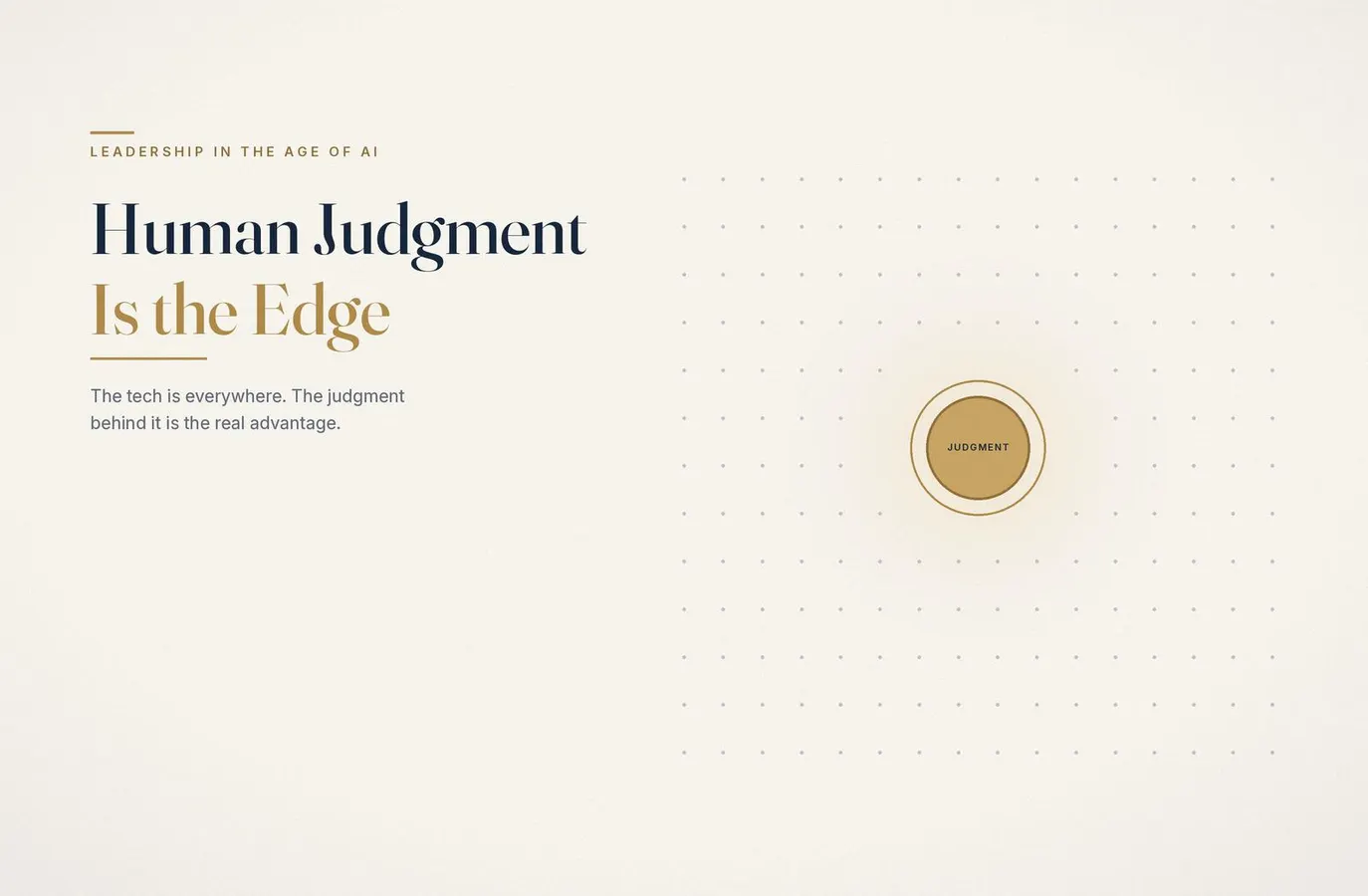
Far from making human judgment obsolete, artificial intelligence turns the discipline of rethinking into our single most decisive leadership capability.
TL;DRAI
Moioli argues AI collapses hypothesis-testing friction from weeks to hours, establishing rethinking as the decisive leadership capability. Tech leaders should deploy models as skeptic—not validator—to pressure-test assumptions before market competition exposes flaws.
1,020 words~5 min read