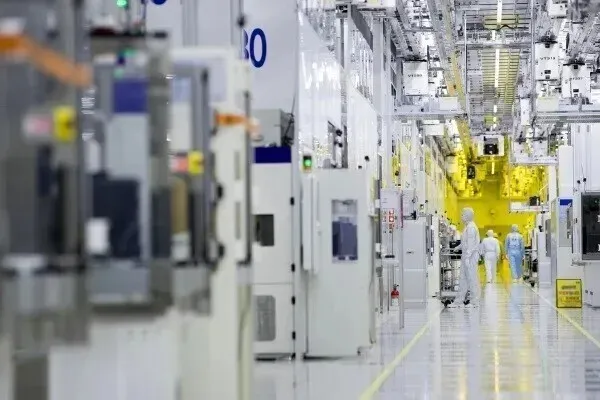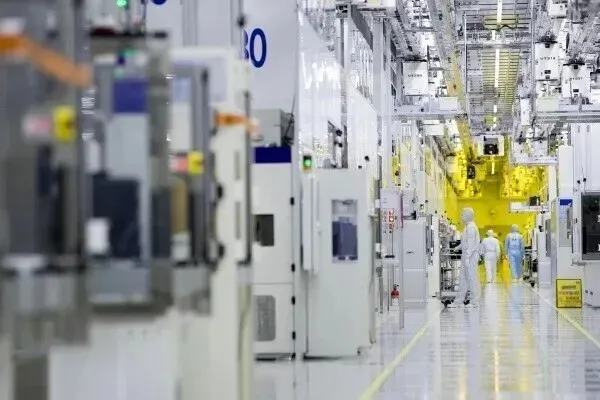
A semiconductor production line. (courtesy of Samsung Electronics)
Korea’s nominal GDP surged 26.4% year on year in the second quarter, its fastest growth in 47 years, fueled by a boom in semiconductor exports.Per capita national income is also predicted to easily exceed US$40,000 this year.On Tuesday, the Bank of Korea (BOK) issued a provisional report on national income for the second quarter. The figures, which showed a 0.6% increase in real GDP from the previous quarter and a 3.7% rise from the same period in 2025, echoed previously announced estimates.Nominal GDP was found to have risen by 9.2% from the first quarter. It also increased by 26.4% from the second quarter in 2025 — its highest rate in the 47 years since the third quarter of 1979, when it reached 27.7%.“Despite the impact of war in the Middle East, rising global artificial intelligence investment and semiconductor-related exports have driven powerful growth during the first quarter and into the second,” said Kim Hwa-yong, the director of the national income division at the BOK.“Increased profitability, especially among semiconductor businesses, appears to have led to increased operating profits that have translated in turn into rises in government income [tax revenues] and household income,” Kim added.In terms of areas of economic activity, real GDP in manufacturing for the second quarter showed a rise of 1.4% from the previous quarter and 6.7% from the same quarter in 2025, with particular increases in the areas of computers, electronics and optical instruments.Construction showed a decline of 1.9% (3.8% from the second quarter in 2025) with a reduction in civil engineering activity. Services showed an increase of 1.0% (3.4%) with particular improvements in wholesale and retail sales, hospitality and restaurants, finance and insurance, and information technology.In terms of expenditure, private consumption showed a rise of 0.4% from the previous quarter and 2.4% from the same quarter in 2025, with increased consumption in both goods and services. Government consumption rose by 0.1% (2.1%), with increased expenditure on health insurance remuneration.Construction investment fell by 0.1% (1.2%), while equipment investment increased by 0.2% (6.3%), with particular growth in machinery (including machinery for semiconductor manufacturing). Intellectual property investment rose by 3.4% (5.0%), with significant increases in research and development and software.Exports were up by 1.3% (8.9%), with rises for semiconductors, machinery and equipment. Imports rose by 0.7% (6.2%), with particular increases in automobiles, machinery and equipment.According to the BOK’s analysis, the large increase in nominal GDP was attributed to an 18.5% rise in the gross operating surplus (compensation for capital and management) compared with the preceding quarter, with particular growth in manufacturing, finance and insurance. Compensation for labor showed an increase of 1.9%, a trend driven by manufacturing.Real gross national income (GNI) was up by 3.1% from the previous quarter and 15.6% from the same period in 2025. This was the highest year-on-year rate of increase since the fourth quarter of 1988, when the rate reached 15.7%.As in the first quarter, the fact that the rate of increase for GNI was significantly higher than for GDP was interpreted as stemming from improvements in trade conditions specifically for the semiconductor sector, with the rise in export prices exceeding the rise in import costs. Nominal GNI was found to be up by 8.8% from the previous quarter and 26.4% from the same quarter last year.The gross savings ratio stood at 45.6%, up by 3.9 percentage points from the previous quarter and the highest level since related statistics were first announced in 1970. The BOK attributed the rise in the savings rate to the fact that the 8.9% rate of increase in gross national disposable income exceeded the 1.6% rate for final consumption expenditures.With the rise in the saving rate signifying increased consumption capabilities, the bank predicted it would have a positive effect on future consumption and investment.The BOK forecast that if current trends continue, Korea would easily reach the 3.3% projected economic growth rate for this year, as well as a per capita national income of US$40,000.“The level right now is one where we could achieve a 3.3% annual growth rate with growth in the 0.2%-0.3% range during the second half of this year,” said Kim. “The likelihood that per capita national income will surpass US$40,000 this year — provided there are no unexpected shocks — has increased greatly,” he added.Commenting on the possible impact on exports from the declining won-to-dollar exchange rate, Kim said, “The exchange rate affects imports as well as exports, so there will be some balancing out.”He also predicted that “exchange rate effects will be limited amid the ongoing supply shortage relative to demand in the area of semiconductors,” which have been driving exports.By Kim Young-bae, senior staff writerPlease direct questions or comments to [english@hani.co.kr]