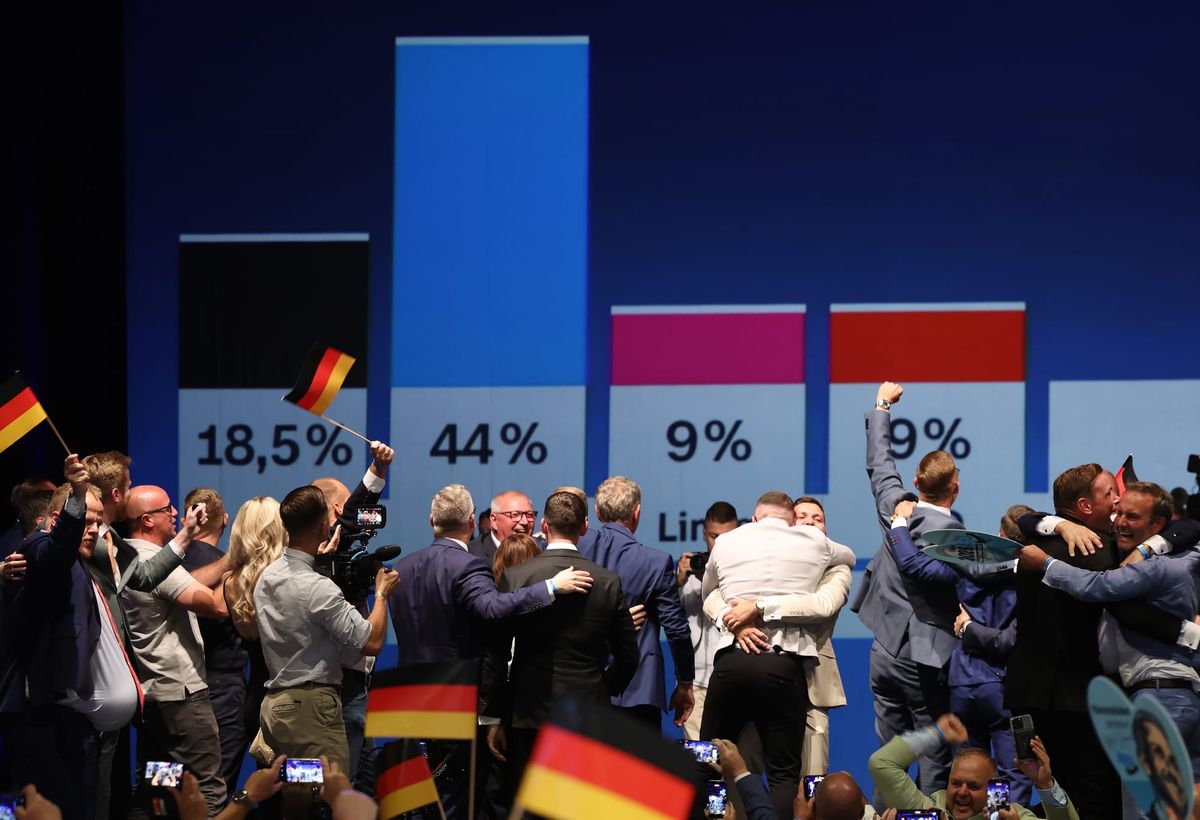
The AfD’s victory in Saxony-Anhalt has roots specific to eastern Germany. But the economic insecurity behind its rise is increasingly visible across the country.
The far-right Alternative für Deutschland (AfD) has just won 43.8 per cent of the vote in Saxony-Anhalt. The conservative Christian Democratic Union, which has governed the state for most of the period since reunification, came a distant second with 17.2 per cent.
For a country still associated abroad with political stability, strong industry and comparatively high living standards, such a result may seem surprising.
Yet the past few years have left deep marks on the German economy. Real economic output has barely grown, industrial production has weakened, and households have suffered a substantial loss of purchasing power. Indeed, real wages only recently recovered their pre-pandemic level. For an average household of four people, the economic losses relative to the pre-crisis trend amount to €12,000 per year.
It is hardly surprising that these developments have led to shifts in the political mood. At the 2025 federal election, the AfD doubled its national vote share. Its support remains much higher in eastern Germany, but the party also made substantial gains in the west. Meanwhile, the mainstream parties have struggled to offer a convincing response to stagnation, industrial uncertainty and the rising cost of living. The federal government has largely stuck to the familiar language of competitiveness, structural reforms and spending restraint, while cutting civilian spending as military expenditure rises.