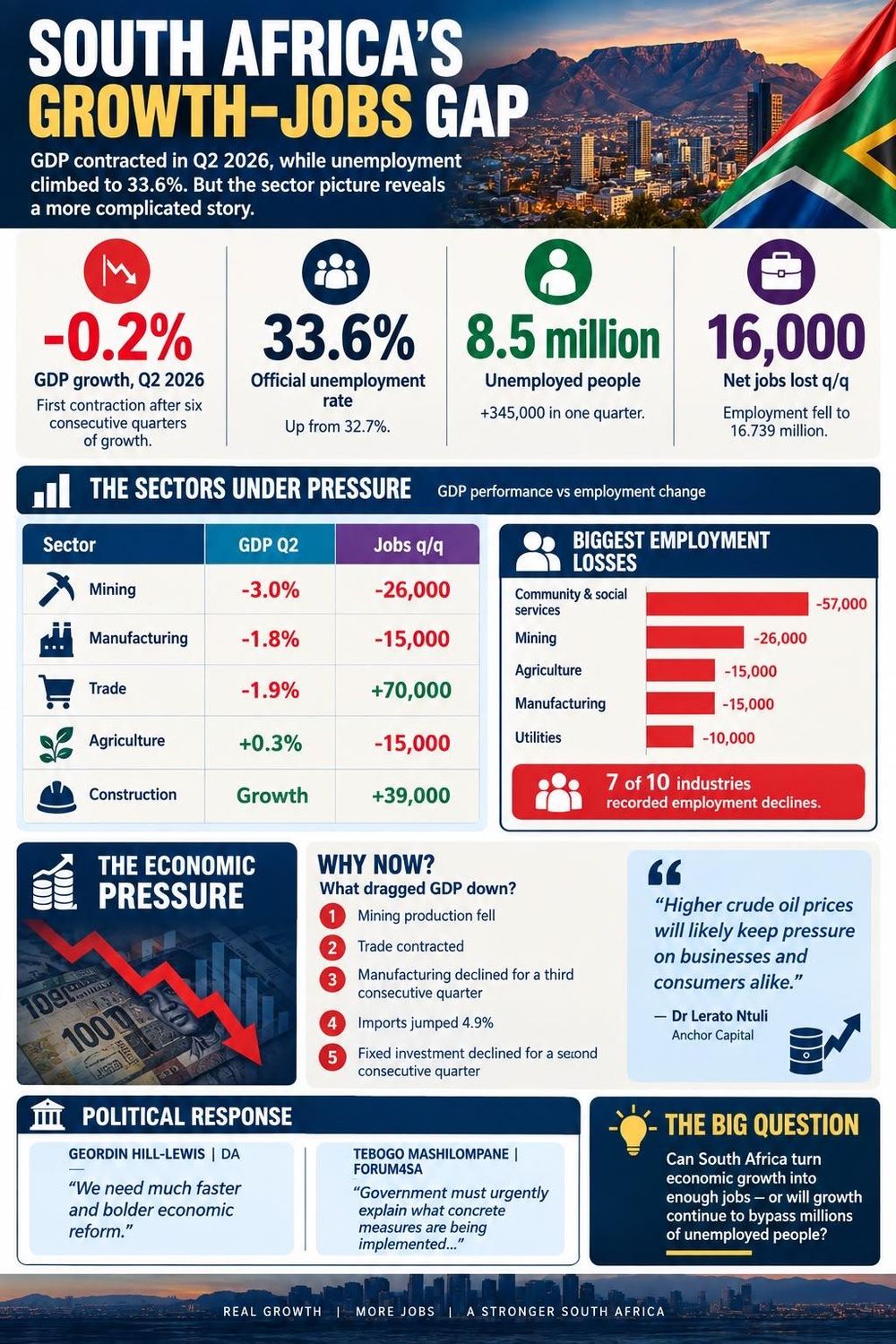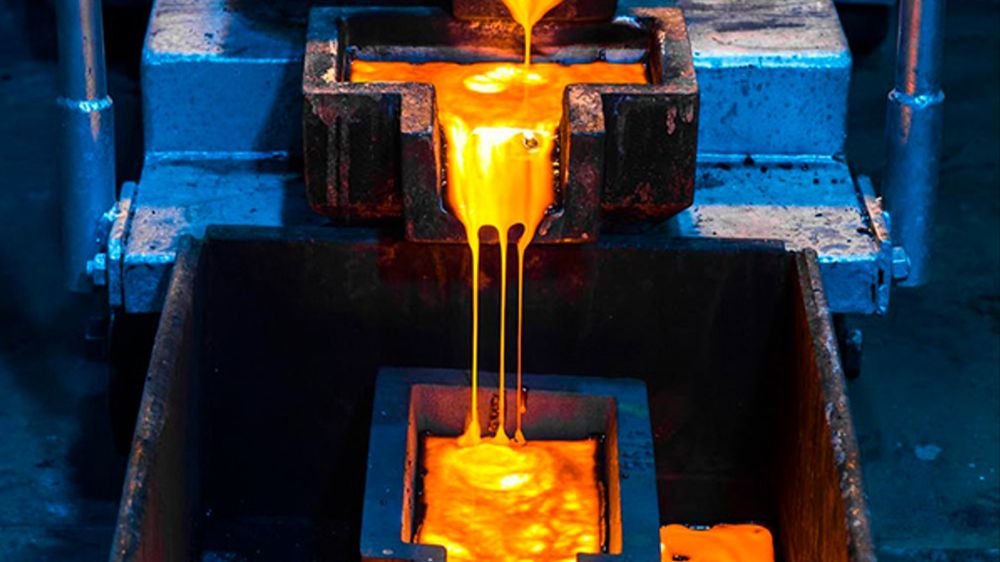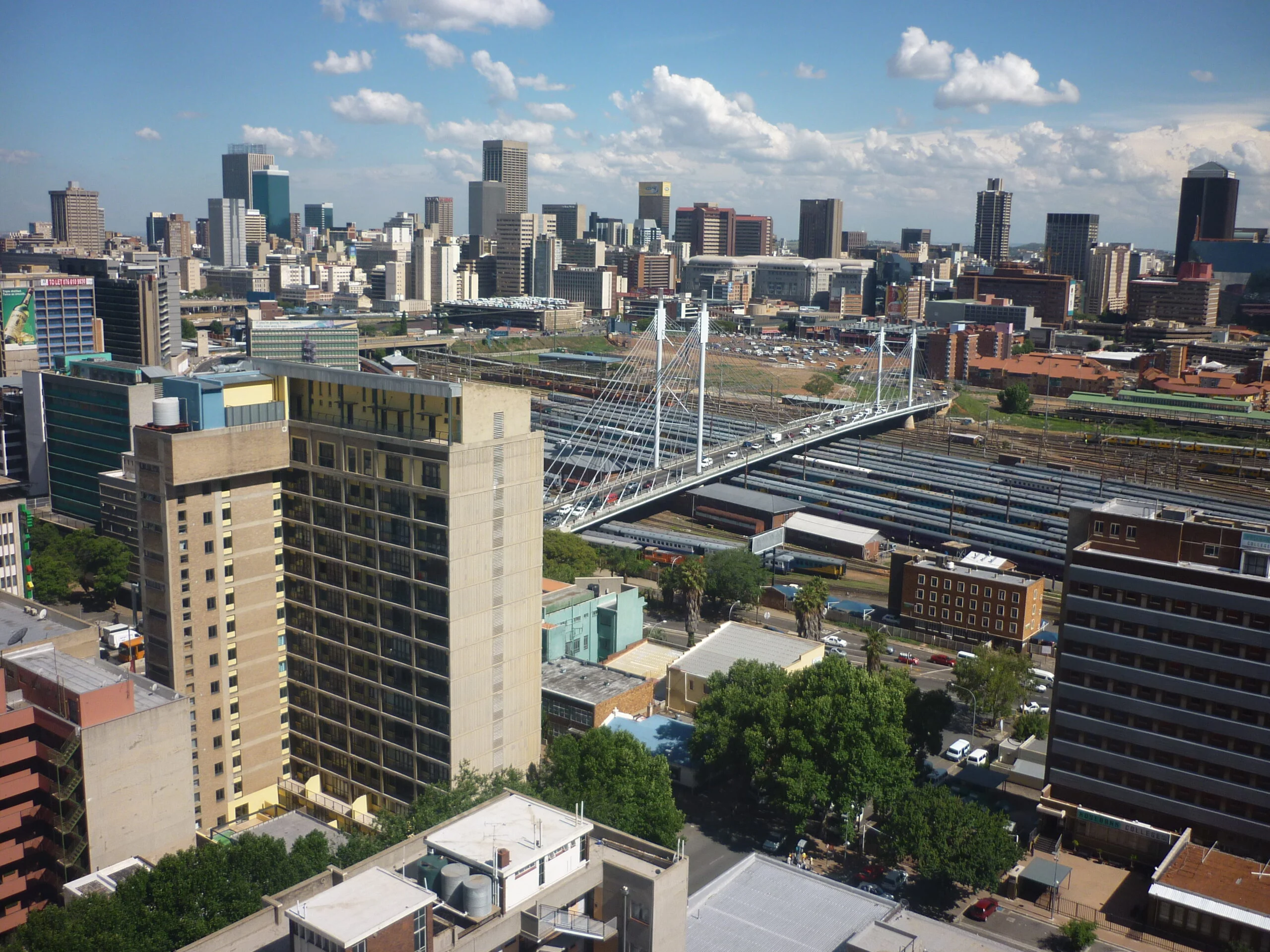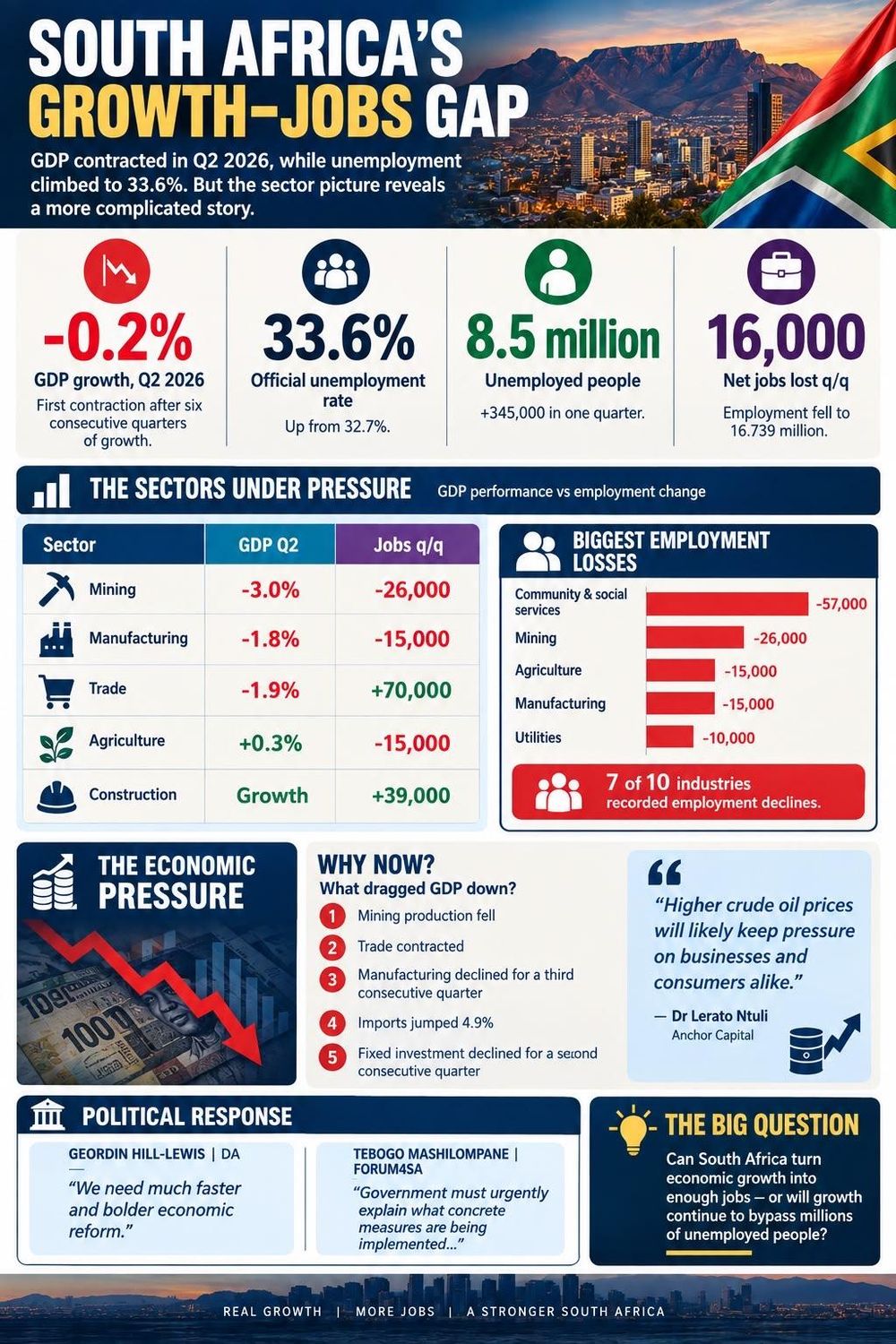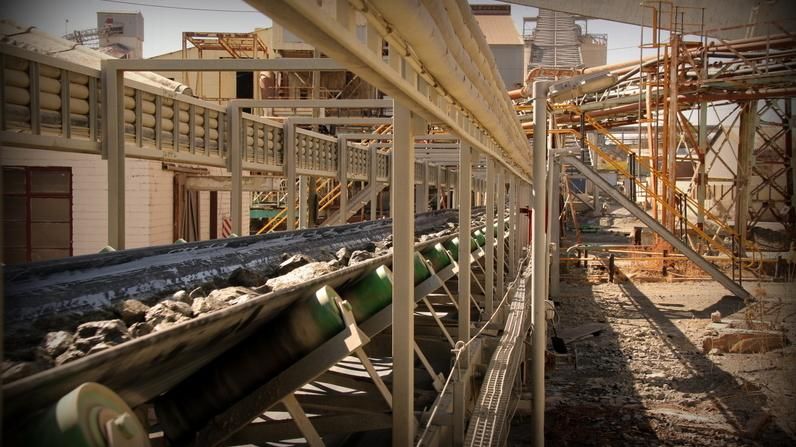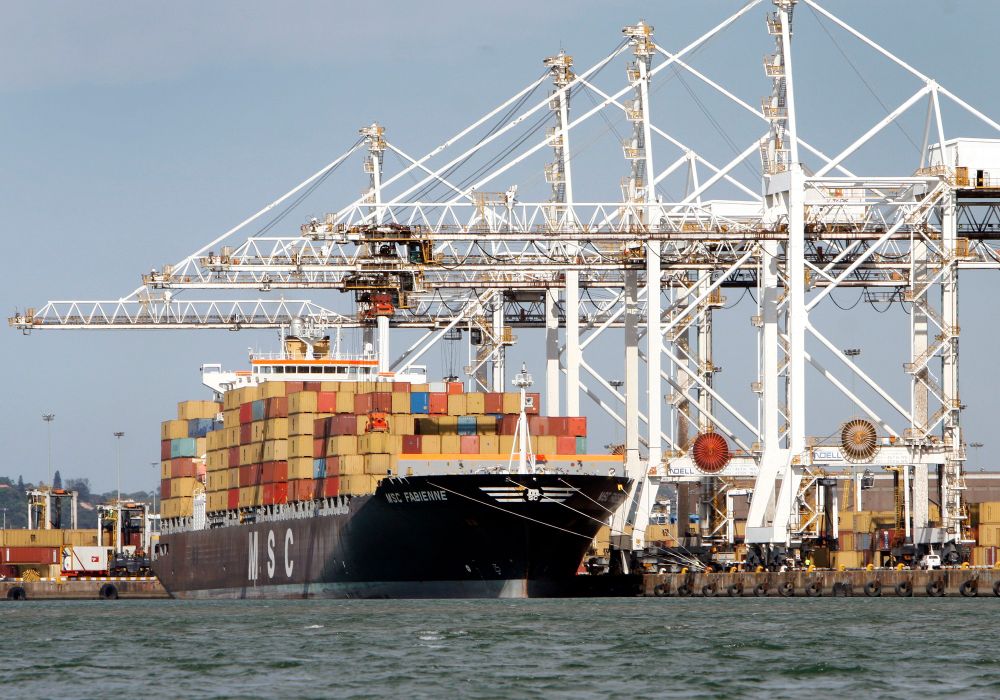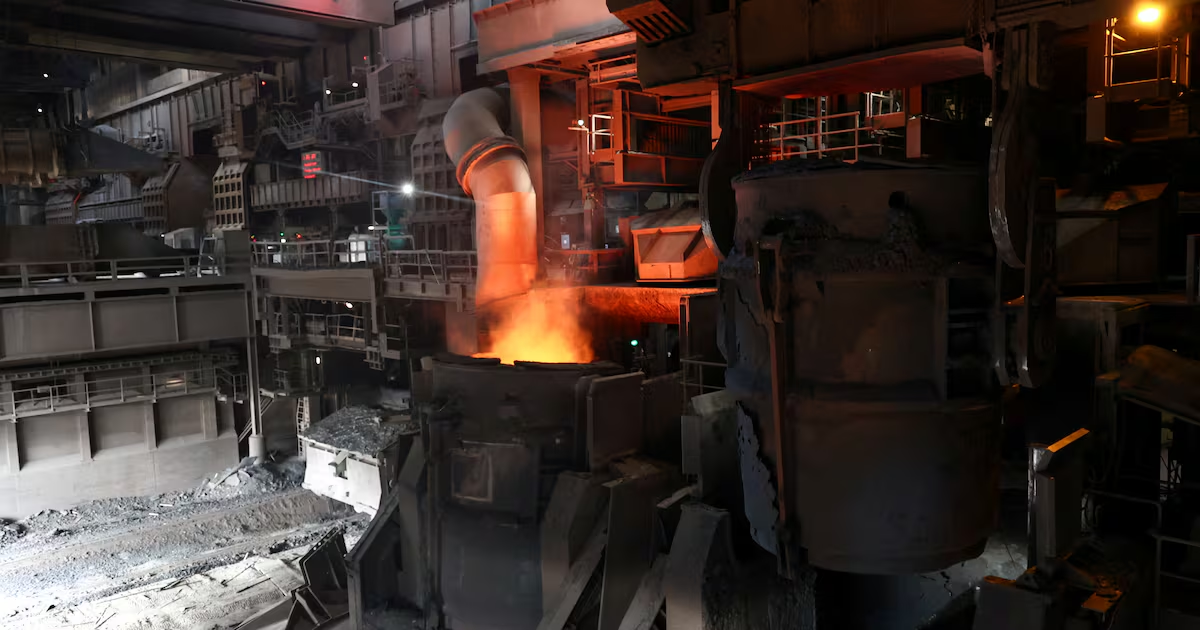
A slump in the trade, catering and accommodation sector, as well as key manufacturing and mining industries, led to South Africa’s first GDP contraction in six quarters, as the economy faces headwinds from geopolitical tensions and weak domestic demand.The second-quarter decline, which comes after recent reports showing consumer and producer inflation slowed in July, gives the South African Reserve Bank (SARB) scope to keep interest rates unchanged at its fifth policy meeting later this month and ease pressure on households whose consumption has traditionally been a key growth driver.Economists had predicted GDP would either be flat or even shrink slightly in the second quarter, after high-frequency data pointed to weakness, particularly in manufacturing and mining, which account for about 12% and 7%-8%, respectively, of national output, with extensive linkages to other parts of the economy.Tuesday’s data from Stats SA confirms that manufacturing shrank 1.8%, with seven of the 10 divisions reporting declines, while output in the mining and quarrying industry fell by 3%, the largest negative contributors being platinum group metals, manganese ore, gold and iron ore. The trade, catering and accommodation industry decreased by 1.9%.The finance, real estate and business services industry was up 0.3% while transport, storage and communication added 0.9%.On the expenditure side of economic activity, household final consumption increased by 0.4% while expenditure by the government was up 0.4%. However, gross fixed capital formation — the value of acquisitions of fixed assets in the economy minus disposals — decreased by 0.2%. South African industries and households have for most of the year to date suffered the effect of higher costs stemming from a surge in fuel prices due to the war between the US and Iran, which has disrupted the flow of cargo through the Strait of Hormuz.The second quarter contraction, after lacklustre growth of 0.4% in the first quarter, suggests South Africa will not meet the National Treasury’s 1.6% expansion target for 2026.“The evidence points to an economy in which recovery has been interrupted and delayed, rather than definitively derailed. A plausible central forecast is now about 1.2% real GDP growth in 2026,” North-West University Business School economist Raymond Parsons said.“Better growth prospects remain vulnerable to renewed Middle East escalation, weak fixed investment, borrowing costs and policy uncertainty. Domestic policy must therefore still act to mobilise available tailwinds and reinforce a resumed economic momentum.”Read: Farming confidence is back, but El Niño threatens the reboundThe weak GDP outcome reinforces the difficult trade-off facing the Reserve Bank at its two remaining policy meetings of the year, FNB economist Thanda Sithole said.The Bank hiked its benchmark policy rate by 25 basis points to 7% in May as second round inflationary effects started to emerge from the spike in global oil prices stemming from the war, but kept rates unchanged in July. It will announce its next rate decision on September 23 against the backdrop of consumer inflation slowing to 4.5% in July from 5% in June, though it still remains far above the 3% target.“On the one hand, the economy remains weak, with growth still well below the rate required to make a meaningful dent in unemployment and improve household incomes. The moderation in 2Q26 therefore argues against a further tightening in monetary policy,” Sithole said.“On the other hand, the recent inflation shock means the SARB cannot respond mechanically to weaker growth. With the inflation target now centred on 3%, the monetary policy committee will need to assess whether the recent increase in inflationary pressures is temporary or likely to become embedded.”Business Day
How GDP contraction puts the Reserve Bank in a bind over rates
Reserve Bank could weigh interest rate pause as GDP shrinks for first time in six quarters
585 words~3 min read