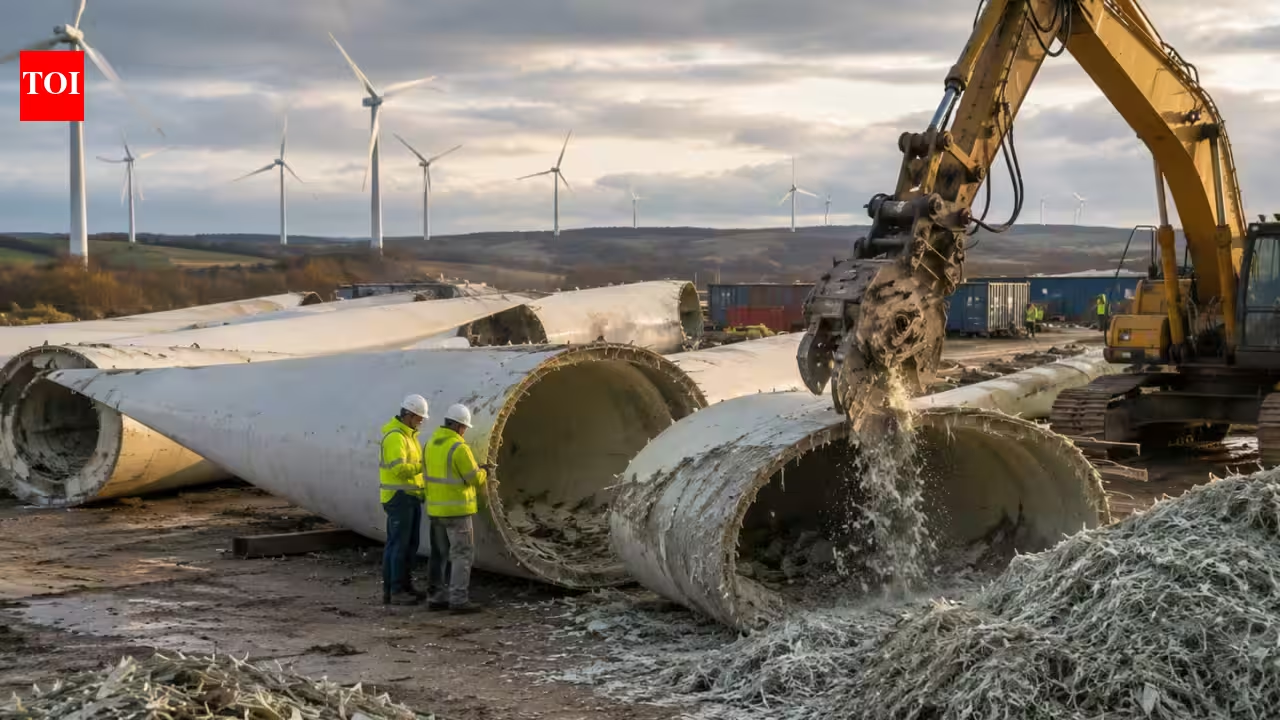
In 2025, Washington State researchers recycled wind-turbine blade waste into plastic; up to 70% of recovered GFRP was reused, while 83.5% of the resin matrix was degradedSynopsisInnovative researchers have unveiled a groundbreaking chemical technique to recycle decommissioned wind turbine blades. This process effectively decomposes the composite materials into usable plastic fragments that are stronger and stiffer than standard nylon. Such advancements serve as a vital answer to the increasing challenge of blade waste, with future designs potentially prioritizing recyclability right from their conceptual stages.Listen to this article in summarized formatRecycling discarded wind-turbine blades (representative image). Image Credit: ChatGPTWind turbines are built to last for decades, but the blades that power them create a waste problem that the industry has not solved. In 2025, researchers at Washington State University developed a chemical process that breaks down retired blade material and turns it into plastic that is stronger than what it replaced, according to the university's Office of Research.Why wind turbine blades are hard to recycleWind turbine blades are made of thermoset composites, meaning they are cured during manufacturing and cannot be melted down and reformed like most plastics. Most common plastics, such as the high-density polyethylene (HDPE) used in milk jugs, can be melted down and remade relatively easily. Blades do not have that option. The glass fiber-reinforced polymer, or GFRP, in the blades is designed to resist wind and weather, and it remains durable long after the turbine has retired from service. GFRP accounts for roughly two-thirds of a blade's total weight, an estimate WSU researchers cite in their published findings. The first generation of modern, utility-scale wind turbines built in the 1990s is now reaching the end of its expected service life, adding urgency to the disposal question. The U.S. Department of Energy has documented the scale of the challenge. A DOE assessment found that the country's current recycling infrastructure can process about 90% of a retired wind turbine's total mass, with blades remaining among the most difficult components to break down.How WSU researchers broke down the blade materialRather than burning away the resin, researchers chopped the GFRP waste into two-inch blocks and then into smaller chips, soaking them for about two hours in a mixture of zinc acetate solution and water under high pressure and temperature, according to the WSU Office of Research. Zinc acetate is a low-toxicity organic salt used in medicines, including throat lozenges, and as a food additive. Because the compound is already handled safely at scale in other industries, the method could be practical and cost-effective if scaled up for commercial use. The researchers did not need to break every chemical bond in the material to make it usable. In addition, they did not need to separate the resin from the glass fibers before reuse. Instead, the scientists broke the cross-linked polymer into smaller pieces that could be melted and mixed with new plastics without first isolating the fiber from the resin, the research team said. Wind-turbine blade waste is processed into recycled GFRP and injection-molded plastic containing 70% recycled material, according to Washington State University.Wind-turbine blade waste is processed into recycled GFRP and injection-molded plastic containing 70% recycled material. Image Credit: Washington State UniversityThe strength gains behind the recycled plasticThe findings, published in the journal Resources, Conservation and Recycling, show the chemical process degraded up to 83.5% of the resin matrix, breaking it into smaller, meltable fragments without fully separating it from the glass fibers. The fibers and decomposed resin were then recovered together and incorporated into new thermoplastic composites, with recycled material making up as much as 70% of the resulting composite by weight. When the researchers blended the recycled material with nylon, the resulting composite was more than three times stronger and more than eight times stiffer than pure nylon, according to WSU. The team also found that the recycled composite could be mixed with other common plastics, including polypropylene (PP), which is often used for shampoo bottles and similar consumer goods, distinct from the HDPE typically used in milk jugs.Cost and scalability of the recovery methodA recycling process can only scale if it is affordable to run. Another advantage of the WSU approach is that the zinc acetate solution was recovered by simple filtration and reused in later cycles instead of being discarded after one use. Reusing the solution instead of discarding it may help reduce cost and waste if the process is scaled up for factory use. The Department of Energy's Office of Energy Efficiency and Renewable Energy funded the work. The DOE has separately reported that thermoplastic-based recycling technologies, including chemical dissolution methods like the one WSU used, could serve as viable medium- and long-term options for the wind industry as a whole.What comes next for blade recyclingThe WSU team is now working to simplify the process further by reducing its pressure requirements. Researchers are also partnering with the university's Office of Commercialization, according to WSU, to design future blades that are recyclable from the start, rather than needing to be retrofitted after decades of use.The WSU study demonstrates, with mechanical test data, that recycled wind-turbine blade material can be blended into nylon composites that are more than three times stronger and eight times stiffer than pure nylon.Read More News on(Catch all the US News, UK News, Canada News, International Breaking News Events, and Latest News Updates on The Economic Times.) Download The Economic Times News App to get Daily International News Updates....moreless
In 2025, Washington State researchers recycled wind-turbine blade waste into plastic; up to 70% of recovered GFRP was reused, while 83.5% of the resin matrix was degraded
Innovative researchers have unveiled a groundbreaking chemical technique to recycle decommissioned wind turbine blades. This process effectively decomposes the composite materials into usable plastic fragments that are stronger and stiffer than standard nylon. Such advancements serve as a vital answer to the increasing challenge of blade waste, with future designs potentially prioritizing recyclability right from their conceptual stages.
905 words~4 min read