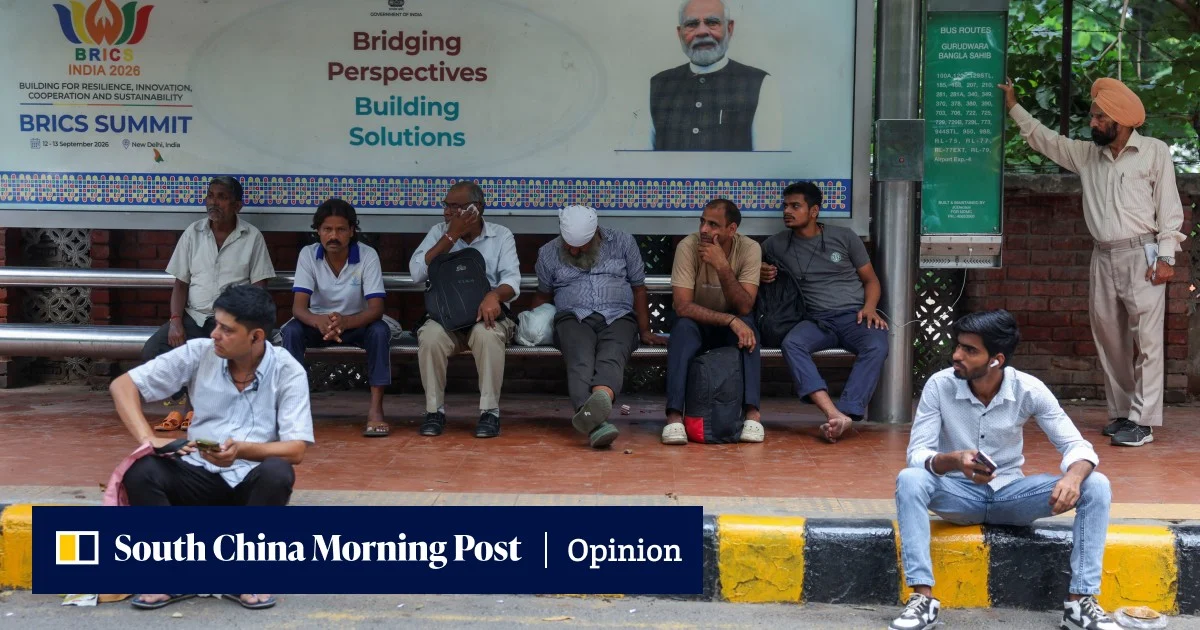
BRICS was not meant to be an economic union at all but to be a sovereign driven diplomatic bloc that aims to seek a more multipolar world
| Photo Credit:
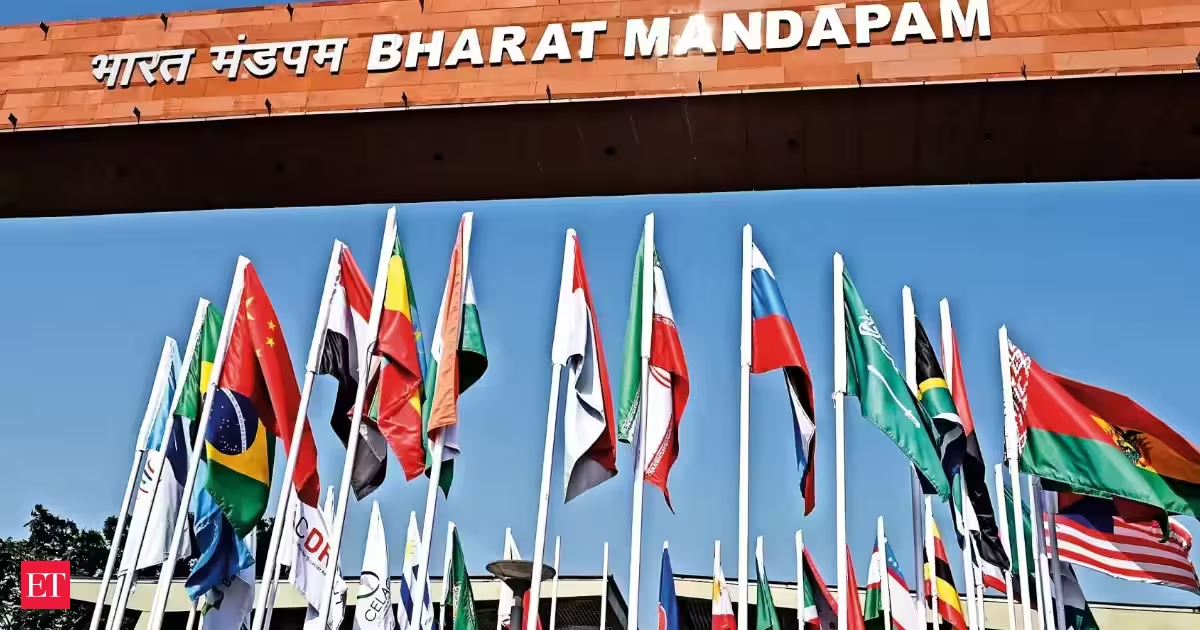
The 2026 BRICS summit is all set to take place in New Delhi from September 11 to 13. BRICS has expanded its membership and now represents a larger share of the global economy in PPP (purchasing power parity) terms than the G7. Member-countries describe the bloc as a forum for multipolarity and shared prosperity. However, despite the carefully managed proclamations, something odd is going on. Intentionally or otherwise, BRICS countries are causing inflation, losses of export revenues, and growth stagnation to their partners. It would unfair though, to not mention what the BRICS has built. For instance, its $100-billion Contingent Reserve Arrangement (CRA), established in 2014, provides balance-of-payments support during financial stress. But the CRA does not monitor or coordinate the currency, commodity and inflation spillovers members impose on one another. BRICS therefore has crisis-response tools but no comparable surveillance mechanism.Nearly two decades on, BRICS has no common mechanism for members to flag or discuss economic damage arising from another member’s policies. So, it has ended up as an ‘economic family’ without the ‘family spirit’ needed for solidarity. The consequences of this institutional gap are already visible in how members’ domestic economic decisions spill across BRICS borders.One example is China’s management of the yuan to support exports. The yuan has weakened repeatedly during periods of economic stress, including during the 2018-19 US-China trade war. Such depreciation affects Indian and Brazilian manufacturers competing in the same markets. By contrast, the European Union has institutional forums through which cross-border monetary effects can at least be acknowledged and debated; BRICS has no equivalent mechanism. While a currency devaluation transmits cost shocks through exchange rates, commodity overlap transmits them directly through the global price of identical goods. Among the members of BRICS+, several major exporters compete in overlapping markets. This creates structural conflicts of interest among members in their export strategies, as illustrated in the Table.This contradiction became evident when Saudi Arabia and the UAE joined BRICS in 2024, making the group home to three major oil producers. The discounted oil offered by Russia since 2022 is illustrative of how one member can defend market share at the cost of another. This spillover can also work in the other direction via imports between members. India imports up to $132 billion of goods a year from China, which is a major channel for the Chinese cost pressures to enter the Indian economy.Rising production costs in China, whether due to wages, energy or supply disruptions, can increase costs for Indian importers, which can trickle down to domestic prices. But BRICS has not measured nor addressed these externalities of inflation. These asymmetries are not unique to China, but occur wherever a member of the BRICs has a significant economic size imbalance and trade dependence. These coordination gaps are more significant when considering the efforts to increase trade and settlement in members’ national currencies.The de-dollarisation paradoxDe-dollarisation is sometimes described as a route to financial freedom. However, it can also give rise to new financial fragilities, unless robust institutions are in place. Despite the distortions associated with dollar dominance, deep dollar markets have historically reduced some of the exchange-rate frictions involved in international trade. Greater use of national currencies, however, exposes trade to thinner bilateral currency markets. Currency pairs characterised by low trading volumes, limited liquidity, and wide bid-ask spreads, such as rupee/rouble, tend to experience greater exchange-rate volatility.In the absence of deep and liquid foreign-exchange markets, economic shocks are more likely to generate sharp currency fluctuations, increasing uncertainty for traders and investors. As a result, inflationary and other macroeconomic shocks originating in one member economy can be transmitted more unevenly and with greater intensity to its trading partners. The argument, therefore, is not against local-currency trade; it is against pursuing de-dollarisation without the monetary coordination needed to manage its spillovers. The dollar meanwhile still accounts for roughly 47-49 per cent of SWIFT-processed payments, illustrating the scale that alternative settlement systems must still match.Economic spillovers are not unique to BRICS; inflation, exchange rates, commodity prices and monetary policies inevitably cross borders. The real difference is that successful economic groupings eventually built institutions to manage them. The EU developed monetary coordination, while ASEAN+3 created mechanisms for macroeconomic surveillance and dialogue. BRICS was not meant to be an economic union at all but to be a sovereign driven diplomatic bloc that aims to seek a more multipolar world. That was a design which allowed for political cooperation without any deep economic coordination. This creates increasing economic interdependence, but no institutions to control costs.But the solution to these problems does not merely involve the creation of a BRICS central bank, a common currency, or even any diminution of national sovereignty. What it does involve is a realisation that economic interdependence is both a source of opportunity and obligation. ASEAN+3’s Economic Review and Policy Dialogue offers a workable model, a macroeconomic surveillance without requiring members to surrender monetary sovereignty. BRICS could attach a comparable function to its existing finance ministers’ track. It could begin with a non-binding annual spillover report tracking how members’ currency, commodity and trade decisions affect one another. Such consultation and spillover monitoring would help members anticipate and manage the costs they impose on one another. Closing this gap will not come from reducing reliance on Western institutions, but from finally building the coordination machinery.The writer is doctoral student in management, National Institute of Technology RourkelaPublished on September 8, 2026