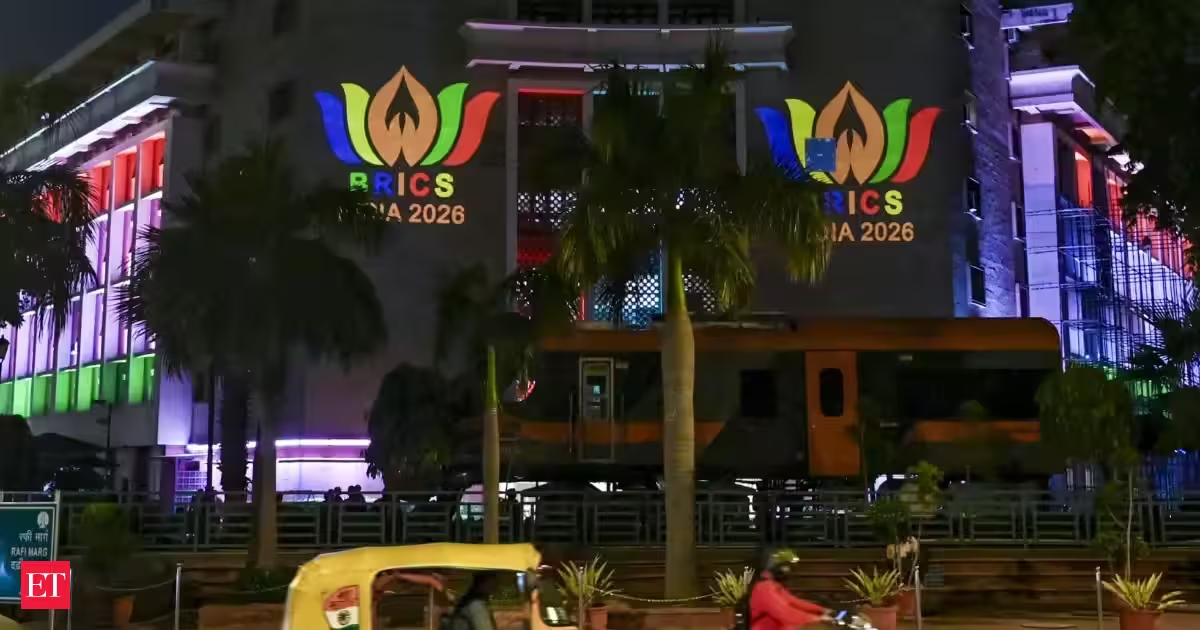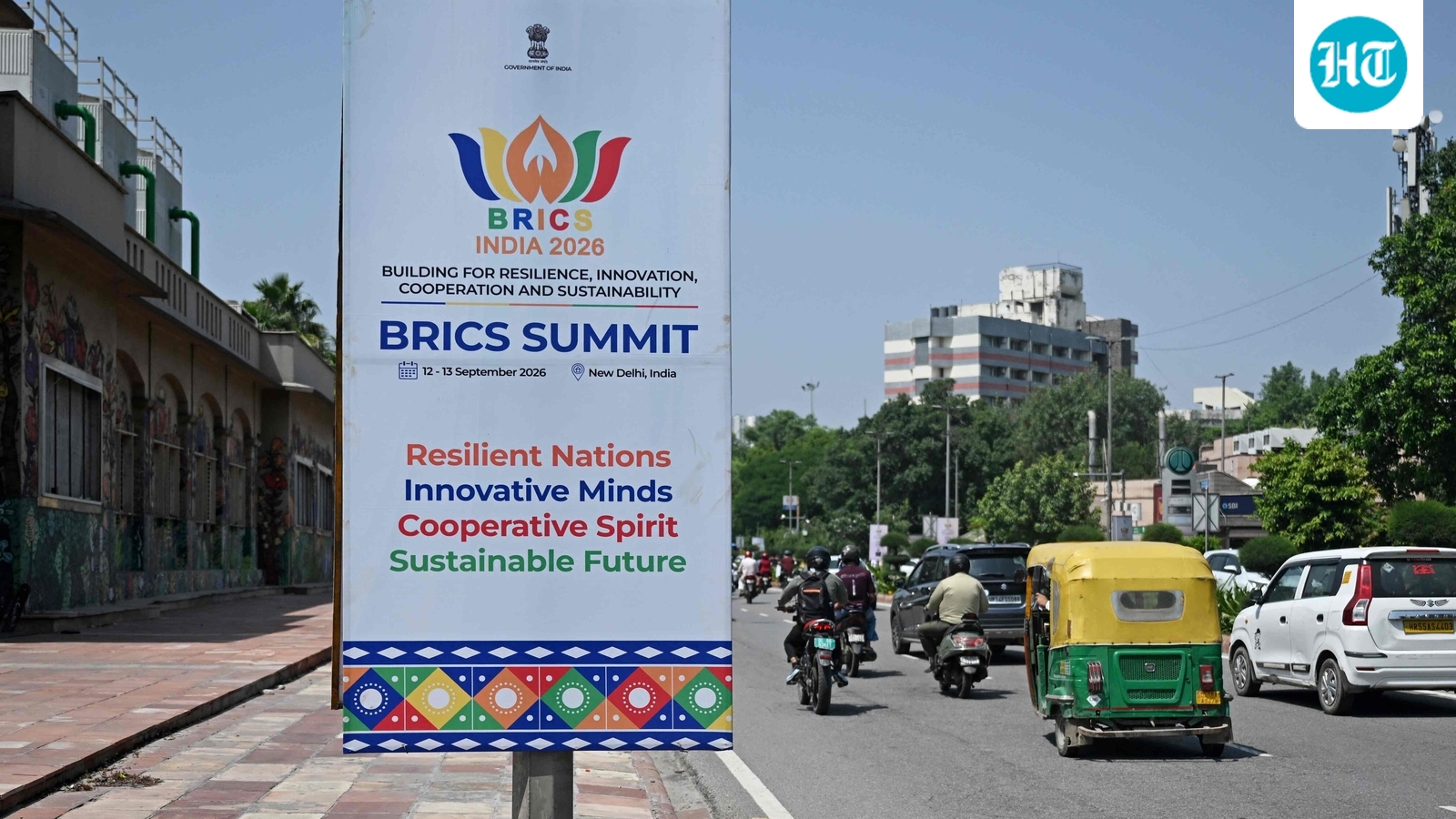
What has happened to the global economic convergence story? How relevant is a group like the BRICS today?Prefer HTon Google The 18th BRICS Summit will take place in New Delhi on September 12 and 13. When BRICS came into shape -- its first conference was held in Russia in 2009 with Brazil, Russia, India and China participating; South Africa joined from 2010 onwards -- the world was a very different place from what it is today. The Cold War had ended just about a decade ago and globalization was truly on the rise. The period before BRICS came into being was also one of rapid economic convergence with emerging market economies catching up with their advanced economy peers in a big way. What has happened to the global economic convergence story? How relevant is a group like the BRICS today?Traffic moves along a street past a hoarding, displayed ahead of the BRICS summit in New Delhi on September 9, 2026. (Photo by Sajjad HUSSAIN / AFP) (AFP)BRICS countries, put together, have been as big as the US in terms of their GDP for almost a decade nowIMF’s World Economic Outlook (WEO) database has GDP data for all BRICS countries from 1992 onwards. The BRICS country missing before this period is Russia (it was the Soviet Union earlier). The 1990s saw the combined GDP share (in current US dollars) of BRICS countries increase form about 5% to 8%. The next decade, saw this number increase by 10 percentage points. While the increasing trend continued for a few more years, it seems to have stabilised in the last decade at about 25%. BRICS as a whole is still a smaller economic club than the G7 – the club of the largest advanced economies in the world whose only non-American non-European member is Japan – in terms of GDP share. But it is now at par with the US, the largest economy in the world. This one statistic lends BRICS the global importance it rightly enjoys.BRICS’s GDP weight needs to be read with their continued lag in living standards via-a-vis rich countriesCountries being rich in terms of GDP does not always mean their citizens are rich too. This holds a lot of importance for any BRICS versus G7 comparison as well. If one were to compare per capita GDP of BRICS member countries with G7 countries, the difference can be seen clearly. All BRICS countries are ranked way below G7 countries in terms of per capita GDP and therefore living standards. India has the lowest per capita GDP among BRICS member countries despite having the second largest GDP in the BRICS group and its soon-to-be-third-largest-economy-in the-world status. It is also worth underlining that the per capita income deficit for BRICS countries such as India and even China continues despite doing exceptionally well in not just GDP but also per capita GDP. This asymmetry between living standards and GDP between BRICS and G7 – the most important groups representing the Global South and advanced economies respectively – underlines the central contradiction in today’s global economy.What complicates the ability of something like BRICS to push for a radical Global South agenda is the growing bipolarity in the worldNeither BRICS nor the G7, as a whole, represent the existing global economic order. The real economic competition in the world today is taking place between the US, the biggest super power in military and economic terms and China the second largest power in the world. If one were to compare the GDP share of BRICS and G7 countries by excluding China and US from these two groups, the story looks drastically different. A lot of the convergence between the two groups is because of China’s meteoric rise in the world even as the US has maintained its global leadership. While the rest of the BRICS countries have made incremental gains in terms of their GDP share, the non-US G7 countries have actually lost their economic importance globally and are on the cusp of being overtaken by China .The US under Donald Trump has abandoned its richer allies to focus on its own interests and the rest of the world, G7-ex US and BRICS-ex China is trying to negotiate between a less altruistic US and a stronger and more transactional China. The original spirit of BRICS promoting a more multipolar world might have become weaker than it was two decades ago, but it is far from irrelevant given the asymmetry between GDP and the living standards of people in rich countries and the Global South. Roshan Kishore is the Data and Political Economy Editor at Hindustan Times. He heads the newsroom's data journalism team, which produces Number Theory, a daily data-driven feature for the print edition and the HT app. Number Theory uses data analysis and story-telling based on it to add value to the newsroom’s daily coverage by putting stories in a larger context on a range of issues, including politics, macroeconomy, markets, global affairs and climate. Under his leadership HT’s data journalism work has established itself as a niche product in Indian journalism and pushed the boundaries of marrying academic rigour with news sense and speed. Along with writing and editing data stories, he has also been writing a weekly political economy column called Terms of Trade for HT Premium.
Brics: Spirit of multipolarity in a bipolar world | Number Theory
What has happened to the global economic convergence story? How relevant is a group like the BRICS today?
973 words~4 min read