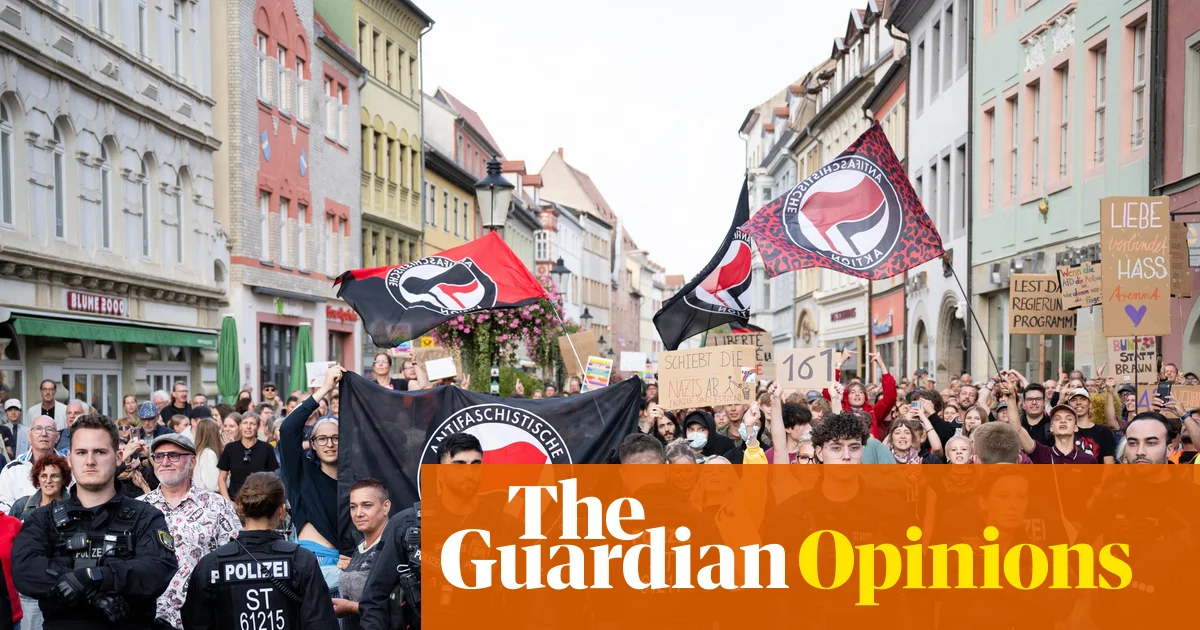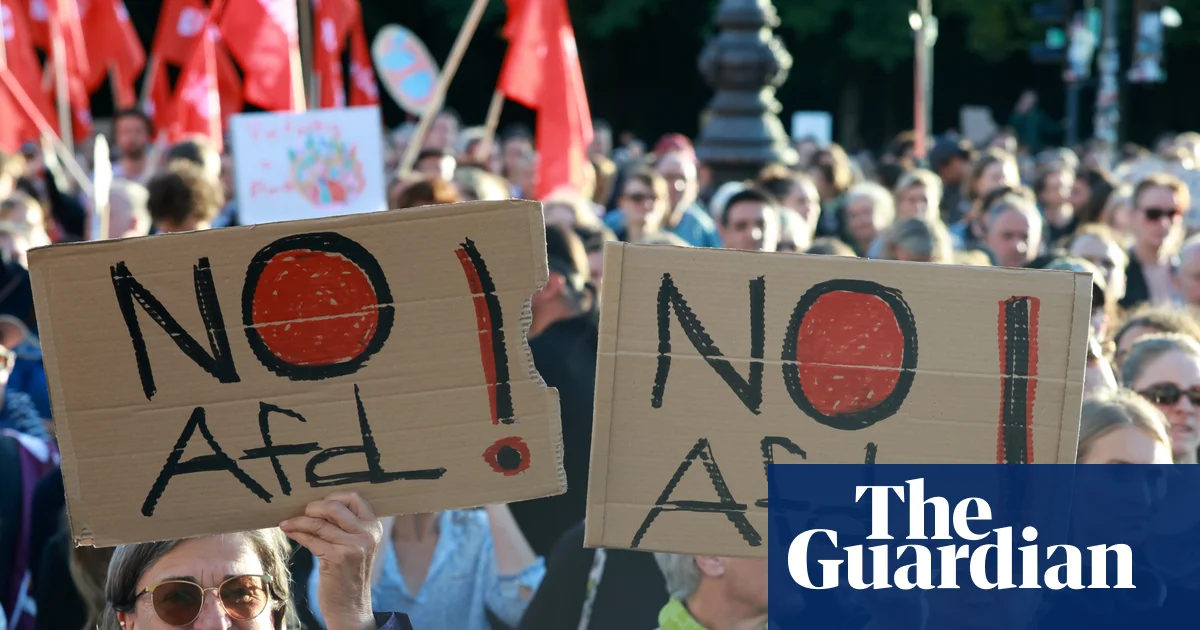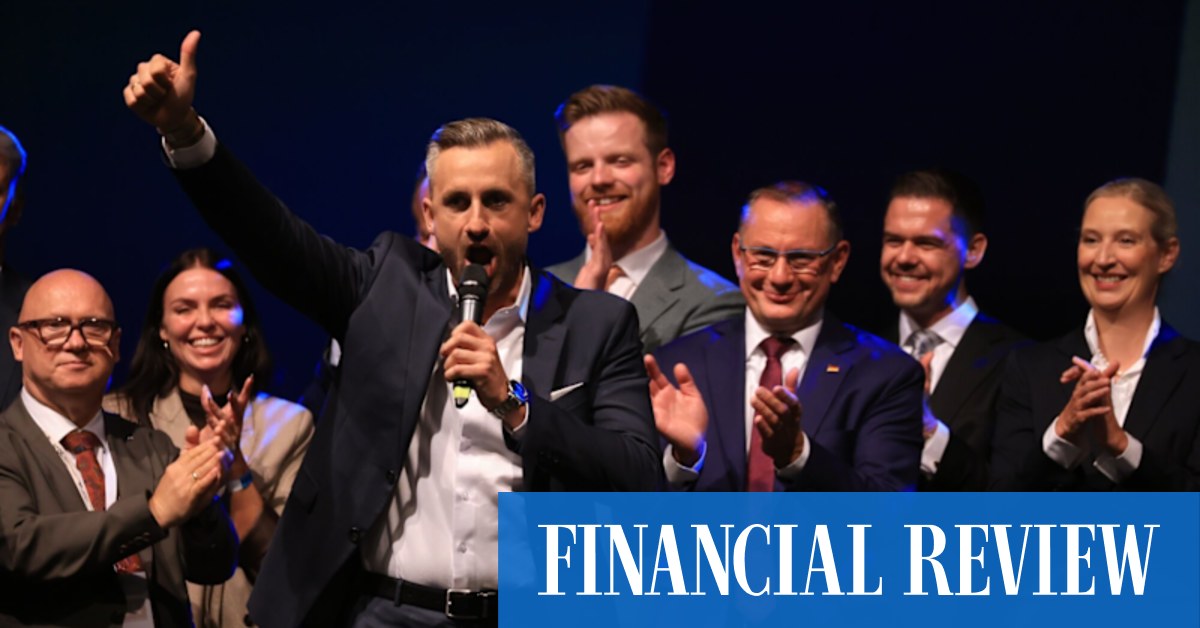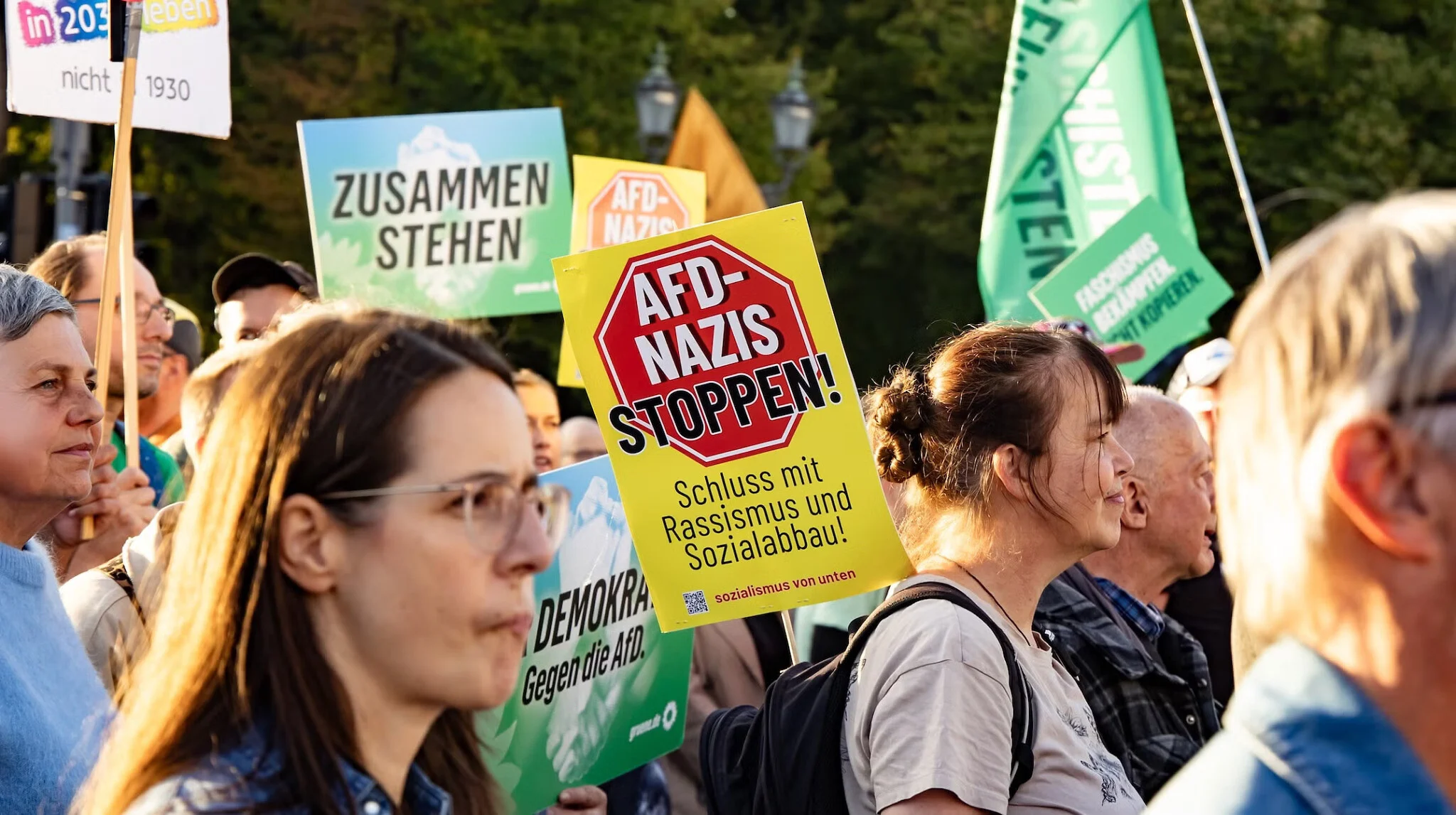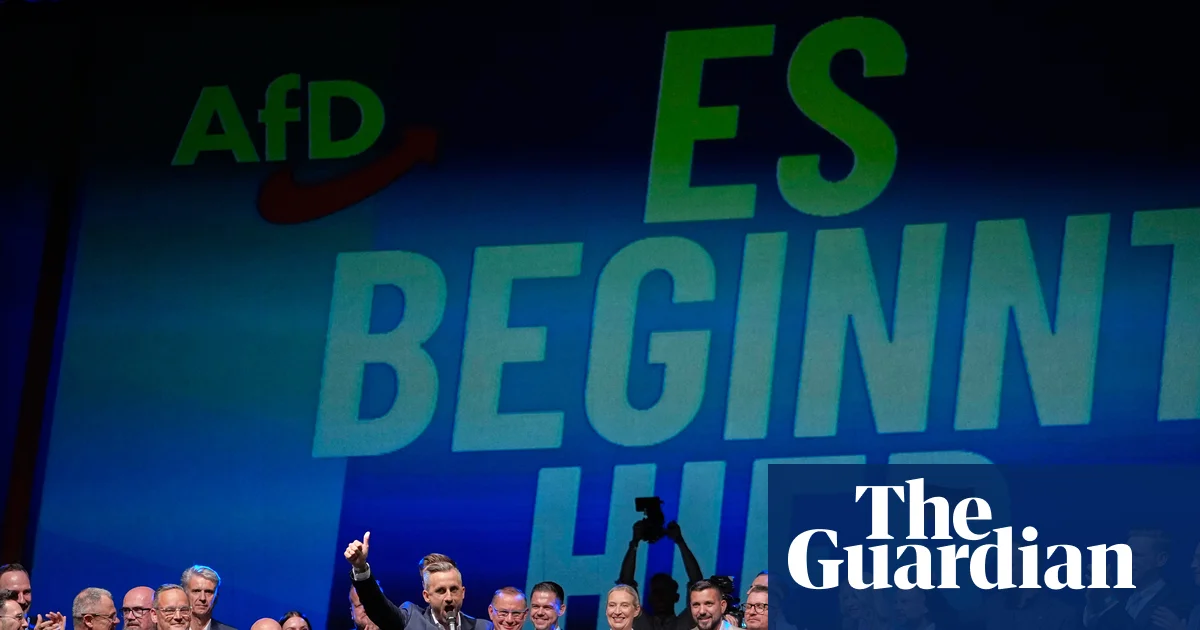
Editor’s note: A version of this article was originally published in March 2024. This has been updated to reflect the Alternative for Germany (AfD) success in recent elections.As Stefan R left the stadium of his favourite German football team in the summer of 2019, a powerfully built man dressed in black approached him, grabbing his arm.Then, at least two other men appeared from behind. He was surrounded.The men had been waiting for him on the street and the chilling message that followed was delivered at speed. “If we see that flag again, we’ll shoot you,” said the man holding him, before one of the other assailants added his own warning. “Now get the f*** out of town.”Stefan, whose name has been changed in this article for safety reasons, had promoted a banner that championed diversity, hanging it from one of the terraces at Stadion an der Gellertstrasse, the home ground of Chemnitzer FC, around 150 miles south of Berlin, during a German cup game against Hamburg. The lettering was presented in rainbow colours and included the words “cosmopolitan” and “tolerant”.The banner at Chemnitzer FC that put Stefan R in danger (Simon Hughes/ The Athletic)Stefan had previously been involved in a supposedly apolitical fans’ group where some of the fringe members harboured Islamophobic and anti-refugee views.His discomfort at these extremists led Stefan to form the “Diversity Section” at Chemnitzer FC. It was then that, as he puts it, speaking in 2024, “the Nazis realised what we were trying to do” and he was targeted by his fellow fans — men he has subsequently been able to identify through Facebook searches.For Stefan, the impact of the incident reverberates — and especially given the rising tide of right-wing extremism in Germany and the question of how to respond to it has been dominating the domestic news agenda.The extreme right-wing element of the Chemnitzer FC fanbase might not be huge, but it is highly influential and also has links to local boxing and MMA scenes. It means that on a matchday especially, Stefan feels like a target. He avoids the south curve, which the extremists occupy like a state force. He is no longer a part of any visible fan movement. “I would feel nervous approaching the stadium and leaving,” he tells The Athletic. “But I know by staying at home, they have won.”Unlike in English football, where tribalism tends to revolve around inter-city or regional rivalries, the German game has long been linked to politics.Many clubs’ fanbases are unabashedly left-wing — St Pauli, based in Hamburg, being among the most famous — but others have historically veered to the right. Borussia Dortmund are perhaps the most widely known, although the club has worked hard to eliminate the more extreme elements of its support in recent years, but they are far from alone.In normal times, such affiliations may mean little, but these are far from normal times. Germany, in common with many European countries, is seeing a spike in support for right-wing political parties, in particular the Alternative for Germany (AfD), which on Sunday dominated a crucial election in the eastern state of Saxony-Anhalt, according to near-final results. Though it fell short of the majority it needs to become the first far-right party to govern any part of the country, affording it powers such as appointing judges and blocking laws, it could still assume control if it negotiates with rival parties that have vowed not to support an AfD government.Opponents of AfD in Germany are nervous. In 2024, AfD’s rise was met with mass protests, including one in Berlin which drew crowds of 150,000, featuring banners carried by fans of several of the city’s football clubs.Anti-AfD protests in Berlin in 2024 (Hami Roshan/Middle East Images/AFP via Getty Images)The anti-right-wing message was endorsed by Bayern Munich, Germany’s biggest club and, in recent years, politically left-leaning. After Uli Hoeness, the club’s honorary president, criticised AfD’s policies, then-manager Thomas Tuchel endorsed the protests. “We can’t stand up enough,” said Tuchel, who now coaches the English national football team. “There’s no doubt about fighting against all forms of extremism, but obviously also against right-wing extremism in particular given the discussion and our history. There can be no doubt there.” Around that time, supporters of Lazio, the Italian club with a notorious right-wing fanbase, placed politics front and centre of a Champions League match in Munich by singing fascist songs at the Hofbrauhaus am Platzl, where Adolf Hitler announced the founding of the Nazi Party in 1920. In Germany, politics permeate many levels of the game. In February 2024, Chemnitzer FC, then in the German fourth division, faced Energie Cottbus — another club with a fanbase that has a strong right-wing presence. The south curve at the Stadion an der Gellertstrasse used the opportunity to comment on transgender people. While one banner declared: “There are only two genders, even a blind person can see that,” another read: “DFB fan shop: men, women, babies and children.”Chemnitz’s fanbase is politically split (Karina Hessland/Getty Images for DFB)After Cottbus fans displayed another anti-trans slogan in their next game — “There are only two genders, both despise the DFB” — Georg Pazderski, an AfD politician, described the message on X, formerly Twitter, as a “cool action”.Such comments were not surprising. The AfD’s popularity in both cities was rising, despite far-right demonstrations turning into riots as they did in Chemnitz in 2018. The city had tried to change its image — its appointment as European Capital of Culture for 2025 is evidence of that — yet there remains a sense that Chemnitz, previously Karl-Marx Stadt and one of the biggest in the old East Germany, has been left behind. Despite a relatively short distance from Berlin, it takes more than three hours to reach Chemnitz by train given the lack of a high-speed rail network.A bus stops outside the Karl Marx monument in Chemnitz (Hendrik Schmidt/via Getty Images)Stefan suggests that makes lots of people feel “disconnected”, but among moderates like him, there remains a belief that key civic institutions, such as the city’s football club, have not done enough to combat nationalism.When Chemnitzer FC was asked by a local newspaper for comment about the transphobic banners, it did not respond directly to any of the questions, instead choosing to refer to the values it spreads on the scoreboard before and during home games. This anti-discriminatory message also appeared on social networks, without explicitly addressing the discriminatory banners.Stefan stresses that not everyone who supports Chemnitzer FC is a right-wing extremist or even right-wing at all. Yet the extremists (fewer than 50 people, Stefan estimates) are so dangerous and influential that a culture of fear exists among the fans and board members who might oppose them but do not want to get attacked.The threats against Stefan came after the death of Thomas Haller, a self-professed neo-Nazi hooligan. His passing was marked by a funeral service inside Chemnitzer FC’s ground that involved fans dressing in black and holding flares aloft, behind a banner in Gothic script with the words “Rest in peace, Tommy”. This was followed by the stadium announcer paying tribute to Haller’s support for the club. “He lived for Chemnitzer FC,” was the eulogy.Mourners gather for Thomas Haller’s funeral in Chemnitz in 2019 (Ronny Hartmann/AFP via Getty Images)Haller had founded the HooNaRa (Hooligans-Nazis-Racists) fan group in the early 1990s and his company, Haller Security, worked with the club until 2006.
German football and the far right: ‘If we see that flag again, we’ll shoot you’
Clubs in Germany are on the frontline of sometimes violent political debate as AfD election success shocks nation.
3,602 words~16 min read