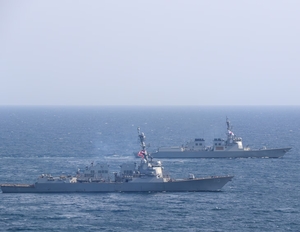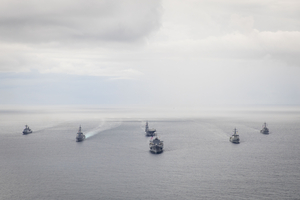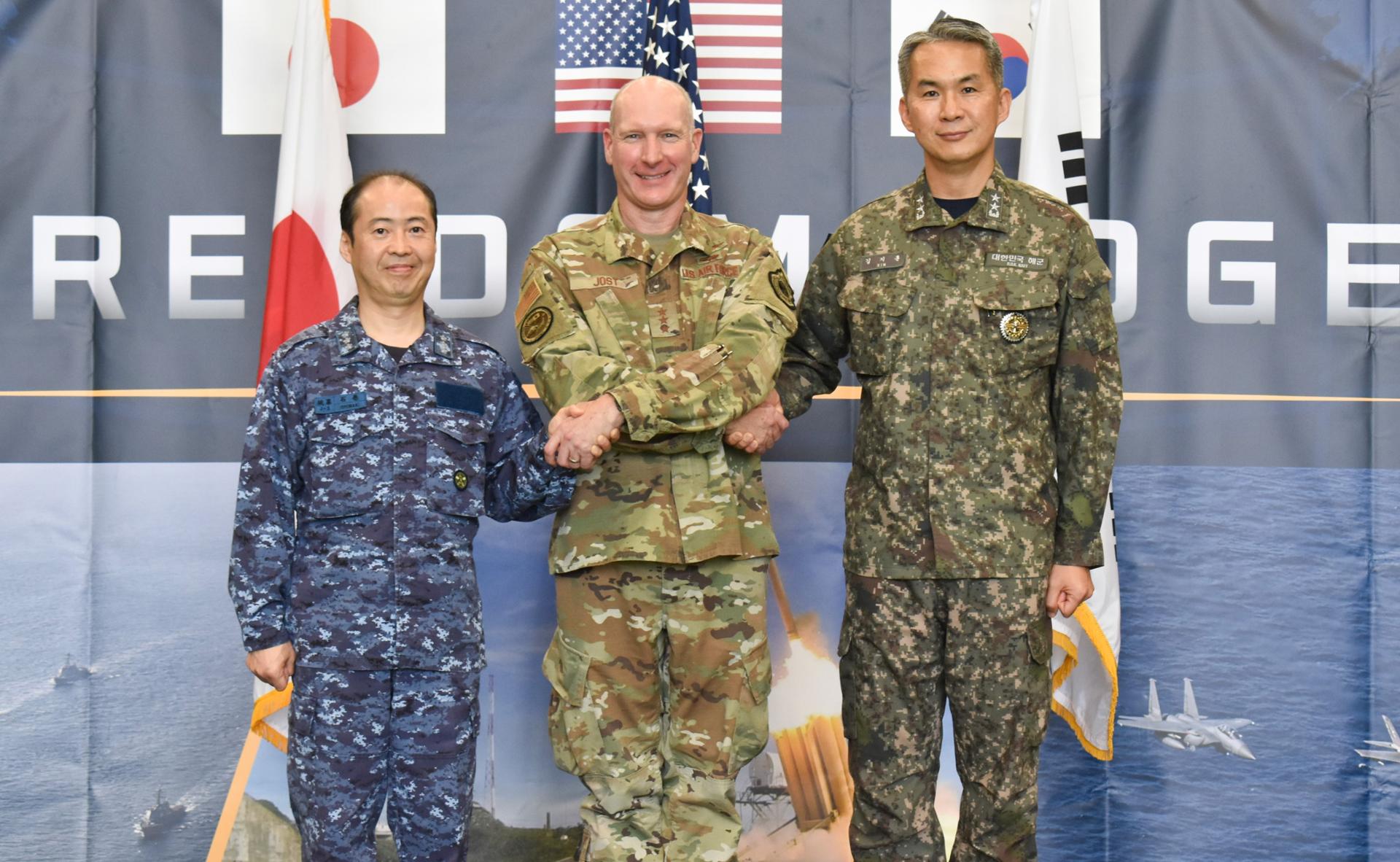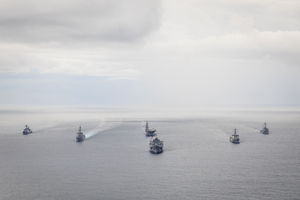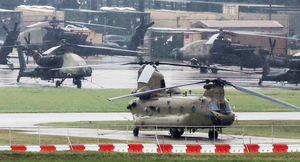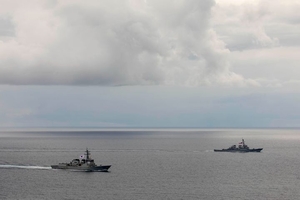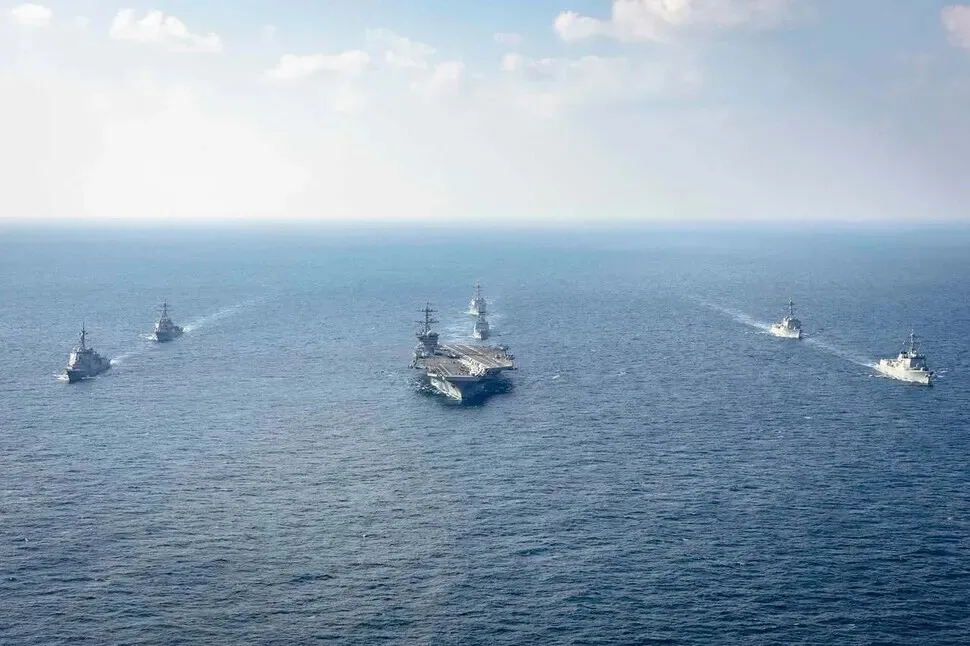
Despite the Trump administration’s decision to scale back the US’ Ulchi Freedom Shield exercises with South Korea in August, the two countries and Japan will press ahead with their multi-domain Freedom Edge drill this week, beginning Monday and ending Friday. In a statement on the Freedom Edge drill published by the state-run KCNA on Aug. 31, a spokesperson for the North Korean Foreign Ministry called it “pointless to expect any détente in the region, given the grave situation where the US’ persistent hostile policy toward the DPRK is evolving in a more dangerous way.” “There is no change in our policy toward the US to respond to its invariable hostile policy with the toughest stand to the last,” the spokesperson said. So why is the US moving forward with Freedom Edge when it scaled back Ulchi Freedom Shield? The reason is that Freedom Edge is a multi-domain exercise that contains and puts pressure on China. Multi-domain drills reflect the theory of multi-domain operations. Multi-domain operations expand domains of warfare — land, maritime, air — to include space, cyberspace, and the electromagnetic spectrum. As multi-domain operations expand to include cyberspace and space, they are no longer limited to conflict zones but extend globally. Multi-domain operations are a principle and doctrine of the US Army developed to counter the rise of China and threats from Russia. US multi-domain operations divide primary adversaries into two groups of two and three — one including Russia and China, and the other including Iran, North Korea, and extremist forces. But, in effect, the operations’ primary focus is on Russia and China. To be specific, the core goal of the operations is to neutralize China’s anti-access/area denial (A2/AD) strategy. Beijing’s A2/AD strategy aims to prevent US carrier strike groups from approaching China (anti-access), and even if they manage to approach Chinese waters, to force them to withdraw through protracted attrition warfare (area denial). The A2/AD strategy is centered around what’s known as the “first island chain,” which spans from Japan’s Kyushu Island to Okinawa, Taiwan, and the Philippines, and the “second island chain,” which begins in Japan’s Ogasawara Islands and continues through Saipan, Guam, and ends in Indonesia. The island chains refer to imaginary boundary lines connecting major maritime routes and strategic points within the region. The first and second island chains are China’s defensive lines that block the US in the Pacific. In the first island chain, China prevents US carrier strike groups from entering with short-range anti-ship missiles, diesel submarines, littoral combat ships, surface-to-ship cruise missiles and fighter jets. In the second island chain, it utilizes mid-range anti-ship missiles, traditional and nuclear submarines, and bombers to prevent carrier strike groups from approaching. US multi-domain operations refer to the mobilization of all available means across multiple domains — air, land, sea, space, cyberspace and electronic warfare — to neutralize the various weapons, such as missiles and air defense systems, that China has developed and deployed to block the approach of US carrier strike groups. When announcing the plan for the Freedom Edge in September 2025, the US Indo-Pacific Command said that cooperation between the three countries involved — Korea, the US, and Japan — would strengthen capabilities within the first island chain. The command made no attempt to hide that Freedom Edge is taking place to keep China in check. Initially, the US designed the AirSea Battle concept to defeat China. The doctrine delineated that the US Air Force and Navy would develop joint operations in the air and in the sea to dismantle China’s A2/AD strategy.However, the US Navy and Air Force would face significant challenges crossing the Pacific and waging war with China, as US carrier strike groups approaching Chinese waters could come under threat from the country’s anti-ship missile systems. Preoccupied with that possibility, the US is attempting to utilize its alliance with Korea and Japan, who are both China’s neighbors, to carry out multi-domain operations. This is the context in which the three countries’ Freedom Edge exercises are being carried out from Monday in the waters east and south of Korea’s Jeju Island. The first Freedom Edge drills took place in the waters south of Jeju Island in June 2024. This is the passage through which the Chinese North Sea Fleet, headquartered in Qingdao, Shandong, and the East Sea Fleet, headquartered in Ningbo, Zhejiang, must pass to reach the Pacific Ocean. In other words, the first multi-domain drill between Korea, the US and Japan took place in a strategic hub to prevent China from extending its reach into the Pacific Ocean. The Freedom Edge exercises that followed in November 2024 and September 2025 also took place in waters near Jeju Island. Including the drills currently underway, all four Freedom Edge exercises carried out by Korea, the US, and Japan have taken place in the waters near Jeju. Freedom Edge training includes maritime missile defense, aerial and air defense, anti-piracy operations, anti-submarine operations, and cyber defense exercises. Seoul emphasizes that the Freedom Edge drill prepares the country against North Korean nuclear and missile threats. However, there are concerns that the increasing frequency of the exercise could trigger a shift in the Korea-US joint defense system from one that defends the Korean Peninsula to a regional multi-domain deterrence system that contains China.
Why Trump cut ROK-US drills, but not three-way drills with Japan
The nature of the drills gives a hint as to why Washington decided to press ahead with the Freedom Edge exercise this week
878 words~4 min read