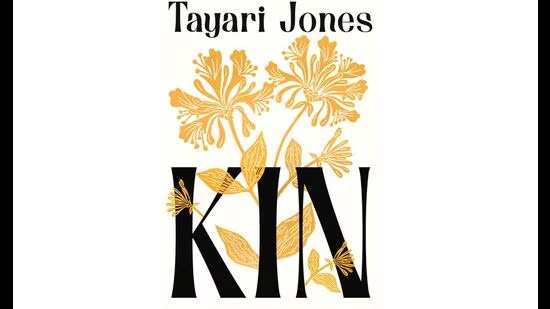
I found myself reading slowly through Tayari Jones’s new novel, Kin till the second half, where it opened up like a flower that had been tightly furled for too long. By the final pages, I realised the significance of its epigraph – “We are each other’s business.”At its heart, Kin is a story of and by women.The men in the novel play their roles well. They hurt, comfort, disappoint, leave, and stay. But it is the women who are its heart. Every time I thought I understood them, they revealed yet another hidden history, an old grief, a private resilience.The remarkable womenHattie Lee is perhaps the best example of this. Initially dismissed as “trifling”, she slowly emerges as a woman shaped by suffering, endurance, and survival. Another character, Babydoll, enters the story as the “other woman” for Annie, someone she is primed to resent. She calls herself and Annie a “package deal” to get them both employed in the new city. When their boss’s wife arrives to accuse her of sleeping with her husband, Babydoll stands as a defiant comrade instead of revealing the truth of what was actually Annie’s affair. It is an unusual relationship indeed and perhaps, only Jones could have written it.My favourite character, however, is Aunt Irene. Irene is a truth-teller with startling precision. Speaking about Annie’s hope that her absent mother might someday return, Irene tells her, “Over time, the daily discouragement will wear her down, like the heel on a loafer.” It is a devastating observation about how suffering often works – not as outbursts but through gradual erosion. Her honesty is one of the novel’s emotional anchors.Jones’s attention to dialogue is felt throughout the novel. Every character sounds distinct. The shifting perspectives between Annie and Vernice are particularly impressive. You hear Annie’s despair accumulating sentence by sentence as life closes around her and watch Vernice polish her own rough edges away as she grows into herself. And then there is the prose itself. The metaphors are truly delectable. Sample this: “One day, I will grow a person within myself and love that little person so hard that it would bind her to me like rich dirt in the corner of a canvas satchel.”Elsewhere, after being abandoned by Bobo, Annie reflects: “As he departed, I listened to the drumbeat of his shoes. For a man so light on his feet, he made a lot of noise walking out of my life. I wouldn't have followed him even if I hadn't been bleeding like a stuck pig. Chasing people who don't want to stay is a waste of time on par with trying to put rain back in the sky.” The image is both sharp and unexpectedly tender. Her dignity shines through even in heartbreak.Even descriptions of how someone looks are full of charm and wit: “What got your attention about him was his smile, and not really in a good way. It was like he opened up his mouth and God tossed in a handful of teeth, not caring what went where. But he grinned like he didn't have one thing to be ashamed of. And in that way that men have of getting you to see them the way that they see themselves. I found myself grinning back.” In the final chapter, Annie imagines repairing her broken heart thus: “When I was on the other side of this, when my body was healed and my spirit mended, my love would be the next thing to repair. I imagined it like a bolt of flowered fabric, silk maybe, but on sale because of a rip. I could line the blossoms up just right and use stitches so tiny that they’d vanish into the pattern.” I had to stop after reading that paragraph. It captures something difficult to articulate: the belief that healing is not the restoration of what once existed but the careful mending of what remains.The novel is also full of smaller delights. Vernice’s new laugh is memorably compared to a three-dollar bill. There is the wonderfully sharp warning that “reading the Bible with a man only leaves you chained to a stove somewhere.” And perhaps one of the most memorable claims in the novel: “People who are loved well always believe there is more out there for them to enjoy.” Few lines better encapsulate the novel’s understanding of how love shapes our expectations of the world.What I found to be the most affecting thread in the novel is Vernice’s relationship with Joette and the way it intersects with her growing feelings for Franklin. Joette is a force in Vernice’s life, someone whom she “didn’t have secrets from” and who “knew [her] in ways that even Annie did not”. Joette “had the itchy readiness of a bullet in the chamber,” a description that conveys both her charisma and her volatility. As Vernice grows closer to Franklin, the relationship reveals the complicated emotional arithmetic of growing up. Bound by historyWhat impressed me most, however, was how naturally Jones weaves larger historical realities into these personal narratives. The Civil Rights Movement, which unfolds in the background, does not impose itself clunkily upon the story. Its force shapes the horizon of the characters as they navigate jobs, friendships, romances, grief, and dreams.The same is true of the novel’s moments of tragedy and revelation. There are shocks, certainly, but they emerge through the gradual rearrangement of a life – and this is profoundly true to experience. Most of us are not transformed by singular cinematic moments but by conversations, disappointments, acts of care, and tiny realisations. It was this commitment to the characters’ interiority that made Kin a remarkable read. By the end of the novel, the title too acquires a richer meaning. Kinship here is not merely biological. It is built through loyalty, shared burdens, chosen care, and mutual witnessing. Kin may start slowly, but it rewards persistence with extraordinary emotional complexity. It is a novel interested in how women survive. Long after finishing it, I found myself thinking about Annie and Vernice, about Irene’s lost past life, and about the weight of Annie naming Vernice her cradle friend, Niecy, her next of kin.Kin, Tayari Jones, Oneworld Publications.
‘Kin’: Tayari Jones’s new novel is a story of and by women, and of their shared passions
The force of the Civil Rights Movement shapes the horizon of the characters as they navigate jobs, friendships, romances, grief, and dreams.
1,042 words~5 min read

 aboutamazon.com