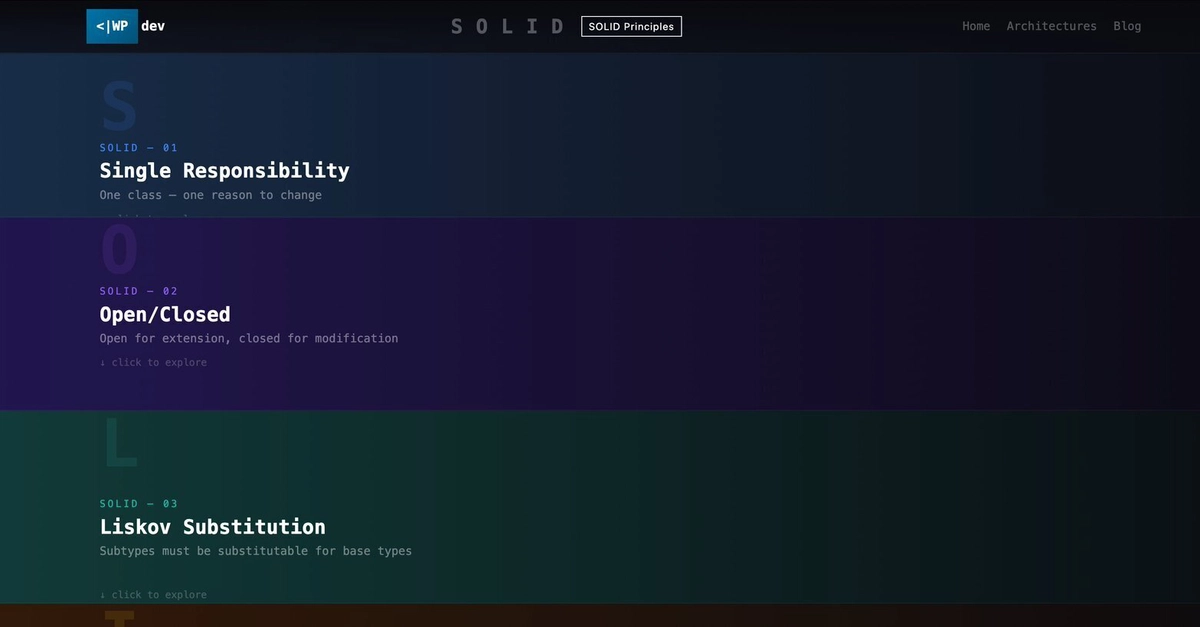
WordPress makes it easy to write code that works and easy to write code that lasts, and those are not the same skill. Hooks, filters, custom post types, widgets — the platform hands you enough rope to build something maintainable or something that collapses the moment a second developer touches it. SOLID is the discipline that decides which one you get. Not as academic dogma imported from enterprise Java, but as five habits that map cleanly onto things WordPress developers already do every day.
We’ve written up all five principles in depth on 4wp.dev/architectures/solid. This isn’t a repeat of that material — it’s the harder question: does our own plugin catalog actually hold up against it? Where does it, and where are we still watching ourselves?
Single Responsibility — the one we had to learn from our own mistake
SRP says a class, a module, a plugin should have one reason to change. The honest WordPress version of this failure mode is the “kitchen sink” plugin — the one that does SEO, and a slider, and contact forms, and social icons, because it was easier to bolt features onto something that already existed than to ship something new.
We named this risk directly on our own SRP page, using 4wp-bundle as the cautionary example: if it ever grew to carry responsive controls, FAQ management, Gutenberg extensions, and settings all in one codebase, that’s exactly the violation. The actual answer wasn’t a paragraph of theory — it’s the catalog itself. 4WP-Booking, 4WP-FAQ, 4WP Smart Link, 4WP Weather, 4WP Drive, 4WP Notifications — each is a separate plugin with a separate reason to change, sharing only infrastructure through 4wp-bundle, not features. That split isn’t a marketing decision. It’s SRP applied at the product level, not just the class level, and it’s the reason a bug in the booking flow can never be a reason to redeploy the FAQ registry.