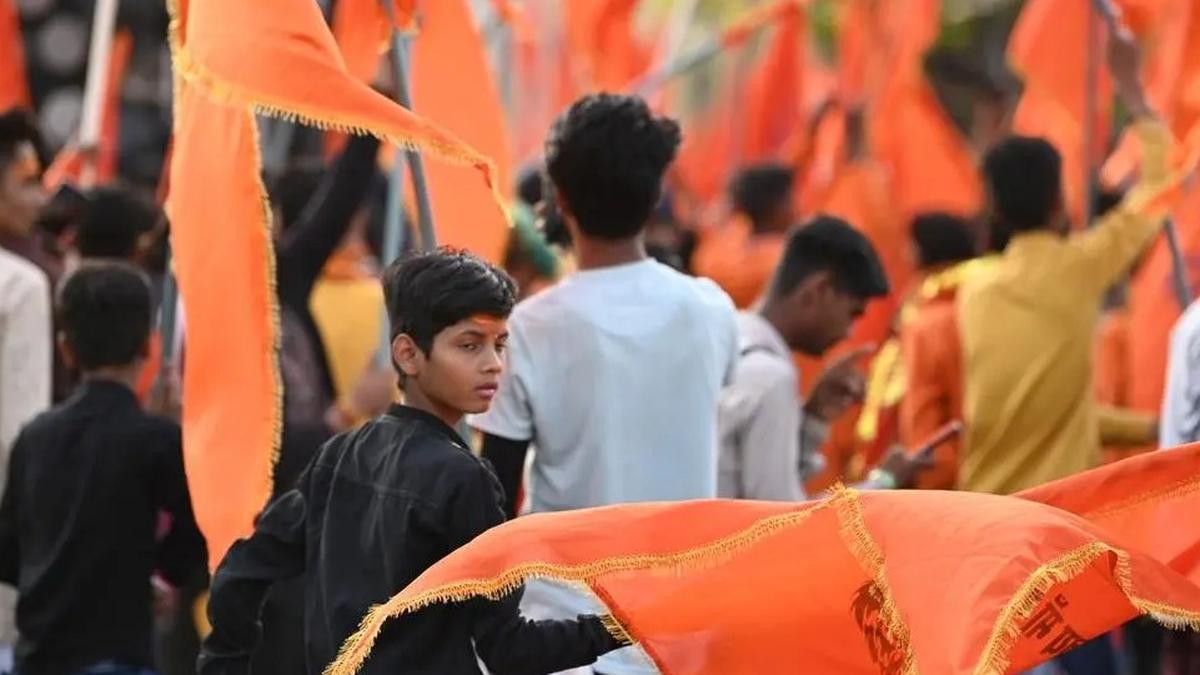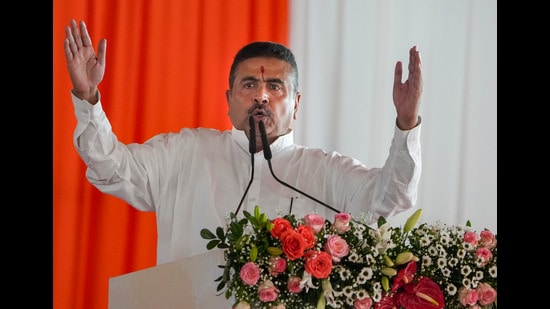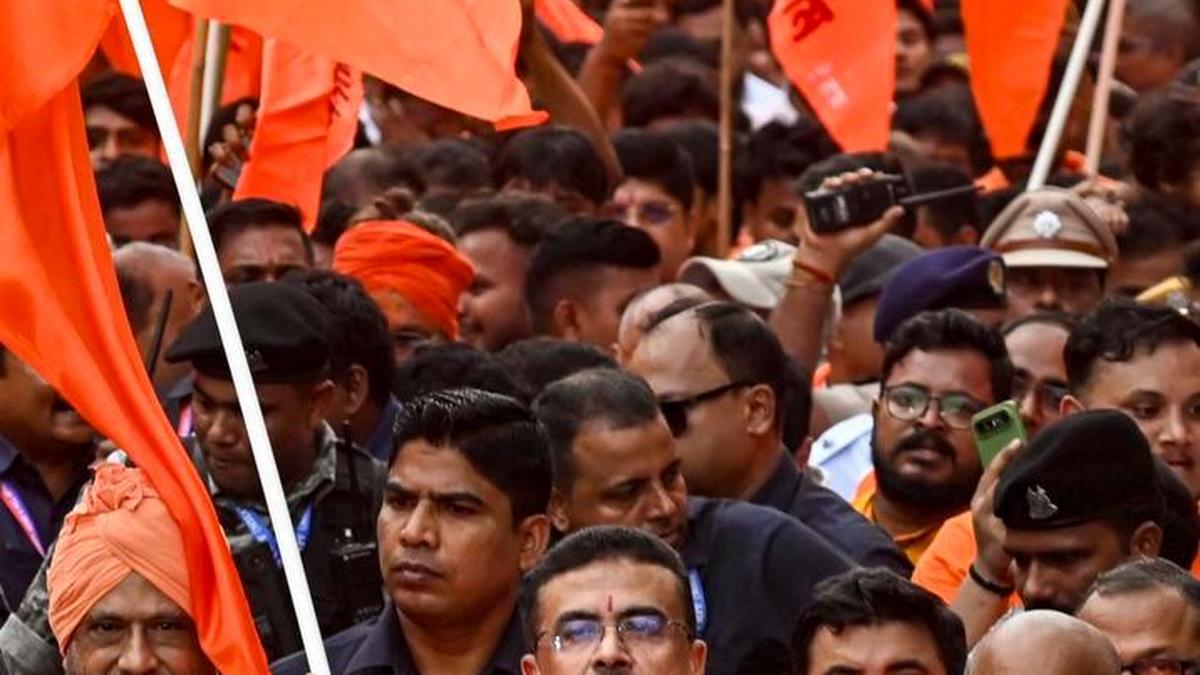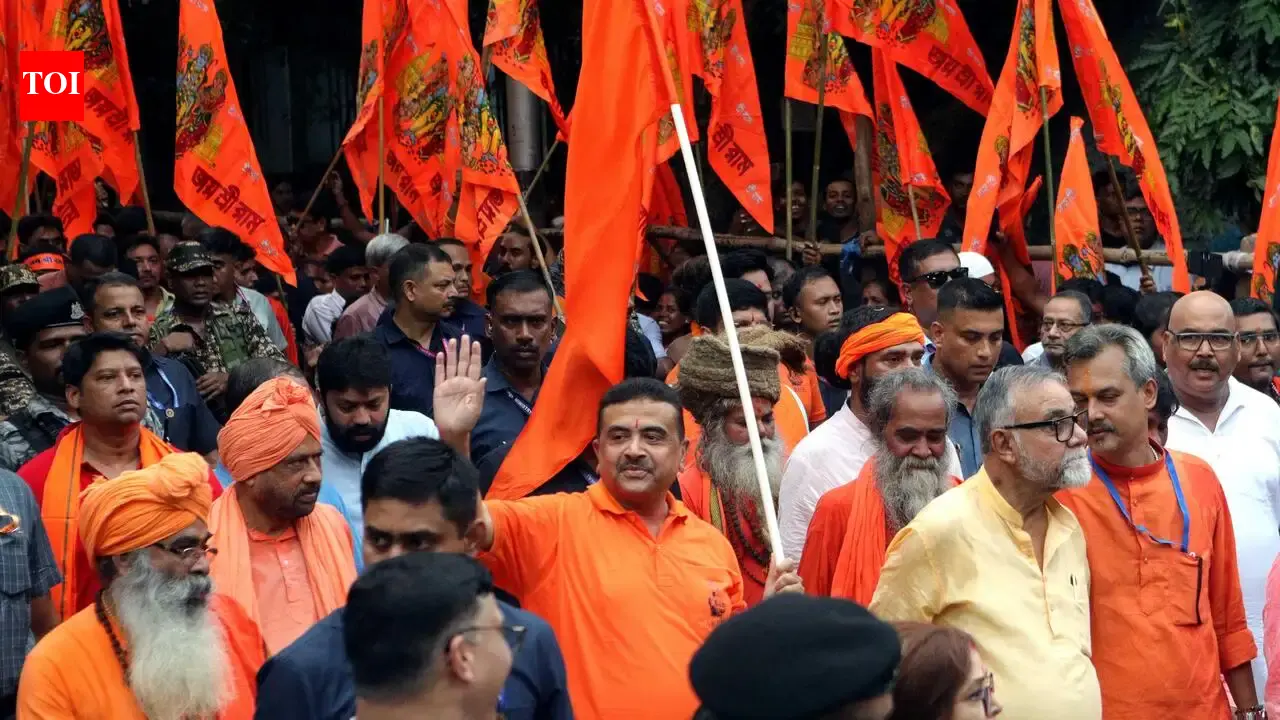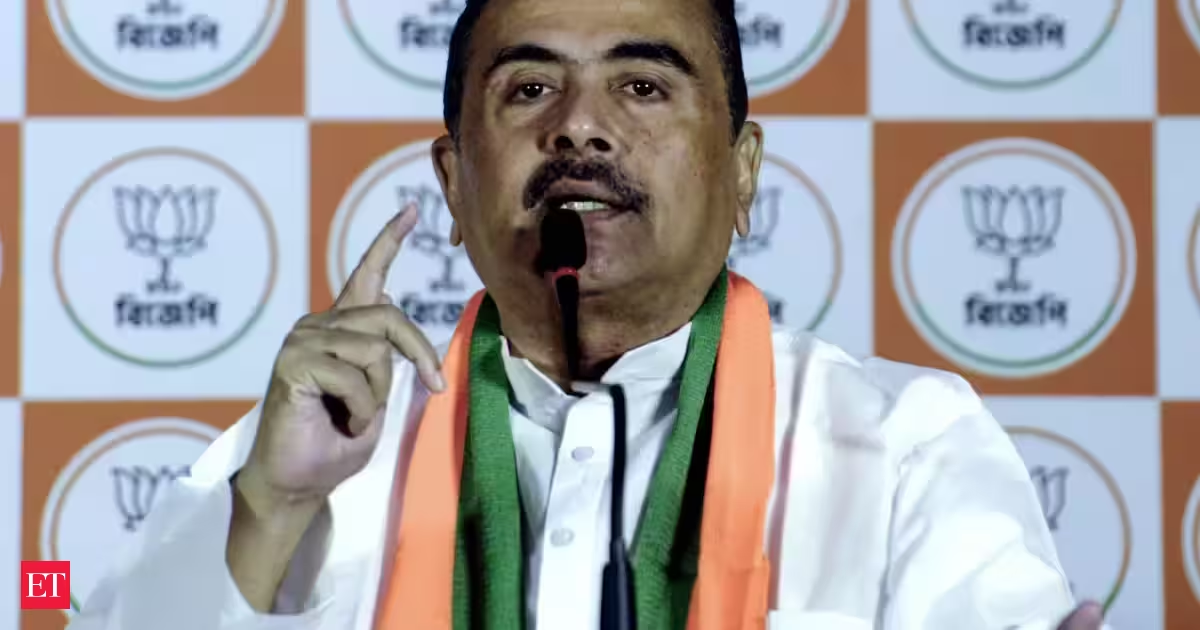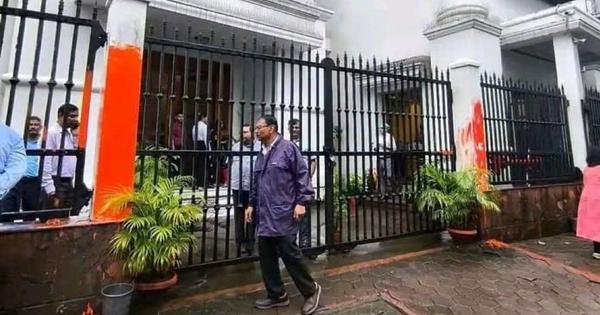
Days after West Bengal Chief Minister Suvendu Adhikari demanded an apology from Anandabazar Patrika for using the term “saffron hooliganism” in a headline, a mob arrived at the newspaper’s Kolkata office on September 1 to prove that the newspaper was right.The mob, which included members of the ruling Bharatiya Janata Party, smeared the publication’s compound wall with saffron paint on Tuesday. They shouted slogans criticising the Bengali daily, one of the oldest newspapers in the country, chanting “bhagwa ka apman nahi sahega Hindustan”. India will not tolerate insults to saffron.Saffron is the sacred colour of Hinduism but has been adopted by the BJP as its signature hue.The Bengali daily had used the phrase “gerua gundami”, or saffron hooliganism, to describe the August 20 violence at Jadavpur University. That day, members of the Akhil Bharatiya Vidyarthi Parishad, the student wing of BJP’s ideological parent the Rashtriya Swayamsevak Sangh, had clashed with Left-affiliated student groups on campus.“The people who entered the campus of Jadavpur University and did hooliganism – they demeaned saffron, not us,” said a journalist working at the newspaper, requesting anonymity.The journalist added: “We vividly described whatever happened that day along with photographs. Everything – the article and the photograph – substantiated the headline.”The journalist has worked at Anandabazar Patrika for decades. He said that the paper, the most-read daily in Bengal, had weathered hostility from previous governments of the Left Front, the Trinamool and the Congress. “For a short while, advertisements were stopped,” he said. “But never did an outfit attack the main building. Nobody did that.”Videos uploaded by BJP members on Facebook show police personnel standing around as men wearing saffron painted the pillars of the compound. “The police remained mute spectators,” the journalist said.On August 28, the police had registered a first information report against staffers of the newspapers. Hours later, Chief Minister Adhikari followed up with a warning that anyone seen to be attacking saffron will “not be able to handle the terrible consequences”.The next day, the journalist said, he saw a group of eight to 10 persons protesting outside the newspaper office. “I was coming in and going out of the office for some errand,” he said. “I saw them raising slogans against Anandabazar Patrika, mostly in Hindi.” The same slogans were shouted again on September 1, but this time the mob was bigger, he noted.He said if somebody had an objection to the headline, there were democratic ways of protesting. “One can write a letter to the editor, and generally those letters are also published with due respect,” he said.But, in this case, he noted: “The chief minister himself incited people.”The journalist added: “The dangerous element with this government is that if you oppose them, if they don’t like anything your writing, they brand you as anti-nationals.”The same thing has happened to the students of Jadavpur University, he continued. “Whatever slogans they are writing, you may not like them, but you can’t call them anti-national for that,” he said.The protesters asked the newspaper to apologise but the ABP Group, the parent organisation of the Anandabazar Patrika, did not succumb to that pressure, the journalist said.“So whatever they’re trying to do, they’re trying to make us frightened,” he said. “They want us to cower down to their pressure.”He said that the intimidation had left an impact on the newsroom. “We feel insecure,” he said. “We feel concerned. We feel anxious for the safety of our colleagues.”While the staff were determined to continue their work despite the threats, he said that they “cannot wait for something more grave to happen”.Even as many media organisations protested this incident, the Press Club in Calcutta had been silent, the journalist pointed out. “This issue is not only about a particular newspaper, it’s about the freedom of press,” he said. The journalist added: “Everybody wants a free working atmosphere. We don’t want to become heroes. Fighting the government or a very influential political party is not our job. We are here to report facts.”Here is a summary of last week’s top stories.Voting rights. The names of more than two crore persons were removed from Maharashtra’s draft voter list as part of the special intensive revision of electoral rolls. The excluded electors account for 21.1% of the state’s previous voter base.In Delhi, 47.7 lakh names were deleted from the draft list. They account for 33% of the Union Territory’s electorate.Those removed from the voter list were marked as either permanently shifted, deceased, absent, duplicate entries or placed under the “other” category, which includes those who refused to fill the enumeration form.Voters can file claims and objections against their exclusion from the draft list between August 31 and September 30. The appeals will be heard by October 29. The final electoral roll will be published on November 4.More than six crore names have been deleted from draft lists of several states during the ongoing phase of the exercise.Scroll’s SIR experience is a microcosm of what urban India is facingEx-bureaucrat booked for a tweet. Former civil servant Ashish Joshi, who was picked up during his morning walk on Wednesday by plainclothes police personnel and interrogated for several hours, said on Friday that a first information report had been registered against him for a social media post. It was filed under sections pertaining to provocation with the intent to cause a riot.The FIR was registered for a post he made on August 26, in which he had reportedly called for a “Nuremberg-style trial” of Chief Election Commissioner Gyanesh Kumar.Joshi, however, said that he had been questioned about another post from last month, in which he had alleged that there had been a “massive showdown” between Union Home Minister Amit Shah and Home Secretary Govind Mohan after the police action against students protesting at Delhi’s Jantar Mantar.NSA detention quashed. The Allahabad High Court quashed the preventive detention of 25-year-old Aakriti Chaudhary under the National Security Act. The Delhi University graduate has been in jail for nearly five months in connection with the workers’ protest in Noida.The court held that she was detained by the Uttar Pradesh government based on a “concocted story”. The Noida authorities were directed to pay Chaudhary Rs 5 lakh as compensation.However, she will remain in jail as she is yet to secure bail in other cases registered in connection with the April protests.Fact check: Despite official denial, viral video showing police beating women workers is from Noida, reported Ayush TiwariAlso on Scroll last weekWill Rahul Gandhi’s ‘smash the patriarchy’ call attract young, urban women to Congress?For months, tribal children in Madhya Pradesh kept dying. The government woke up too lateIn Congress-ruled Karnataka, Bengali Muslim migrant workers come under citizenship scrutinyTwo days after Bhagwat’s speech in New York, 90 US politicians pledge to not take RSS-linked fundingFlood risks to Nepal hydropower project were known – but banks ignored themWhy Tamil Nadu’s factories are death traps for migrant workersHow a Victorian philosopher found common ground between Hindu philosophy and socialismA decade since landmark law, disability rights and justice are stuck in a loopWhat the film ‘Last Man in Tower’ says about Mumbai: ‘No corner of the city’s left untouched’‘Gandhari’ review: Film about child sex trafficking is all a blurFollow the Scroll channel on WhatsApp for a curated selection of the news that matters throughout the day, and a round-up of major developments in India and around the world every evening. What you won’t get: spam.And, if you haven’t already, sign up for our Daily Brief newsletter.
Have attacks on ‘Anandabazar Patrika’ proven its ‘saffron hooliganism’ headline right?
Bengal chief minister demanded an apology and a mob smeared the publication’s compound wall with paint after it used the phrase to describe campus violence.
1,255 words~6 min read