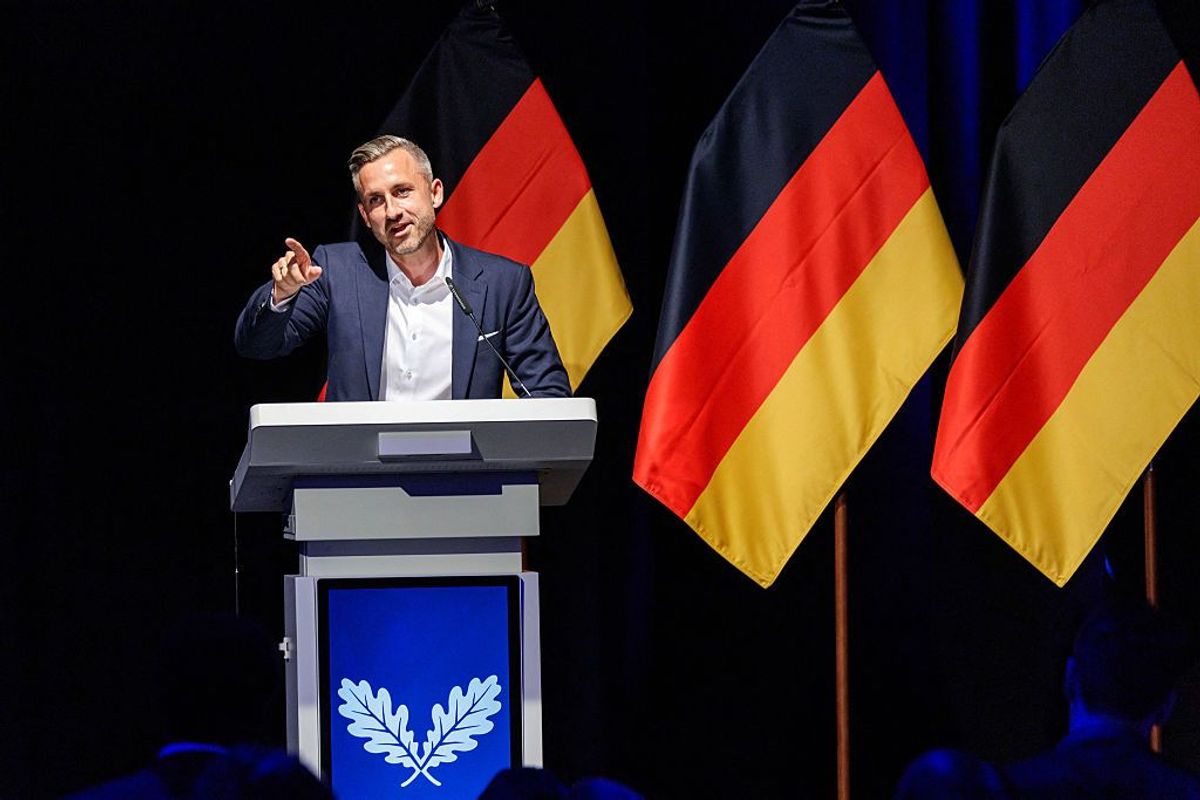
Germany enters a decisive month of state elections with the far-right Alternative for Germany (AfD) closer to executive power than at any point in its history.Saxony-Anhalt votes on Sunday, Sept. 6. The latest projection gives the AfD 41%, almost twice the 20.8% it received in the previous state election in 2021. The governing Christian Democratic Union (CDU) trails on 23%.JOIN US ON TELEGRAMFollow our coverage of the war on the @Kyivpost_official.In practical terms, approximately two out of every five voters now support the AfD, while only slightly more than one in five backs the CDU. The AfD could become the largest party by an 18-point margin, although the projection indicates that an outright parliamentary majority remains unlikely.The party is also leading in Mecklenburg-Western Pomerania, which votes on Sept. 20. An Infratest dimap poll puts the AfD at 35%, narrowly ahead of the governing Social Democratic Party (SPD) with 32%.The AfD received 16.7% there in 2021. It has therefore more than doubled its support in the last five years, while the SPD has fallen from 39.6%.Berlin votes on the same day. The AfD is not leading there, but its support has risen to approximately 18%, compared with 9.1% in the city’s 2023 repeat election.From eastern protest party to national forceThe September elections form part of a longer rise.The AfD received 10.4% in Germany’s 2021 federal election. Four years later, it doubled that result to 20.8%, becoming the country’s second-largest party in the Bundestag. National polling now places it at approximately 28%, ahead of Chancellor Friedrich Merz’s CDU/CSU bloc.
Pro-Russia AfD Could Win Power in a German State for the First Time
The AfD has doubled its support in Saxony-Anhalt and Mecklenburg-Western Pomerania. It cannot determine German foreign policy from a state capital, but victory would give the pro-Russia party control over powerful regional institutions and strengthen its
1,255 words~6 min read