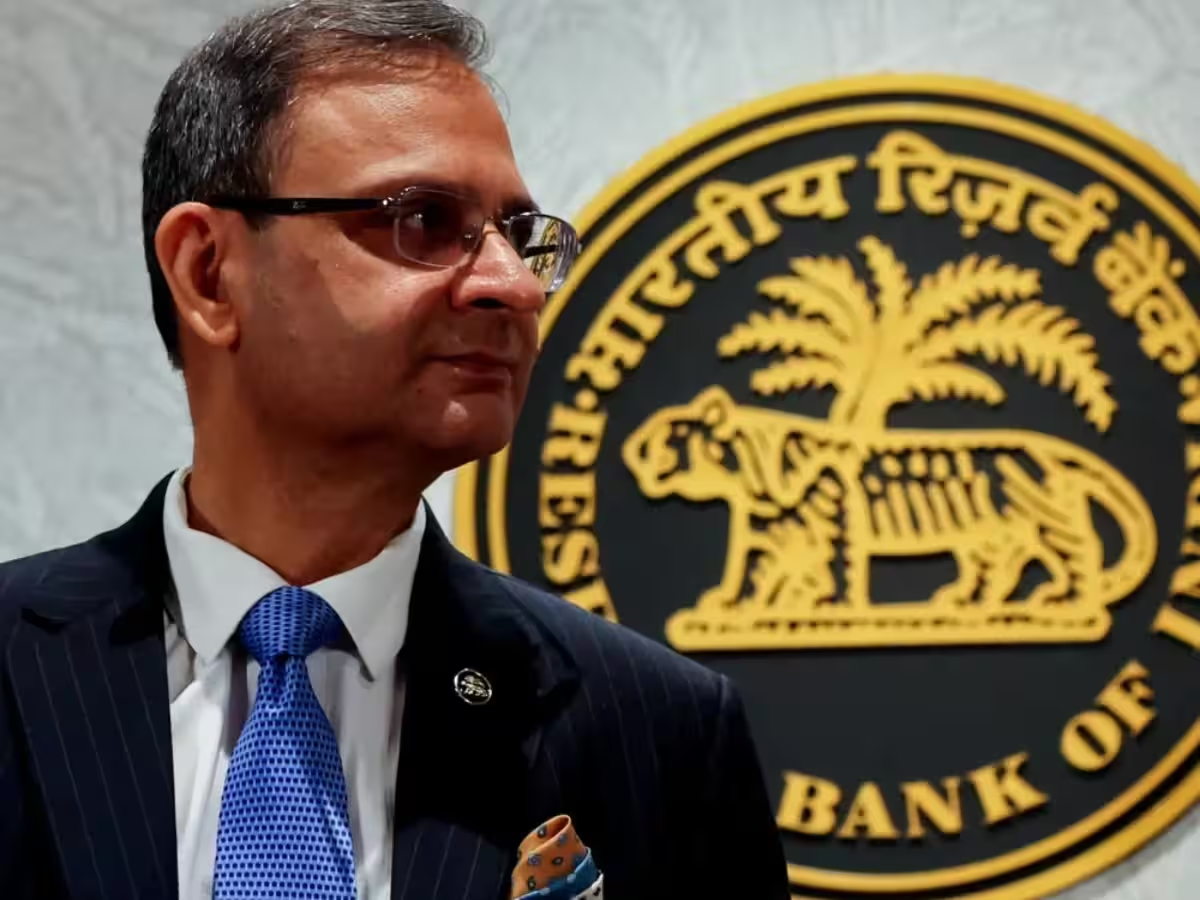
More than two-thirds of the deposits were in the five-year category, with a smaller proportion opting for three- or four-year tenures
| Photo Credit:
According to bankers’ estimates, about 80 per cent of the total $127.23 billion mobilised by Non-Resident Indians (NRIs) under the special Foreign Currency Non-Resident (Bank) FCNR(B) deposits offered by banks through the RBI’s limited-period concessional swap facility came through the leverage route, while more than two-thirds of the deposits were parked in the five-year tenor.Inflows into the special FCNR(B) deposit scheme were robust during the 85-day period from June 8 to August 31, 2026, as high interest rates of 6-7.5 per cent offered by banks attracted NRIs.The Leverage PlayA senior executive at a large public sector bank said that around 80 per cent of the funds mobilised under the special FCNR(B) deposit scheme came through the leverage route, with banks extending loans to NRIs on the condition that the proceeds were redeployed in FCNR(B) deposits.The non-leveraged and non-SBLC-backed component accounted for less than 10 per cent of the total inflows, while SBLC-backed deposits accounted for another 10-12 per cent.“Overall, leverage was the key driver of the inflows,” the banker said.Lured by the prospect of earning higher returns over a longer period, NRIs, particularly those using leverage, largely opted for the maximum five-year tenure. “More than two-thirds of the deposits were in the five-year category, with a smaller proportion opting for three- or four-year tenures,” said a senior executive with a large private sector bank.According to the banker, most FCNR(B) inflows originated from non-US markets because of the tax implications applicable to US-based account holders.“The US market is relatively stringent from a taxation perspective. Under the Foreign Account Tax Compliance Act (FATCA) requirements, account holders may face significant tax implications depending on the treatment of interest earned on loans. As a result, inflows were more prominent from West Asia , Europe and parts of Africa, rather than from the US,” he said.Banking expert V Viswanathan observed that large and mid-sized banks, including public and private sector lenders, leveraged their International Banking Units (IBUs) in GIFT City, thereby avoiding the need for SBLCs from other banks and the associated costs. Combined with tax considerations in countries such as the US, this meant that a substantial share of the FCNR(B) deposits likely came through the leverage route.Viswanathan stated that an NRI who places a $100,000 FCNR(B) deposit at 6 per cent and raises a $900,000 loan at 5.4 per cent could redeploy the loan proceeds into an FCNR(B) deposit earning 6 per cent, thus earning a spread of 0.6 percentage points on the leveraged portion. “The investor earns $6,000 on the original $100,000 deposit and an additional $5,400 through the leveraged position, resulting in total earnings of $11,400. The effective return therefore works out to 11.4 per cent,” he said. While market discussions included leverage levels as high as 19 times, these were reportedly linked to a British bank. “For most banks, however, leverage was closer to nine times,” a banker said.Published on September 4, 2026