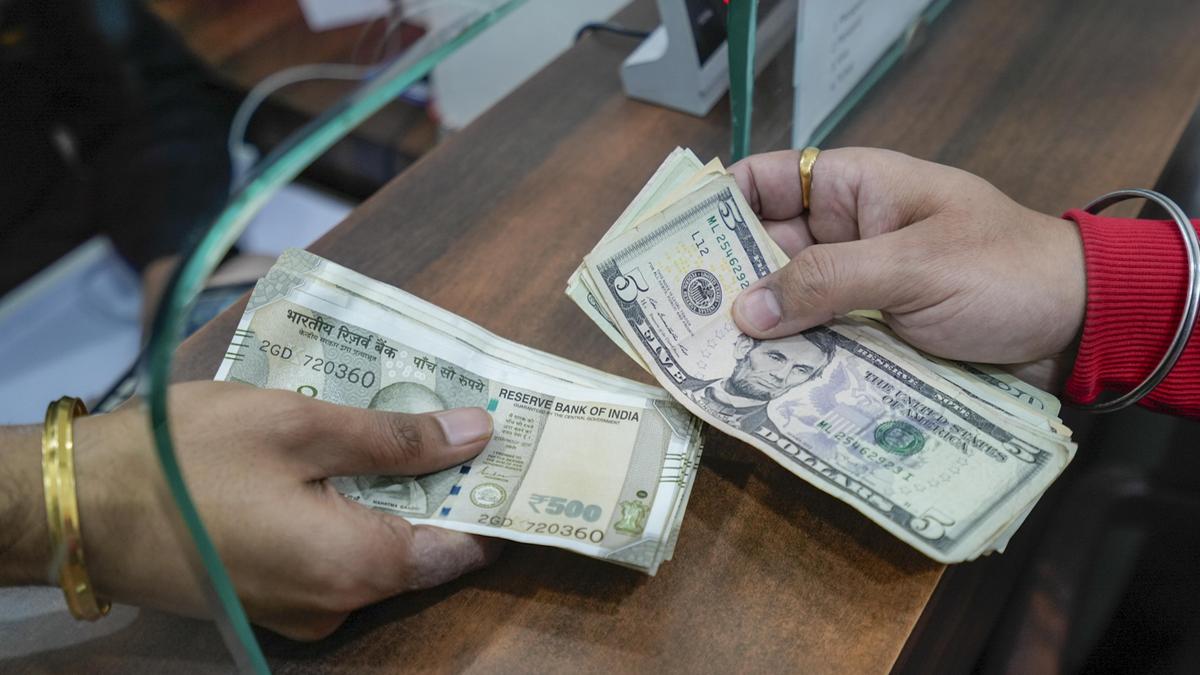
After the government decided to cover hedging costs for 3 to 5-year Foreign Currency Non-Resident Bank- FCNR (B) accounts until September 30, 2026, a lot of banks have raised interest rates on these deposits. With some banks offering over 7% interest rate on FCNR(B), Non-resident Indians (NRIs), Overseas Citizens of India (OCIs) and Persons of Indian Origin (POIs) can look forward to higher maturity amounts than before. But what if they want to explore ways to maximise their returns from FCNR(B)? Can leveraging help them earn even more? An Anand Rathi Shares & Stock Brokers projection shows that by leveraging a $10,000 investment, you can earn as much as $6,150 in interest from a three-year FCNR(B) deposit offering a 7% rate. The projections also show that even with a deposit offering a 6% rate, you could see potential returns of up to $3,150 in three years. This stands in stark contrast to the $4,750 loss you would incur for the same period if the interest rate of the same FCNR(B) were only 3.5%. How does leveraging work in FCNR(B)? Is it safe all the time or are their risks? What is leveraging in FCNR(B) and how can NRIs, OCIs and POIs benefit from it? Leveraging in FCNR(B) is a rate arbitrage strategy where you open an FCNR(B) deposit, borrow against it at a Secured Overnight Financing Rate (SOFR-linked) secured rate, and reinvest that loan into another FCNR(B) deposit. Tanvi Kanchan, associate director, Anand Rathi Shares & Stock Brokers pointed out to ET Wealth Online that one can borrow against the second FCNR(B) deposit also, reinvest again, and repeat until the math no longer supports another cycle. Your own capital stays fixed while your effective deposit base compounds with each iteration. You are, in essence, borrowing cheap dollars and parking them in higher-yielding dollar deposits: a carry trade within a fully secured, bank-intermediated structure. Will leveraging work in your favour all the time? Kanchan explains that the strategy only works when FCNR(B) deposit rates are meaningfully above borrowing costs. When a bank accepts a dollar deposit, it converts the proceeds into rupees for domestic deployment and must hedge that currency exposure in the forward market. That hedging cost, typically 3–3.5% per annum, was passed back into the deposit rate ceiling, keeping FCNR yields in the same 3–3.5% band — too low to make leverage worthwhile. The RBI has now removed that constraint entirely. Banks raising fresh 3–5 year FCNR(B) deposits between June 8 and September 30, 2026, can swap the proceeds with the RBI at par, with the central bank absorbing the full hedging cost. These deposits are also exempt from CRR and SLR requirements. Together, these measures have given banks the headroom to raise deposit rates by 150–300 basis points, and the market has moved immediately. Can NRIs, OCIs and POIs use leveraging higher returns on their deposits? Kanchan shows how leveraging was not a beneficial affair for FCNR(B) depositors before the government’s announcement of bearing hedging costs and how they can now earn more. Why was leveraging not a good option under low FCNR(B) interest rate cycle? In a step-by-step calculation, Kanchan shows how leveraging was not beneficial when FCNR(B) interest rates were low, and how investors can make profits now as rates rise to 6-7%. The expert has taken an example of a 3-year FNCR(B) deposit offering a 3.5% rate. Particulars Amount Own capital $10,000 Total FCNR corpus (10x) $100,000 Interest earned @ 3.5% $3,500/year Borrowing cost on $90,000 @ 5.5% $4,950/year Net result −$1,450/year (loss) In the example above, leverage is $90,000 on a $10,000 deposit and the borrowing cost for that leverage is 5.5%. At those rates, the investor was at a loss of $1,450 per year, or $4,350 in three years. Other two examples show how the same depositor will make profits at 6% and 7% FCNR(B) interest rates following rate revisions.Profit when interest rate in 3-year FCNR(B) rises to 6% Particulars Amount / Details Own capital $10,000 Total FCNR corpus (10x) $100,000 Interest earned @ 6% $6,000 per year Borrowing cost on $90,000 @ 5.5% $4,950 per year Net income $1,050 per year → $3,150 over 3 years Return on own capital ~10.5% p.a. In the calculation, you see that at the same borrowing cost of 5.5%, a 6% rate FCNR(B) can provide a $1,050 profit per year or $3,150 over three years. Profit when interest rate in 3-year FCNR(B) rises to 7% Particulars Amount / Details Own capital $10,000 Total FCNR corpus (10x) $100,000 Interest earned @ 7% $7,000 per year Borrowing cost on $90,000 @ 5.5% $4,950 per year Net income $2,050 per year → $6,150 over 3 years In the calculations, you can see that how a person who was suffering a loss of $4,350 in three years at a 3.5% FCNR(B) interest rate, can earn a profit of $6,150, at an internal rate of return (IRR) of 17.31%, for the same duration when the interest rate of the same deposit rises to 7%. It shows that leveraging may work in favour of depositors when interest rates are higher than the borrowing costs. But that brings us to the next question, will borrowing costs remain fixed throughout the FCNR(B) tenure? Is the borrowing cost of an FCNR(B) depositor fixed? Kanchan says leveraging amplifies returns when the spread works in your favour — but it cuts equally hard in the other direction when it does not. “The FCNR deposit rate is locked in at booking. The borrowing cost is not always fixed. If Secured Overnight Financing Rate (SOFR) rises at the point of loan rollover, your funding cost goes up while your deposit yield stays where it was. A 50–100 basis point move in SOFR can compress, or entirely eliminate, the margin you are counting on,” says Kanchan.SOFR is the primary benchmark interest rate used for US dollar-denominated loans and derivatives. It’s a market-driven rate that changes every day and is published by the Federal Reserve Bank of New York. Can leverage magnify losses? Kanchan says leverage can also magnify losses and not just gains. “At 10x, a small adverse move has ten times the impact on your equity. If borrowing costs rise enough to flip the spread negative, you are not just earning less — you are paying out of pocket on a position ten times the size of your original investment,” says Kanchan. Tax in country of residence also matters Kanchan says that the returns from FNNR(B) are tax-free in India, but investors may need to pay tax in their country of residence. “Tax in your country of residence can change the numbers materially. FCNR interest is tax-free in India, but that exemption does not travel. A UAE-based NRI captures the full headline return. A US-based NRI pays federal income tax on the same income, must file FBAR disclosures, and must comply with FATCA — potentially reducing net returns by 30% or more,” says Kanchan. Hence, you can see that leveraging works well when FNCR(B) interest rates are high andthe borrowing cost is low. If borrowing costs go up during the FCNR(B) tenure, you may end up suffering losses. Lastly, interest earned on FCNR(B) is tax-free in India, but you may need to pay tax in the country of your residence. What is FCNR(B) and who can invest? FCNR(B) is a term deposit account that allows Non-resident Indians (NRIs), Overseas Citizens of India (OCI) and Persons of Indian Origin (POIs) to invest and withdraw deposits in designated foreign currencies such as USD, GBP, EUR, AUD, CAD and JPY with an authorised Indian bank. Additionally, interest earned on FCNR(B) deposits is exempt from income tax in India for eligible non-resident depositors. This is in contrast to Non-Resident External (NRE) accounts where an NRI can invest and withdraw in Indian currency and the interest income is taxable in India. What has changed in FCNR(B) deposit hedging cost for banks? In the June 2026 Monetary Policy Committee (MPC) meeting, RBI governor Sanjay Malhotra announced that the government would bear the entire hedging cost for fresh 3 to 5-year FCNR(B) deposits until September 30, 2026.It means since banks will not bear the hedging cost till September 30, they can pass on more interest to NRI depositors directly. Based on bankers' estimates, rates could go up by 1.5% to 2%.
Looking for over 17% return from FCNR deposit through leverage? Check pitfalls before getting lured - The Economic Times
The Indian government's decision to cover hedging costs for FCNR(B) deposits until September 2026 has enabled banks to offer higher interest rates, exceeding 7%. This allows NRIs to leverage these deposits for potentially greater returns, though risks associated with fluctuating borrowing costs and foreign taxes remain.
1,385 words~6 min read