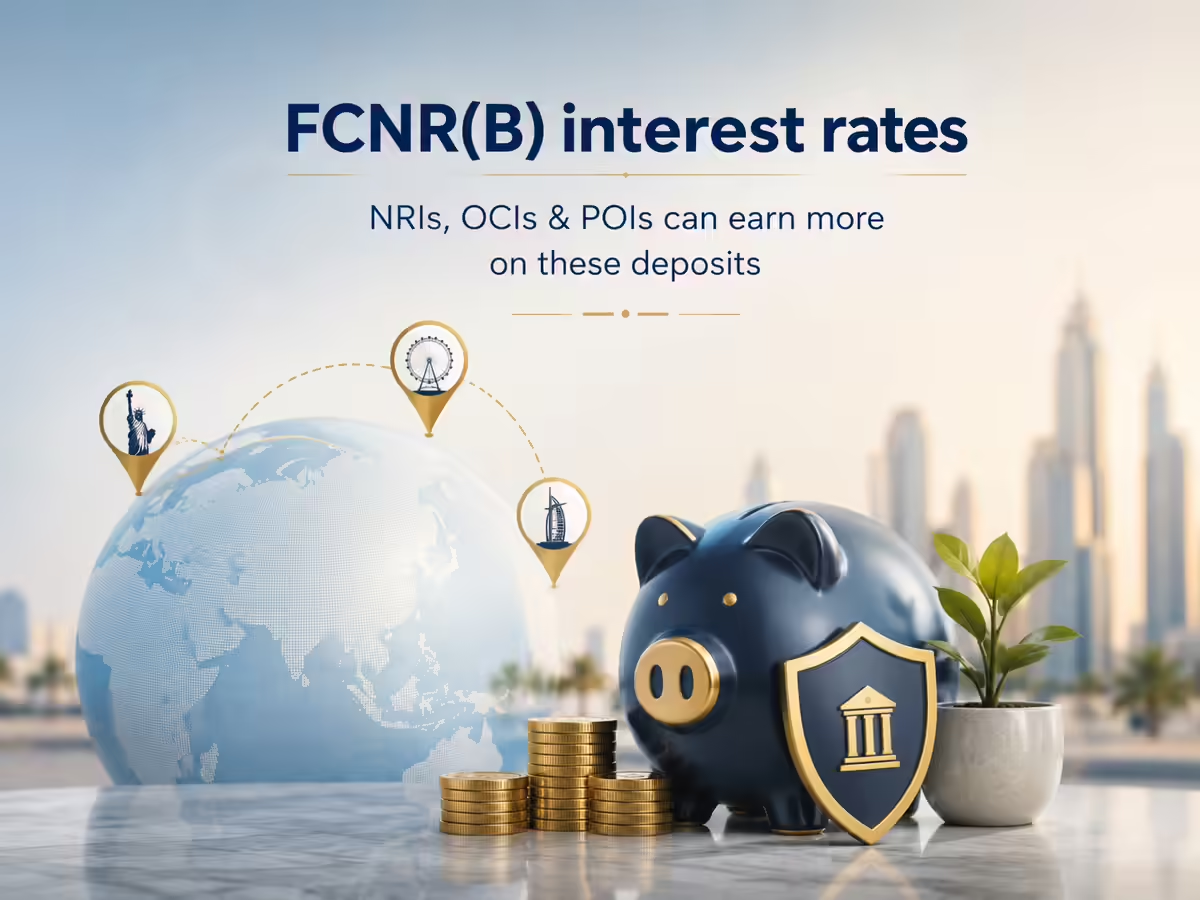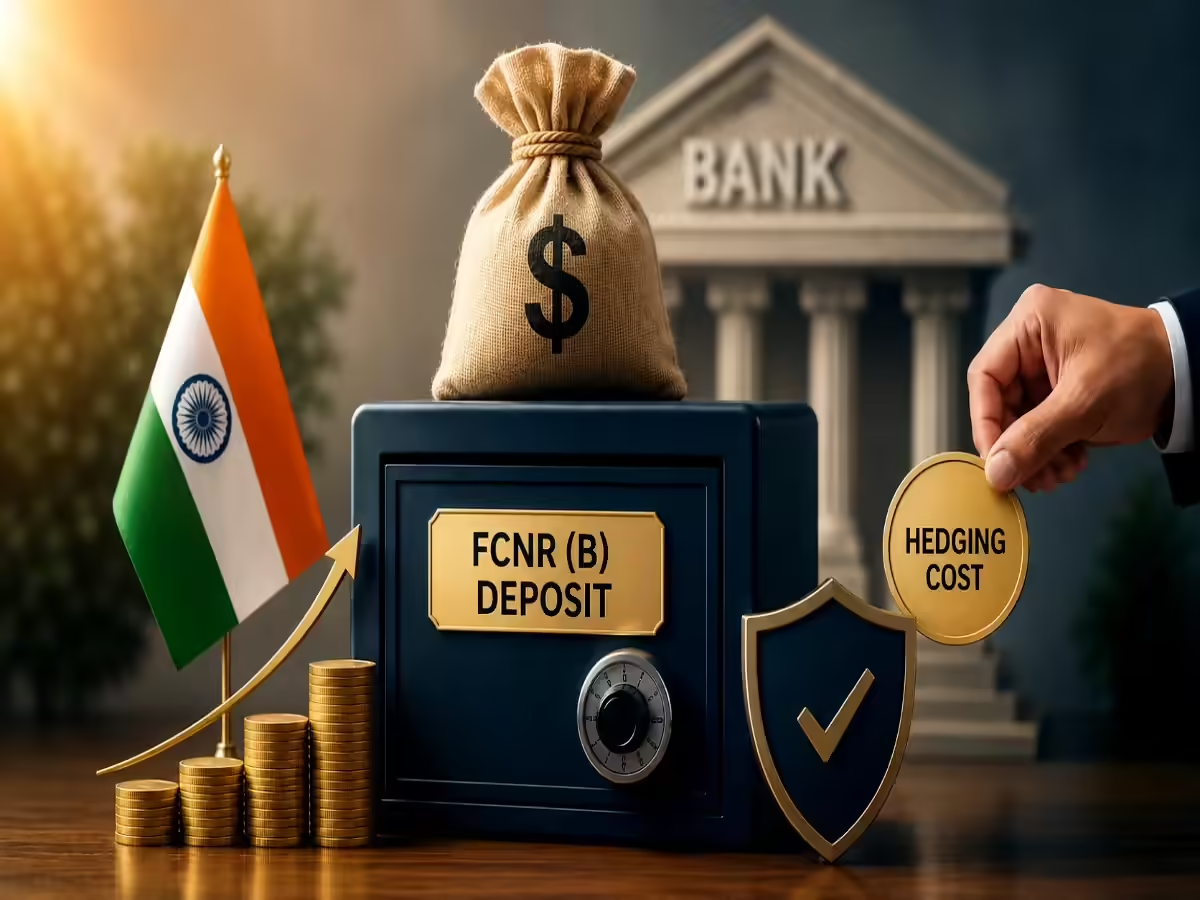
Banks are visibly euphoric about mobilization of FCNR (B) deposits following the RBI decision that it will bear the full hedging cost till September 30, 2026 to banks for raising fresh 3-5-year FCNR (B) deposits. The facility has spurred banks to offer higher rates for such deposits varying between 6 per cent and 7.1 per cent.At these rates, there could be arbitrage and leverage opportunities for FCNR (B) depositors, besides the opportunity to convert NR(E)RA deposits to FCNR (B) deposits.However, we argue that banks need not be ‘excessively exuberant’; rather they should be ‘cautiously optimistic.’Income Effect – The Missing LinkBasically, two variables define the savings function: Income (Y) and Rate of Interest (r). Normally, both ‘Y’ and ‘r’ have positive influence on savings.While the current opinions on FCNR (B) deposits are overwhelmingly shaped by ‘r’, it totally ignores the first and foremost variable (‘Y’). Our ‘main’ argument articulated below is about the missing ‘Y.’The US is the topmost source of remittances to India, with it accounting for 27.7 per cent of India’s total inward remittances (RBI Survey on Remittances, 2023-24).1 Further, the ‘retail’ Indian depositors constitute the major providers of FCNR (B) deposits in USD.The ‘retail’ Indian depositors in the US mainly comprise the H1-B workers, green card holders and even OPT (Optional Practical Training) interns. With Trump coming into power for the second time in January 2025, the Indian workers were pounded by various so-called “executive” orders leading to massive layoffs across-the-board, but especially from the technology companies where most of the Indians were employed. Ultimately, several Indian workers left USA, and several others became unemployed or switched to lower-paid jobs. A lot paid $100,000 to get H1-B visa.Add to this the increased inflation in USA which now borders at 5 per cent. It is noteworthy here that the inflation rate that Indians face in USA is higher than the general US inflation rate,as the former buys their groceries from the so-called ‘Indian Stores’ which import consumables from India with higher tariffs, post-Trump presidency.Thus, the Indian diaspora in USA is, at present, facing a severe income or budget constraint, less reported in India. Besides, their credit ratings are under cloud, making it difficult for them to avail of loans.In such ‘uncertain’ environment, which has been exacerbated by the AI spectre, the Indian diaspora would like to have cash or near-cash with themselves or in nearby banks, instead of investing them in India as 3-5 year deposits. Sluggish servicing of education loans by the H1-B workers is illustrative.That the ‘need’ has outweighed the ‘return’ is quite but natural.Statistical evidence in respect of the ‘Trump effect’ on India’s inward remittances from USA is crystal clear. During 2025-26, the outstanding FCNR (B) deposits (in USD terms) grew by just 2.9 per cent as against 27.5 per cent during 2024-25 and 32.9 per cent in 2023-24.Further, in the 9-month period following Trump’s second term, FCNR (B) deposits grew by 2.3 per cent as against 22.8 per cent recorded in the similar period prior to his presidency.Therefore, the question is: Will the ‘income’ effect overshadow the ‘interest rate’ effect? If so, then banks may have to focus on bulk FCNR (B) deposits from the rich or super-rich and/or look forward to depositors converting their NR(E)RA deposits to FCNR (B) deposits, with the former potentially increasing the concentration risk for banks.Other Issues· Euphoria incentivises window-dressing. NR(E)RA deposits (only) – not NRO - are convertible into FCNR (B) deposits. There is no problem so long as the depositors, on their own, exercise this option. However, in order to achieve their targets, if banks ‘trick’ the NR(E)RA depositors into it, then, it will attract the ‘mis-selling’ tag. The central bank should monitor such events.· The RBI is also in the process of increasing the limits for investment by NRIs and OCIs in equity instruments traded on the stock market without SEBI registration, with the same facility being extended to all individual Persons Resident Outside India at par with NRIs and OCIs.· Banks, while canvassing FCNR (B) deposits will have to reckon with this competition. Moreover, “without SEBI registration” should not be a bone of legal contention later.· Banks will have to tackle remittances through the so-called ‘hawala’ route which in such circumstances become very active.· With the US-Iran peace deal on the anvil, the stock markets in USA and India have begun to brighten up. Therefore, FCNR (B) deposit mobilisation will also have to compete with stock markets, in which the latter will likely weigh more. In such a situation, even the providers of bulk FCNR (B) deposits will be circumspect before committing funds for 3-5 years.· For new accounts, proper KYC documentation will be paramount against the backdrop of growing money laundering especially through mule accounts, cyber frauds and the like, in the domestic as well as international markets.· Remittance cost, another determinant, will escalate in the case of ‘round tripping’ through gifting. However, remittance cost from USA to India has significantly declined over time.· Finally, the likely impact on banks’ Asset-Liability Management, net interest income, some of the Basle prudential norms such as the Liquidity Coverage Ratio and Net Stable Funding Ratio, and deposit insurance premium to be paid need to be watched.The writer is a former Assistant General Manager (Economist), SBI. Views expressed are personal.Published on June 19, 2026
Euphoria over FCNR (B) deposits misplaced
Sections of the Indian diaspora in the US are facing an income squeeze, which may cloud the prospects of this scheme
885 words~4 min read