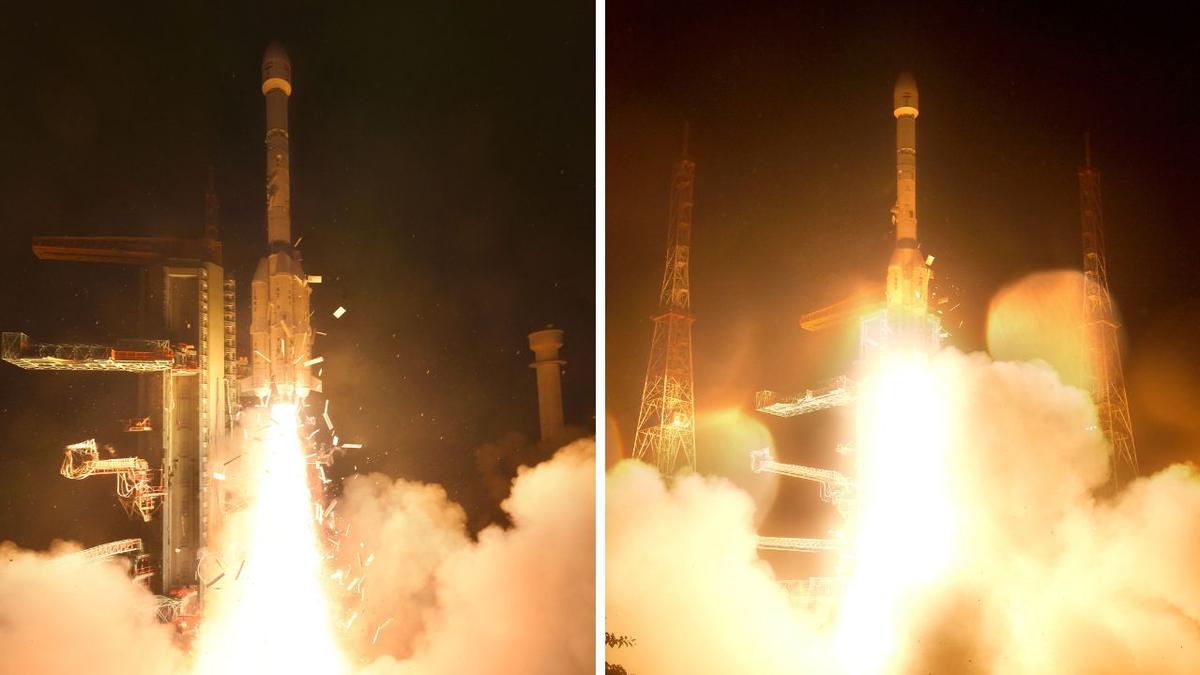
ISRO’s GSLV successfully launched EOS-05, India’s first imaging satellite headed for geosynchronous orbit, strengthening capabilities in surveillance, weather monitoring and disaster management.
A silent, pitch-black horizon. Some faint murmurs that soon faded away as the countdown reached the last few digits. ‘Liftoff’ had barely echoed from the speakers when it cut through the night sky speckled with rain, and soared above to turn the dark sky into bright golden hue.ISRO’s Geosynchronous Satellite Launch Vehicle (GSLV) lifted off for the nineteenth time and carried with it EOS-05 - India’s first imaging satellite headed to the Earth’s Geosynchronous Earth Orbit.The satellite has been injected into the Geostationary Transfer Orbit (GTO) and is expected to reach GEO over the next few days using its own engines.From 36,000 Kilometers, EOS-05 will act as India’s ‘eye-in-the-sky’ that will help monitor critical assets like remote borders and conflict zones. Unlike other imaging satellites stationed at lower altitudes, EOS-05 will match Earth’s rotation, providing continuous, real-time viewing of the same region rather than multiple snapshots captured by satellites in lower orbits.This continuous view will bolster India’s strategic surveillance capabilities and assist with weather forecasting, cyclone and storm tracking, disaster management, agriculture, and environmental monitoring.Second time’s the charmInterestingly, ISRO attempted to accomplish this mission once in 2021 but was unsuccessful due to a technical anomaly during the third Cryogenic Upper Stage ignition.Speaking after the launch, V Narayanan, Chairman, ISRO, emphasised ISRO’s lessons from previous missions and the gradual improvements it made.“The first launch of the GSLV was with a payload of 1536 KGs. Since then we have gradually improved the performance of this vehicle by optimising the structural mass and improving the propulsion system and today we have injected the heaviest satellite - 2367 KGs- launched with this vehicle,” he said.Narayanan added that ISRO has planned six more launches this financial year, including the critical NVS-03 navigation satellite. He also mentioned that the team is working vigorously on the Gaganyaan programme with targets for the first launch this calendar year. ”We will have to complete three uncrewed missions, after which we can target the first crewed mission,” he said.Respite for ISROReturning to the launchpad for the first time after roughly seven months, the GSLV’s successful launch has brought some much-needed respite for ISRO. The space agency had previously had to contend with two consecutive failures of its ‘workhorse’ Polar Satellite Launch Vehicle, including the PSLV-C62/EOS-N1 mission in January, alongside concerns about employee attrition.Dubbed the ‘naughty boy’ for its unpredictability and occasional failures, GSLV’s scorecard now includes 13 successes, 4 failures, and 2 partial failures.At a press conference post the launch, Narayanan also emphasised on the importance of the private sector in India’s space ecosystem. The agency had recently invited private operators to run and maintain the under construction SSLV space port in Kulushekarpatanam near Thoothukudi.“The space sector has to grow. The private companies are not from a different country. It is our own people. It is our responsibility to handhold them and bring them to our stature” he said responding to a query on whether the private sector has required access to talent needed to carry out such operationsPublished on September 4, 2026