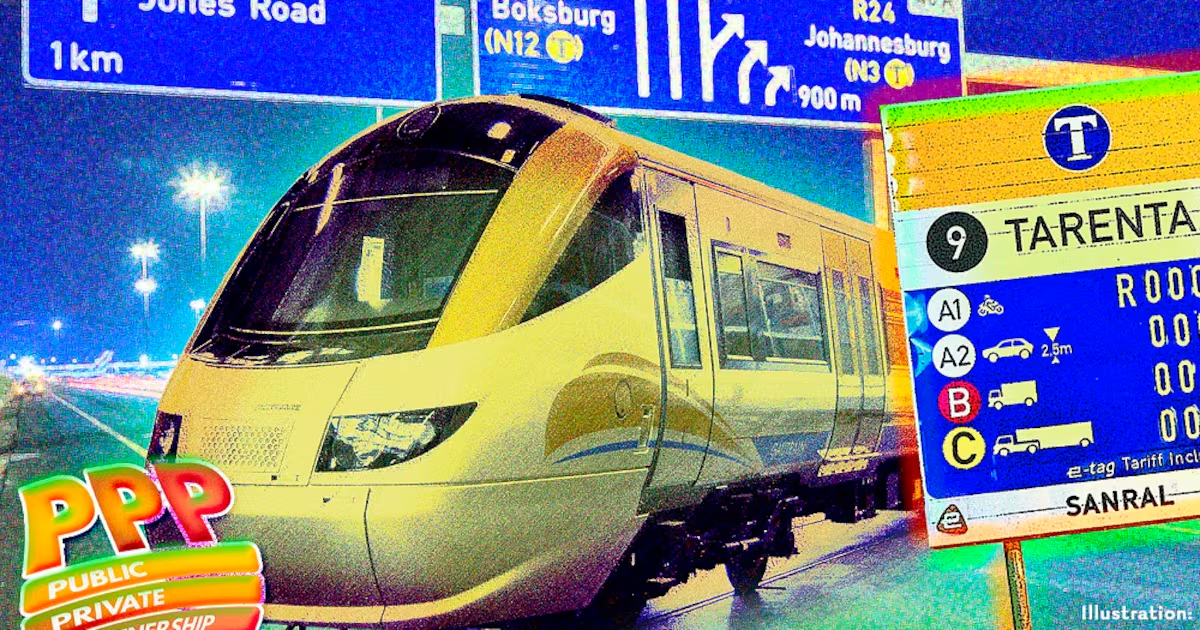
South Africa’s infrastructure challenge is usually described as a shortage of money. The description is understandable. It is also incomplete. The 2026 budget provides for R1.07-trillion in public sector infrastructure expenditure over the next three years. Yet fixed investment stood at only 14.2% of GDP in 2024, less than half the National Development Plan’s target of 30%. More revealingly, only R25.2bn of the R1.07-trillion is formally classified as public-private partnership (PPP) expenditure. That is about 2.4% of the total. These figures expose a conversion gap between the infrastructure South Africa intends to build and the projects that are sufficiently prepared to attract finance and reach construction. The National Treasury reports that 63 PPP projects are at different stages of development. However, 17 remain in inception, 32 are undergoing feasibility studies and only 14 have reached procurement. The same pattern is visible in the budget facility for infrastructure. During the first three submission windows of 2025/26, it received 42 projects with a combined capital cost of R438.8bn. Only 10 were accepted into the pipeline. The remainder required further preparation or reconsideration. That is where South Africa’s infrastructure problem increasingly begins. Capital cannot finance a policy announcement, a concept note or an item on a national project list. It finances a project with a clearly defined asset, a credible business case, realistic costs, lawful approvals, an identifiable revenue or payment mechanism and risks that can be understood and managed. A PPP is not free money The public conversation about PPPs often begins at the wrong point. Supporters sometimes present them as the answer to fiscal pressure. Critics regard them as privatisation by another name. Private finance does not make infrastructure free. Despite any form of repayment, the project must ultimately have an affordable source of revenue. A weak project does not become viable simply because a private company is invited to finance it. A PPP also does not automatically require the state to surrender ownership or responsibility. Government can retain ownership of strategic infrastructure while using private capital and maintain it under regulated conditions. The opening of South Africa’s freight rail network demonstrates this distinction. The state retains the rail infrastructure, while private train operating companies receive regulated access to available capacity. An argument can be made that this is private participation without the disposal of the national rail network. Effective partnership therefore requires a more capable state, not a retreating one. The government must define the outcome, prepare the project, regulate performance and enforce the agreement. The private sector must then be held accountable for the risks and responsibilities it has accepted. Energy infrastructure is a system Energy debates tend to concentrate on generation. Yet a power plant without transmission capacity cannot supply the economy. Gas-fired generation without ports, pipelines, storage and dependable offtake arrangements remains an incomplete proposition. Fuel cannot reach farms, factories and transport networks if rail lines, roads, terminals and distribution systems are unreliable. Potential domestic energy resources belong in the same systems view. Their value depends on responsible licensing, credible environmental safeguards, community participation and infrastructure connecting production to demand. The scale of the transmission challenge makes the point. South Africa plans to construct about 14,000km of transmission lines at an estimated cost of R450bn. The government has consequently established a credit guarantee mechanism to help share risk and attract private investment. This does not predetermine who should own the grid or what the future energy mix must be. It recognises that infrastructure systems of this scale cannot be planned one asset, one institution or one balance sheet at a time. The renewable energy independent power producer procurement programme offers an important lesson. Its significance lies not only in the capital raised. The programme created a repeatable procurement process, clearer rules, competitive bidding and an identifiable route to market. That is the difference between inviting investment and creating the conditions in which investment can occur. Project preparation is infrastructure Recent reforms are encouraging. Amended PPP regulations have simplified parts of the approval process. New rules provide a framework for unsolicited proposals and closer monitoring of fiscal commitments. The Infrastructure Finance & Implementation Support Agency has been established to mobilise private finance and technical expertise at scale to accelerate infrastructure delivery countrywide. These are important changes, but their success should not be measured by the number of new frameworks created, but by how many credible projects reach financial close, begin construction and provide a reliable service. Project preparation must then be funded as deliberately as construction. Engineering studies, environmental work, financial modelling, legal structuring and community engagement are not peripheral administrative expenses. South Africa should also move from isolated transactions towards repeatable programmes. Standard contracts and sector-specific risk frameworks can reduce the time and expense involved in designing every transaction from the beginning. Clarity on the “rules of the game” on effective and sufficient stakeholder engagement is required in this space — in the past decade or so, what is considered “sufficient consultation” has been shifting, and a number of projects have stalled due to stakeholder engagement. What then happens to projects in which stakeholders do not have a common view is the big question. South Africa does not need to choose between a capable state and private investment. It needs a capable state that can direct private investment towards public outcomes. • Museisi is country chair at Shell Downstream South Africa.Business Day
ALUWANI MUSEISI | SA’s infrastructure problem starts before the money
South Africa's infrastructure pipeline stalls at the preparation stage, not financing
895 words~4 min read