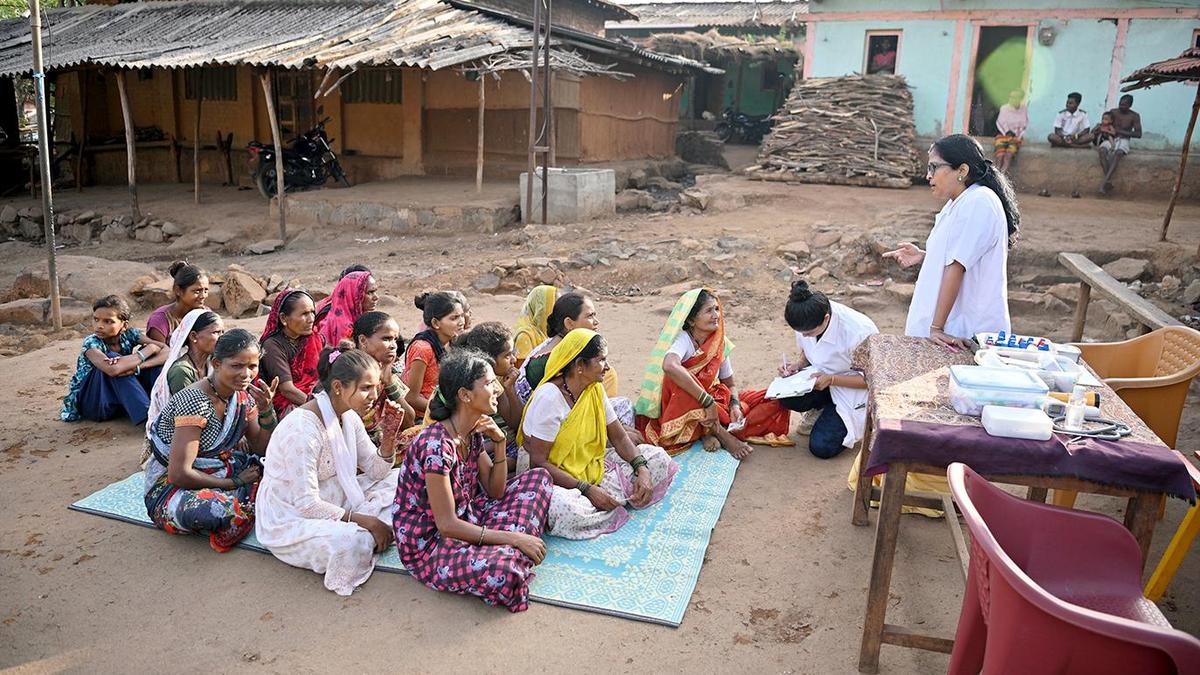
Every now and then, we see it in the newspapers: the picture of a pregnant tribal woman being carried in a makeshift stretcher or a wooden cot along a mud path in some remote village. People see the picture, feel a flicker of something, and then the news cycle moves on. In the tale of Sombari Sabar, Ramani Atkuri shows us what happens next.“The procession moved slowly down the hillside, almost regal in appearance. The woman sat on a wooden chair secured to two bamboo poles and carried by four men. A black umbrella had been fixed to the back of the chair to shield her from the sun… The chair was lowered carefully outside the dispensary and the woman’s arms and legs were untied, having been anchored to the chair for safety. She was in late pregnancy and walked slowly towards me. She told me she had been in labour for the past two days without delivering the baby and had received two takatara suji (injections) intended to increase strength but to no effect. My heart sank as I examined her… I felt a surge of fear.”The chapter in Staying Alive is titled ‘Saving Sombari Sabar’. Against all odds, the health workers make every possible effort. They rush her to the district hospital in their jeep, racing down the mountainside. In the hospital, they hang her IV drip from the bar of a window. When Sombari needs blood and her family members are found to be too anaemic, they donate blood themselves. They even buy the medicines on credit when all their money is gone and they cannot even get a cup of tea for themselves. Despite all these efforts, neither the baby, which Atkuri reflects had possibly died days ago, nor Sombari, will survive.Atkuri reflects on what Sombari’s story says about maternal health in rural India. “What caused Sombari’s death? It was not a single factor, but a cascade of events that resulted in the death of a young woman who was barely twenty: obstructed labour, inappropriate administration of injections for ‘strength’, uterine rupture leading to infection and shock, the long distance to reach medical help, and the delayed treatment at the hospital.”Struggle to surviveFor those on the margins of society, “healthcare” is perhaps too vast a word to describe the effort of not succumbing to all the things that can take a life: hunger, haemorrhage, the hidden abscess, the bite of a malarial mosquito. Staying Alive is about how those who are unseen and forgotten struggle just to survive. Atkuri trained as a doctor, specialising in community medicine at CMC Vellore, and has spent 35 years working with rural and tribal communities, mainly in Central India. In these dispatches from those margins, she tells their stories.For two long and painful years, a woman has gone from one misdiagnosis to another until her skin ailment is finally diagnosed for what it is: leprosy. A middle-aged diabetic tailor comes to terms with his irreversibly failing eyesight. A 10-year-old child with untreated epilepsy falls into a fire and is brought with burns all over her body. These are the stories of those who are often invisible to the system. In spare, austere prose, Atkuri bears witness and recounts their struggle.Systemic challengesBeyond individual stories, Atkuri widens the lens to the structural conditions that produce smaller versions of these outcomes. Anaemia, low BMI, and gaps in antenatal care leave babies vulnerable to low birth weight, with each generation entering the world already behind. Distress migration triggered by drought adds another challenge. It dislocates communities not just from the land, but from whatever fragile access to a clinic or a health worker they once had. Families crushed by debt are uprooted to locations where even the language is unfamiliar. Away from any continuity of care, a child’s immunisation schedule or a pregnant woman’s antenatal checkup may simply fall through the cracks of a system that is unable to reach people across State boundaries.Much of what Atkuri writes about are diseases of neglect. TB and malaria, cholera and snakebite, drowning, poisoning, and burns are the everyday hazards of poverty, some made worse with malnutrition. They are possible to survive with timely care — and potentially fatal without it.Diagnosing the weaknesses of the system too, Atkuri argues that India’s public health architecture is well conceptualised, with sound policies, but hollowed out by inadequate investment, chronic under-staffing, deteriorating infrastructure, uneven data, and technology that is deployed without sufficient planning. She is blunt about the overall outcome: that those who are least able to afford it end up shouldering a substantial burden of health expenditure.There is no silver bullet for any of this, and Atkuri is too honest a witness to pretend otherwise. Decentralisation will certainly help to improve service delivery and can make the public health system more responsive to the needs of rural communities. Quality infrastructure, better data, and more staffing are reforms that are necessary — even if, for the Sombari Sabars of these pages, they will always arrive a little late. What Staying Alive offers instead is an insistence that lives on the margins should be looked at with humanity, written about, and cared for.The reviewer is in the IAS.
When healthcare comes too late | Review of Ramani Atkuri’s Staying Alive
Explore Ramani Atkuri's "Staying Alive," revealing the urgent need for compassionate healthcare for marginalized communities in India.
877 words~4 min read