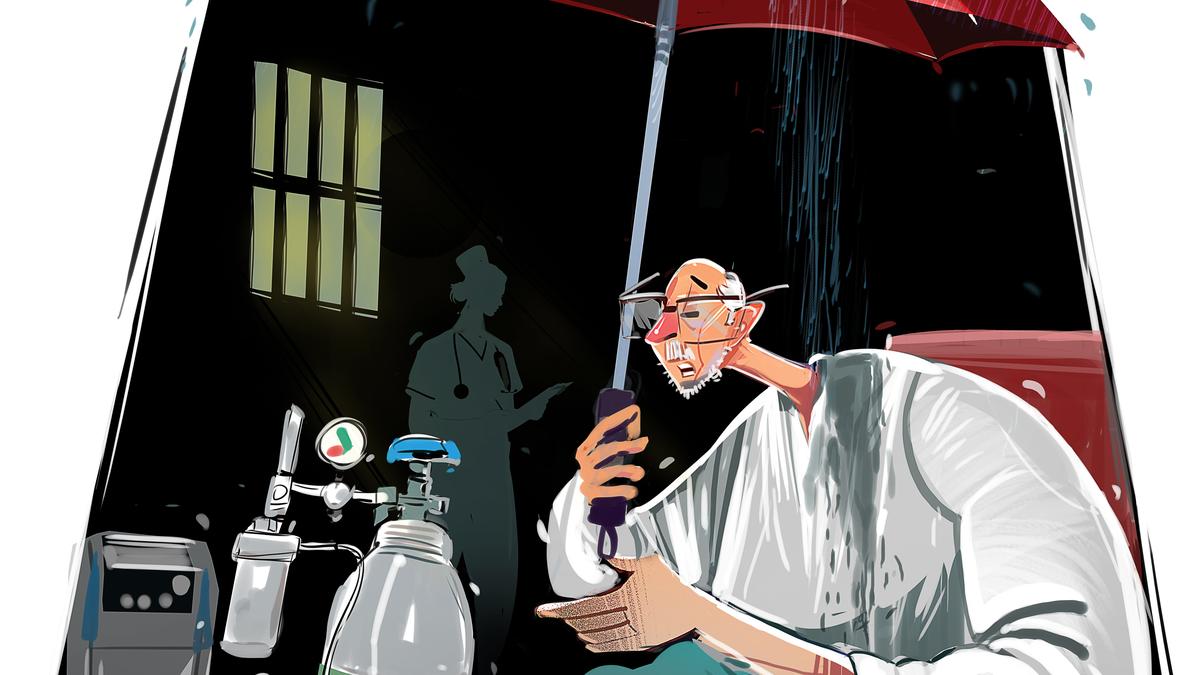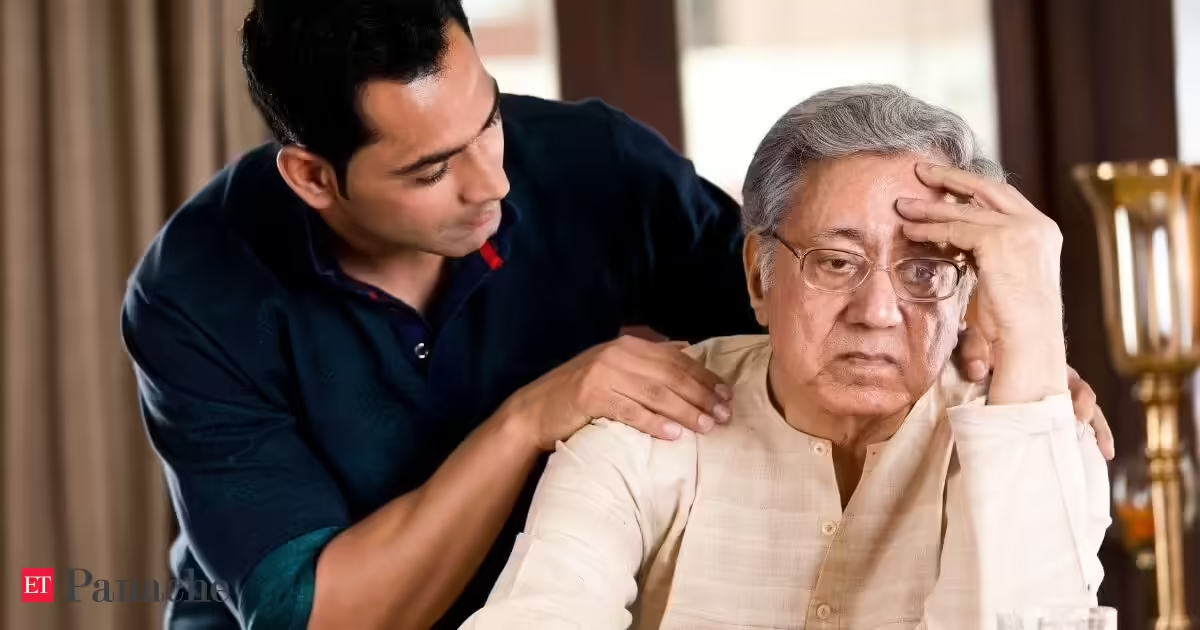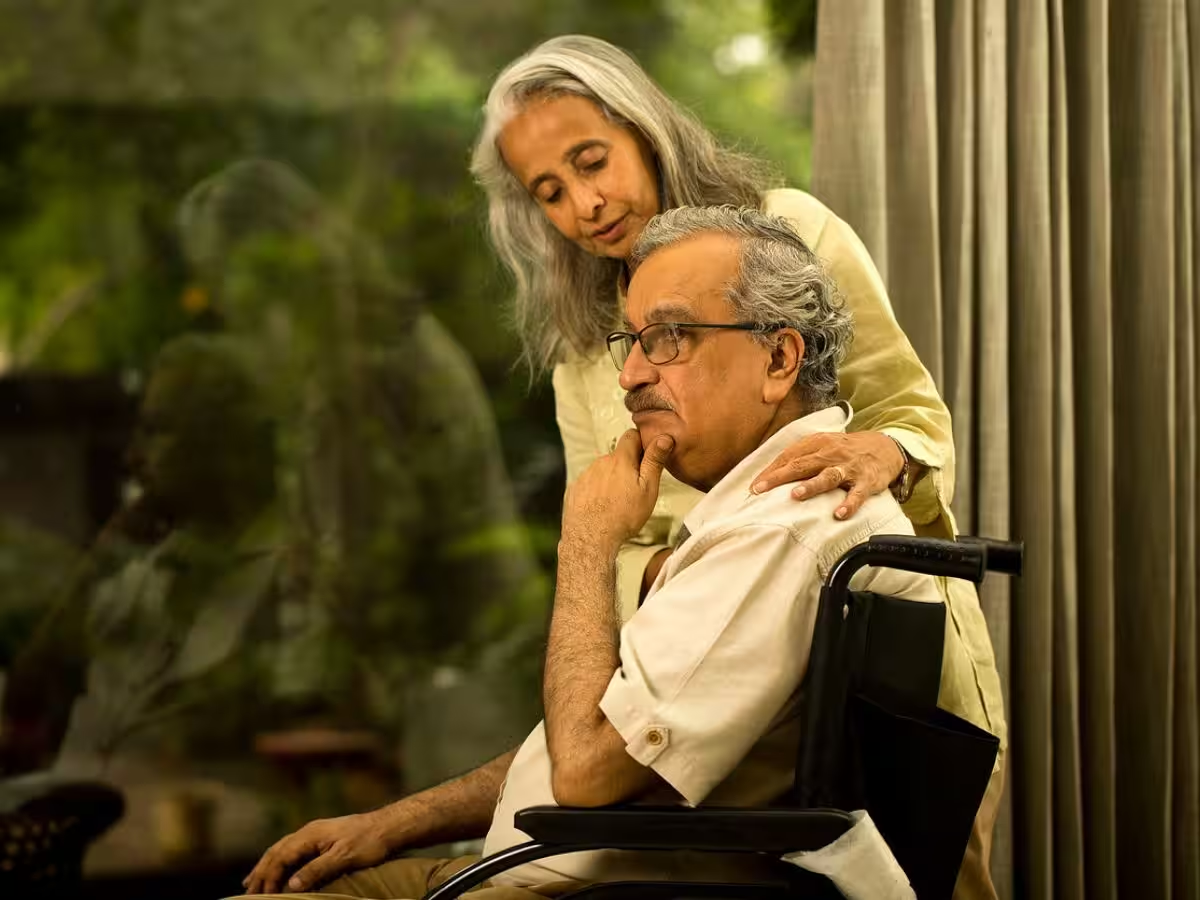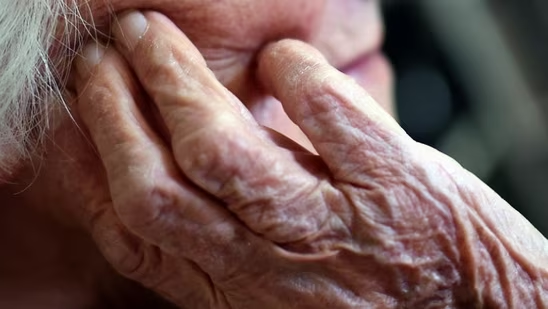
There is a scene that plays out in Indian households with quiet, grinding regularity. A parent, perhaps in their late sixties, falls. A hip is fractured. An adult child, often working in another city or another country, rushes back. The parent is hospitalised, operated on, and eventually discharged. But discharged into what? A home that is not adapted for reduced mobility. A city with no accessible physiotherapy on demand. A family that must now reorganise its entire routine around a loved one who can no longer stand unassisted. Six months later, the parent has not regained full function. Depression sets in. The family has spent the savings and financial reserves it took two decades to build. And no one has a name for what happened. They call it ‘old age’ but the reality is far more specific. What happened is frailty. And India is catastrophically unprepared for it.Ageing (Britta Pedersen/dpa/picture alliance )According to the UNFPA's India Ageing Report 2023, by 2050 the share of older persons in India will reach 20.8%; 347 million people aged 60 and above. By 2046, for the first time, they will outnumber India's children. As a nation and a society, we speak often, and rightly, about cancer. We have national missions for cancer; awareness months, celebrity advocate. Cancer is visible, urgent, and terrifying, and it lends itself to difficult but legible narratives. Frailty, by contrast, is slow, stealthy. It does not announce itself suddenly. It creeps in through a slight loss of grip strength, a reluctance to climb stairs, a growing fatigue after meals, and a steadily narrowing world. By the time a family recognises the crisis that has been slowly building, it has usually already crossed a threshold from which return is partial at best.What is rarely discussed in health policy is exactly how this population will age. A 2023 nationally representative study published in Aging Medicine revealed that an alarming 42% of Indians aged 60 and above are already clinically frail. A comprehensive 2025 meta-analysis in The Journal of Frailty and Aging placed the pooled community frailty prevalence at 36 %t, with pre-frailty affecting an additional 48 %. Applied to UNFPA's projection of 347 million elderly Indians by 2050, even a conservative frailty rate would translate to well over 100 million frail older adults a public health burden with no existing system to absorb it. People who are not acutely ill but nevertheless cannot function independently, who fall repeatedly, who are hospitalised not because of a single dramatic disease but because their physiological reserves have been so depleted that any stressor tips them over.The health care system these individuals will encounter is almost entirely unprepared for them. The Journal of the Indian Academy of Geriatrics estimates are alarming, India needs approximately 27,600 trained geriatricians for it’s present population to meet international care ratios. The actual number who practice today are a tiny fraction of that. Geriatric medicine in India remains, in most cities, a speciality that exists in name alone on hospital websites and barely in practice on the ground. Geriatric services are virtually absent at the primary health level. Community physiotherapy is inaccessible in most tier-two and tier-three cities. Memory clinics and fall-prevention programmes, standard pillars of ageing care in Europe and much of East Asia, are rarities here.The economic argument alone should make people think; force an urgent policy pivot. The World Bank has estimated that if unpaid caregiving for elderly and disabled persons were compensated at market rates, it would account for nine per cent of global GDP. In India, where formal geriatric care systems are underdeveloped, this burden falls almost entirely on families and disproportionately on women. The daughter-in-law who gives up employment. The son who negotiates reduced working hours with an employer who may not be sympathetic. The family that drains fixed deposits to pay for a private nurse who often has no formal training in geriatric care. This is not a health problem alone. It is a profound economic and gender crisis, one that compounds quietly across millions of households with no accounting in any national ledger.The Indian elderly are also among the most financially vulnerable. Over 40% are in the poorest wealth quintile; nearly 19% have no income at all. In households composed entirely of elderly members, health care spending consumes over 13% of total expenditure, compared to 5% in relatively younger households. Insurance covers only 31% of Indian seniors. The rest must pay out-of-pocket for conditions that, unlike a single surgical intervention, tend to be chronic, recurrent, and indefinitely expensive.Frailty is not the end of a life well-lived. It is a medical syndrome, in many cases preventable and in most cases manageable, if only we choose to treat it as such.What makes this particularly urgent is that frailty, unlike many of the other conditions it is confused with, is neither inevitable nor untreatable. The science is clear and has been for some years. We have decades of Level 1 clinical evidence detailing exactly how to intervene. Early identification of pre-frailty through simple low-cost clinical tools, such as grip strength, gait speed, and self-reported exhaustion, allow for meaningful intervention that can change a patient's trajectory. The physiological countermeasures are well-established: Targeted resistance training to combat sarcopenia and rebuild neuromuscular integrity, protein optimisation by shifting from carbohydrate-heavy traditional diets to specific amino-acid and protein rich diets, controlling insulin resistance to preserve vascular and cognitive health, comprehensive fall-prevention programmes that preserve balance and mobility, rich community and social engagement - these measures have all demonstrated efficacy in reversing or slowing frailty progression. The tragedy is not that we lack the science or knowledge, but that we lack the systems, the policy will, the delivery models -and frankly, the cultural vocabulary to act on it.We tend, as a society, to speak of ageing as a decline that must be endured, managed by families out of duty, and addressed by medicine only when a crisis arrives. This framing is costly. A frail elderly person who falls and fractures a hip costs the health care system and their family vastly more than one whose frailty was identified and addressed two years earlier. The hospital admission, the surgery, the rehabilitation that may or may not materialise, the long-term loss of function, the financial devastation -all of this is, to a meaningful degree, preventable.There are structural steps that can and must be taken. Geriatrics needs to be embedded in the medical curriculum with the seriousness it receives in the United Kingdom, Canada, and across Scandinavia. ASHA workers and primary care physicians need training in basic frailty screening tools to catch the decline in the ‘pre-frail’ window. The National Programme for Healthcare of the Elderly, which exists on paper and is poorly funded in practice, requires not a revision but a reimagination. Long-term care insurance, not unlike what Japan introduced in 2000, in anticipation of precisely this demographic curve, deserves a serious policy conversation in India. And urban planning, including buildings, pavements, parks and public transport, needs to account for a population that is growing older faster than our cities are growing more accessible.None of this is beyond India’s capacity. What it requires is that we first agree to have an honest conversation. To acknowledge that the most significant health burden the next generation of Indian families will carry is not a disease with a cure. It is a syndrome with a trajectory that leads either toward managed, dignified ageing or toward dependence, impoverishment, and years of quiet suffering for both the patient and the family.A country of that ambition and scale cannot afford to remain, in its approach to the elderly, a place where the families must absorb a massive burden the state has chosen not to see.We do not get to call ourselves a developed nation while treating the frailty of our citizens as a private problem.Frailty will slowly overcome Indian families, whether we are ready or not. The only question is whether we will meet it with systems, science, and political will or with improvised care, depleted savings, and the kind of exhausted love that should never have had to do this alone.(The views expressed are personal)This article is authored by Dr Navin Gnanasekaran, longevity physician, head, radiology, Apollo Hospitals.
Future burden on Indian families is frailty
This article is authored by Dr Navin Gnanasekaran, longevity physician, head, radiology, Apollo Hospitals.
1,369 words~6 min read