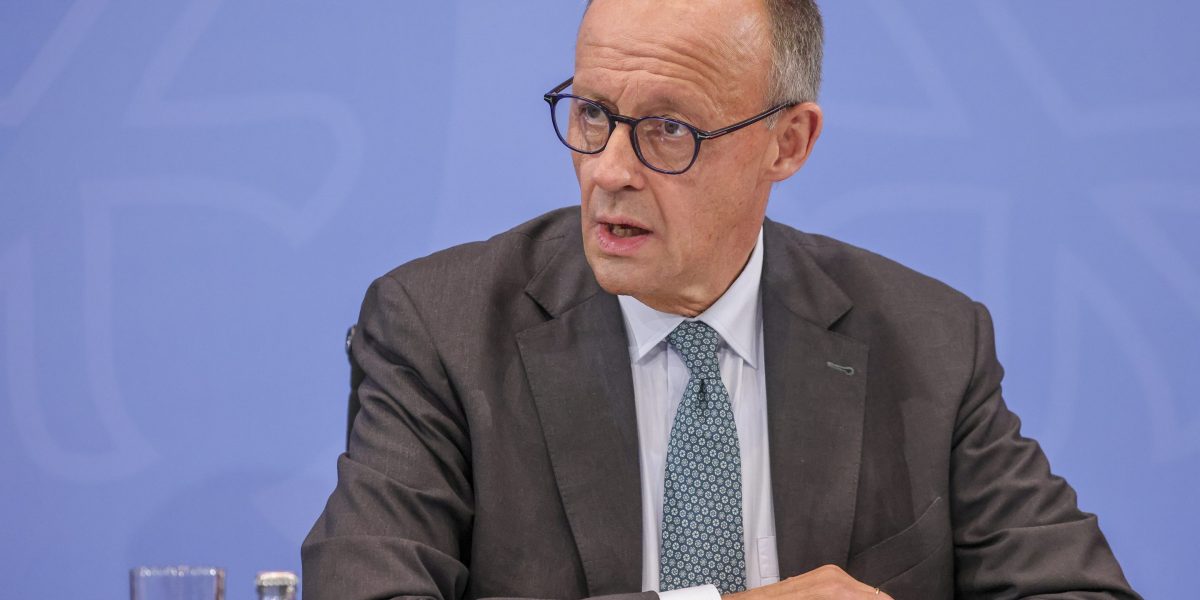
An old video of German Chancellor Friedrich Merz saying that Germany is “no longer productive enough” has gone viral and triggered a fresh debate over working hours, productivity and the country’s economic troubles. The video began circulating widely on social media after Merz’s visit to China earlier this year. In the clip, the German leader draws a comparison with China and questions whether Germany can maintain long-term prosperity while prioritising shorter working weeks and work-life balance.Also Read: Travis Kelce charity foundation’s $1.5 million funding faces scrutiny as records show less than 50% spent on charity, $469,000 reported as management expenses“We are simply no longer productive enough,” Merz says in the video. He acknowledges that many Germans may feel they are already doing enough, but argues that the country needs to increase its overall level of work if it wants to remain economically competitive.“With work-life balance and a four-day week, long-term prosperity in our country cannot be maintained,” Merz says. “We will simply have to do a bit more.”— UnamunoAgain (@UnamunoAgain) What did German Chancellor Merz say about China?Merz made the comments while addressing supporters of his conservative Christian Democratic Union at a rally in Volkmarsen, ahead of local elections in Hesse. The remarks gained attention following his China trip, with social media users linking his comments to what he saw during his visit to the world's second-largest economy.China’s rapid industrial development and manufacturing strength have increasingly become part of the discussion about Germany’s competitiveness, particularly as German industry faces weak growth and pressure from global rivals. Merz’s argument, however, has also raised a broader question: is Germany’s economic problem really about people working fewer hours?Merz’s criticism of Germany’s work cultureThe chancellor has previously argued that Germans need to work more. He has pointed to relatively low working hours and high levels of sickness absence as factors that can weigh on economic output. His comments come at a difficult time for Germany, whose economy has struggled with prolonged stagnation. Merz has been pushing policies aimed at improving competitiveness and giving businesses more room to grow.The debate over working hours has therefore become closely tied to a much larger argument about how Germany can revive its industrial economy. For some, the answer is straightforward: more hours and greater productivity. Others argue that simply asking people to work longer misses deeper structural problems, including high costs, regulation and the changing nature of modern economies.Social media divided over Merz’s remarksThe resurfaced video has generated sharply different reactions online. Some users agreed with Merz and argued that European economies need to become more productive if they want to compete globally.Others rejected the idea that longer working hours alone can explain the difference between Germany and China. One commenter argued that regulations and costs are more important factors, while also noting that the number of holidays does not necessarily explain China’s economic performance.Another user said Merz had identified a genuine need to improve efficiency but was looking at the issue too narrowly. The commenter argued that China’s economic progress was driven not only by workers but also by government policy and long-term planning.There were also those who supported Merz’s broader argument that Europe may need to rethink its approach to work if it wants to maintain its competitive position.A bigger debate for GermanyThe viral clip has turned into something bigger than a discussion about the four-day workweek. Germany is facing questions about industrial competitiveness, productivity and how to sustain prosperity as global economic competition intensifies. Merz’s comments have put the spotlight on one part of that debate: how much people work.But whether longer working hours can solve Germany’s economic problems remains contested. The resurfaced video has ensured that the argument is back in the public conversation, and this time, China is at the centre of it.
Germany ‘is no longer productive’: Chancellor Merz’s old video criticising work-life balance and four-day week goes viral
A resurfaced video of German Chancellor Friedrich Merz saying Germany is “no longer productive enough” has sparked a fresh debate over working hours, work-life balance and the countrys economic competitiveness. Merz argued that Germany cannot maintain long-term prosperity with a four-day workweek and urged people to work more, while social media users debated whether longer hours are really the answer to Germanys economic challenges.
630 words~3 min read