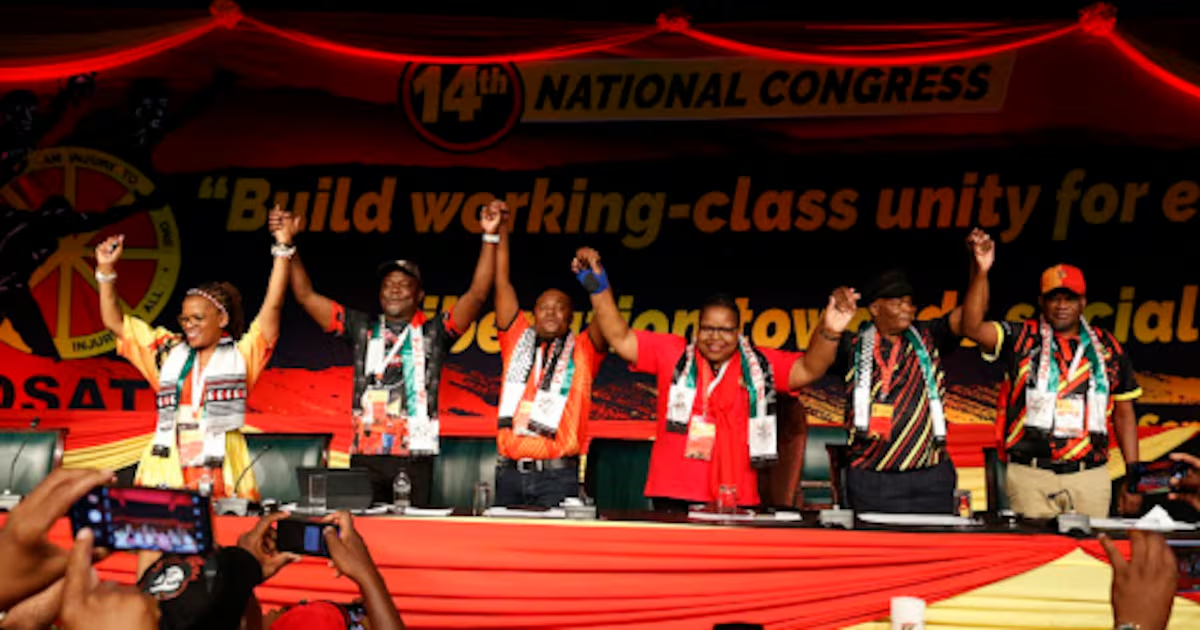
Half of Cosatu’s leadership said they would accept an opportunity to serve another term as national office bearers, even as the labour movement confronts mounting challenges. Cosatu is set to hold its 15th national congress at Gallagher Convention Centre in Midrand on September 14-17. The 14th national congress, which was held at the same venue in September 2022, elected: President: Zingiswa Losi; First deputy president: Michael Shingange; Second deputy president: Duncan Luvuno; General secretary: Solly Phetoe; Deputy general secretary: Gerald Twala; and National treasurer: Freda Oosthuysen. In an interview with Business Day on Tuesday, Shingange, who also serves as president of the National Education, Health & Allied Workers’ Union, said: “Of course, we always respond to workers’ calls. If they call on me to return and serve in any capacity, I will definitely respond positively.” Phetoe said: “Yes, if I am called by workers to stand again, I will be available.” Luvuno, who also serves as the national chair for occupational health & safety at the National Union of Mineworkers (NUM), said: “I will never say no if workers say I must make myself available. I will always be available to service workers in any capacity, but I must stress that they are the final arbiters on this issue of leadership election.” Losi said the leadership question was managed internally in the federation by unions “themselves outside of ourselves as serving national office bearers”. “Ours, as serving national office bearers, is to focus on convening a successful 15th national congress, and when nominations get opened, then we will know the thinking of affiliates on the leadership question,” the Cosatu president said. Twala was equally guarded in his response, saying questions of leadership “are ultimately matters for Cosatu’s members, affiliates and duly mandated congress delegates. It would therefore not be appropriate for me to speculate on leadership outcomes or my own position ahead of that process. “My focus remains on the work and responsibilities entrusted to me and on contributing, alongside others, to a successful congress that advances the interests of workers. I believe the democratic processes of the federation should be allowed to unfold without being pre-empted through public commentary.” Cosatu national spokesperson Zanele Sabela said: “There’s no limit to the number of terms national office bearers can serve just as long as they are nominated and elected at the national congress. Affiliates are currently in the process of nominations. Delegates to congress will decide.” At its final central executive committee (CEC) meeting on August 24 and 25 before the congress, Cosatu reflected on the political, organisational, socioeconomic and international conditions confronting workers. The CEC, its highest decision-making body between congresses, also assessed progress since the 14th national congress in September 2022, where affiliates including the Police and Prisons Civil Rights Union, South African Municipal Workers Union and Nehawu called for Cosatu to ditch the ANC and back the SA Communist Party (SACP) in elections.During the period under review (2022-26), Phetoe noted Cosatu secured big socioeconomic gains through struggles at the workplace and sectoral level, collective bargaining, the National Economic Development and Labour Council, parliament and engagement with government and the alliance. “Among these victories are the R253bn Eskom debt relief intervention that contributed towards stabilising the utility and ending load-shedding; the two-pot pension reforms that have enabled more than 4-million workers to access more than R79bn of their retirement savings; the adoption of the National Health Insurance Act (NHI) towards universal healthcare; the Basic Education Laws Amendment Act strengthening access and transformation in education; and the Expropriation Act advancing the transformation agenda,” the Cosatu general secretary said. “The national minimum wage has risen from R20 per hour in 2019 to R30.23 in 2026, with significant gains for domestic and farm workers, while Cosatu has continued to defend the social relief of distress grant and campaign for its evolution into a basic income grant. “Important advances were also secured through the employment equity, labour law reform and occupational injuries and diseases reforms, strengthening protection for vulnerable and atypical workers, promoting greater wage transparency and extending occupational injury protection to 1-million domestic workers,” Phetoe said. “As we head towards the 15th national congress, our task is, therefore, not simply to celebrate these victories but to consolidate them, defend workers against austerity and retrenchments, strengthen public services and public ownership, and intensify the struggle for decent jobs, affordable services and an economy that serves the working class.” Business Day
Half of Cosatu leadership open to another term before national congress
Final decisions rest with union affiliates and delegates as the federation faces political and economic pressures, including debates over an alliance with the ANC
737 words~3 min read