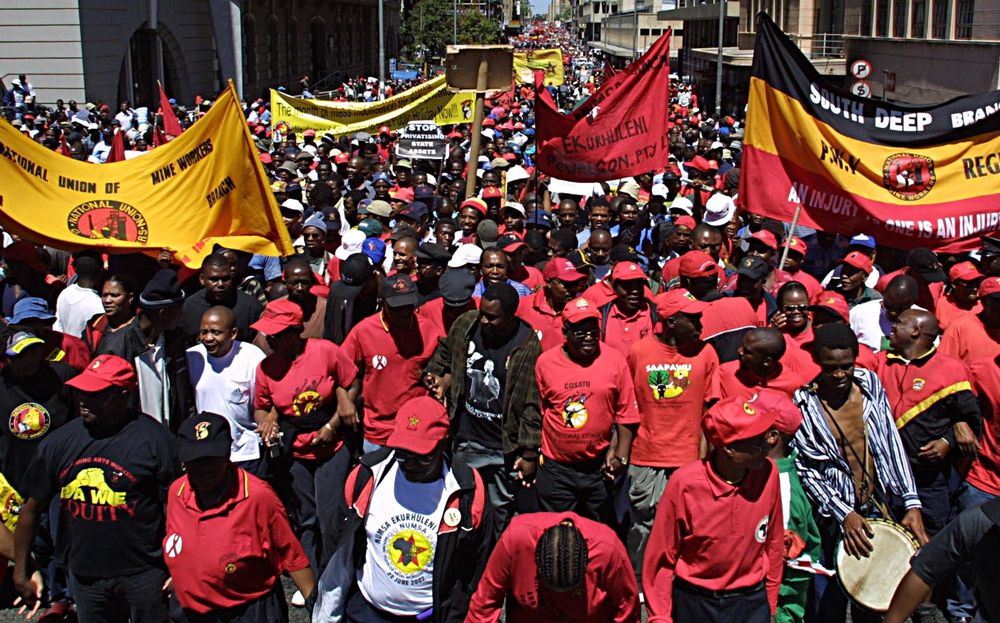
The Congress of South African Trade Unions’s (Cosatu) national congress in September is shaping up to be a critical test of the labour federation’s ability to contain internal factionalism and reclaim its influence over a working class increasingly alienated by the political establishment.Facing growing friction within its decades-long alliance with the ANC, the federation’s leadership has warned delegates against turning the event into a battlefield. Instead, Cosatu is urging leadership to chart a unified political strategy that restores confidence across the broader labour movement.At its final central executive committee (CEC) meeting on August 24 and 25 ahead of the congress, Cosatu reflected on the political, organisational, socioeconomic and international conditions confronting workers. The CEC, its highest decision-making body between congresses, also assessed progress since the 14th national congress in September 2022, where affiliates including the Police and Prisons Civil Rights Union, South African Municipal Workers Union and National Education, Health and Allied Workers’ Union called for Cosatu to ditch the ANC and back the SA Communist Party (SACP) in elections.Four years later, the political question remains unresolved. The September congress will therefore be about more than electing new leaders: it could shape Cosatu’s political identity, its relationship with the ANC and SACP, and its ability to still be a credible and united voice for workers amid mounting economic and political pressures.The SACP took the decision during its fifth special national congress in Boksburg in December 2024. The party, which has campaigned for the ANC since SA’s first democratic elections in 1994, has become increasingly critical of its record in government and has spoken out against state capture, malfeasance, maladministration, looting and poor service delivery. Cosatu general secretary Solly Phetoe said the CEC reflected on the state of the tripartite alliance ahead of the municipal elections in November. “Cosatu remains concerned about the failure to convene the necessary alliance political council and alliance summit despite repeated calls by the federation. The current challenges confronting the alliance cannot be wished away or postponed indefinitely,” he said. “Cosatu will continue engaging its alliance partners and will intensify its efforts to convene the alliance and develop a common programme before and after the municipal elections.” Phetoe stressed the CEC affirmed the labour federation’s political analysis and programme must remain a unifying federation position. “The 15th national congress must not become a platform for factional political battles. It must provide a political direction capable of uniting workers and rebuilding the confidence of the working class in its own collective power,” he said. The CEC was concerned about the worsening political and socioeconomic conditions confronting the working class and broader society. Workers continued to bear the brunt of unemployment, poverty, inequality, rising living costs and the deterioration of public services. “These conditions are compounded by corruption, criminality, the weakening of state capacity and the growing influence of organised criminal networks,” Phetoe said. “The CEC expressed particular concern about the revelations from the Madlanga commission regarding corruption and criminality within law enforcement institutions. Cosatu believes the capture and corruption of institutions of the democratic state are a serious threat to workers, communities and constitutional order.” Cosatu goes to its 15th congress with about 1.5-million members, below its target of 2-million. “This decline cannot be treated as a statistical problem. It represents a weakening of the organised power of workers at a time when employers are intensifying attacks on collective bargaining, employment security and workers’ rights,” Phetoe said, calling on Cosatu to “return to the workplace and rebuild shop floor organisation”. “Recruitment, retention, political education, workplace visibility and militant campaigning must become central to the daily work of every affiliate and structure of the federation.” During the period under review (2022-2026), Phetoe noted Cosatu secured significant socioeconomic gains through struggles at the workplace and sectoral level, collective bargaining, National Economic Development and Labour Council, parliament and engagement with government and the alliance. “Among these victories are the R253bn Eskom debt relief intervention that contributed towards stabilising the utility and ending load-shedding; the two-pot pension reforms that have enabled more than four million workers to access more than R79bn of their retirement savings; the adoption of the National Health Insurance Act (NHI) towards universal healthcare; the Basic Education Laws Amendment Act strengthening access and transformation in education; and the Expropriation Act advancing the transformation agenda,” the Cosatu general secretary said. “The national minimum wage has risen from R20 per hour in 2019 to R30.23 in 2026, with significant gains for domestic and farm workers, while Cosatu has continued to defend the social relief of distress grant and campaign for its evolution into a basic income grant. “Important advances were also secured through the employment equity, labour law reform and pccupational injuries and diseases reforms, strengthening protection for vulnerable and atypical workers, promoting greater wage transparency and extending occupational injury protection to 1-million domestic workers.” Phetoe said these victories, however, remained accompanied by significant unfinished business. “Electricity may be more stable, but its cost remains increasingly unaffordable, municipal debt to Eskom has reached about R120bn, and Cosatu remains resolutely opposed to the privatisation of Eskom or any restructuring that threatens jobs, collective bargaining and public ownership. “The federation continues to demand the full implementation of NHI, the filling of more than 27,000 vacant teaching posts, stronger enforcement of the national minimum wage, improved social protection and the expedited recruitment of 10,000 additional labour inspectors.” The painful experience of the South African Post Office, where about 6,000 workers were retrenched and half its branches closed, “is a reminder of the devastating consequences when strategic public institutions are allowed to deteriorate”. “As we head towards the 15th national congress, our task is therefore not simply to celebrate these victories, but to consolidate them, defend workers against austerity and retrenchments, strengthen public services and public ownership, and intensify the struggle for decent jobs, affordable services and an economy that serves the working class.” Business Day
NEWS ANALYSIS | Cosatu heads into congress with political fault lines exposed
Federation celebrates recent gains but warns of unfinished business and threats to workers' rights
982 words~4 min read