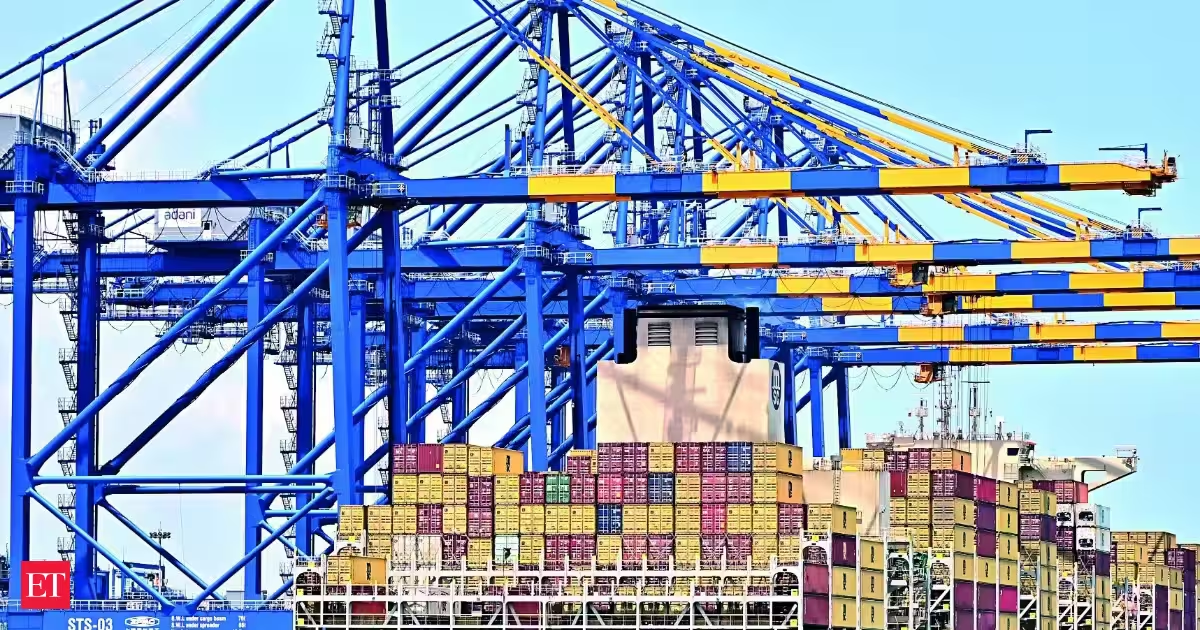
For much of modern economic history, national competitiveness was shaped by visible infrastructure. The investments in roads, ports, railways and warehouses investments enabled production to scale, markets to integrate and firms to reach customers at lower cost.The next frontier of logistics competitiveness, however, will not be defined by physical capacity alone, but by the quality of information that allows such capacity to be discovered, compared, trusted and used. Logistics is entering an intelligence-led phase in which data may become as critical to economic performance as concrete, cranes, carriers and containers.The economic principle is “markets work better when information moves faster than goods”. When logistics assets, routes, capacities, service capabilities, compliance conditions and performance records are visible, firms make better choices. Better logistics intelligence reduces search costs, shortens decision cycles and improves economic outcomes.Conversely, when information is fragmented, incomplete or inaccessible, the economy pays a hidden tax. Trucks run empty. Warehouses remain underutilised. Firms overstock to protect against uncertainty. Smaller service providers remain invisible to larger customers. Investors misread demand signals. Governments spend on infrastructure without a full picture of utilisation. These are not merely operational inefficiencies. They are economic leakages.The economics of logistics intelligence therefore rests on five connected principles: reduction of information asymmetry, lower transaction costs, higher asset productivity, better capital allocation and stronger network effects. Together, these principles explain why countries and companies are investing in shared logistics data systems rather than relying only on asset expansion.Global success storiesGlobal experience supports this logic. Singapore shows that logistics intelligence can become a source of national competitive advantage. Its PORTNET system links a large community of port and logistics users and enables high-volume digital coordination across shipping, port, freight and trade processes. The economic lesson is that information became a shared infrastructure for users who needed faster, more predictable and more coordinated movement.The United States adopted a similar principle through Freight Logistics Optimization Works, a public-private partnership in which participants share logistics data and receive aggregated, anonymised visibility into demand, supply and throughput. The user benefit is that companies can look beyond their own operational silos. They cananticipate congestion, align capacity with demand and improve resilience before disruptions become costly.Japan’s collaborative logistics initiatives point in the same direction. Faced with labour shortages, ageing demographics and rising delivery complexity, Japanese firms are exploring shared standards, common platforms and higher vehicle utilisation. The economic response is not only to add more vehicles or labour, but to make use of existing capacity through better coordination.The European Union’s electronic Freight Transport Information regulation, or eFTI, shows that governments now view logistics information as economic infrastructure. The eFTI provided a framework for the electronic exchange of freight transport information between businesses and authorities.Hamburg’s Port Community System demonstrates how shared logistics information can improve coordination and transparency across thousands of participants in the port ecosystem.For India, this debate is timely. The National Logistics Policy, PM Gati Shakti, Unified Logistics Interface Platform (ULIP) and the Logistics Data Bank have strengthened digital integration and decision support. ULIP has facilitated over 160 crore digital transactions, while the Logistics Data Bank has tracked over 10 crore EXIM containers.Economic gainsThe economic benefits are clearest when viewed from the user’s side of the market.For manufacturers, logistics intelligence translates into lower delivered cost, better route choices, more reliable partners and improved working-capital efficiency. When transport uncertainty declines, firms can reduce buffer stocks, shorten fulfilment cycles and serve wider markets with greater confidence.For MSMEs and exporters, the gain is market access. Smaller firms often lose competitiveness because they cannot easily identify dependable warehousing, freight forwarding, cold-chain or multimodal options. A visible logistics ecosystem lowers search and verification costs, allowing smaller enterprises to connect more easily to national and global value chains.For logistics service providers, the benefit is demand discovery. Regional transporters, warehouse operators, technology firms and specialised service providers can become visible to new customers. This increases utilisation, reduces idle capacity and enables smaller operators to participate in more organised supply chains.For investors and infrastructure developers, logistics intelligence improves capital allocation. Data on demand clusters, industrial corridors, service gaps and utilisation patterns helps investors place capital where economic need is real. This reduces the risk of stranded assets and accelerates investment into productive logistics capacity.For governments, it strengthens policy targeting. Better visibility enables public agencies to identify bottlenecks, prioritise infrastructure, monitor corridor performance and design interventions that improve competitiveness rather than merely expand capacity.For the economy as a whole, these user-level gains compound into larger outcomes: higher asset productivity, lower logistics cost, faster trade movement, stronger manufacturing competitiveness, improved export readiness, better resilience and more inclusive participation by smaller enterprises.The future of logistics, therefore, is not merely about moving goods more efficiently. It is about enabling economies to use resources more intelligently. That may well become one of the defining drivers of competitiveness in the decades ahead.The writer is Director General, CIIPublished on September 2, 2026
Logistics intelligence
Logistics data will be key to competitiveness
812 words~4 min read