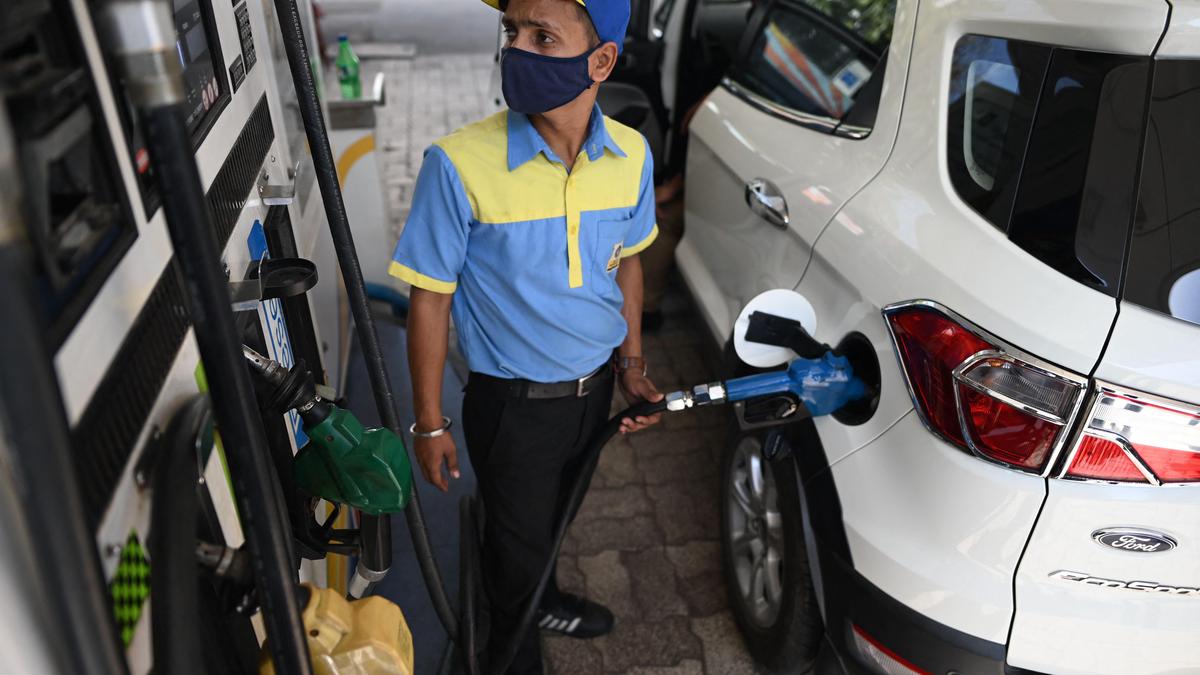
The Federation of Automobile Dealers Associations (FADA) had predicted in July that hesitation around ethanol-blended petrol would influence customers’ purchase decisions
| Photo Credit:
Fewer people in India are buying petrol-powered passenger vehicles than before. Petrol’s share in the passenger vehicle (PV) market has fallen below half to 48.1 per cent in August, amid concerns over the transition to E20 petrol that have pushed buyers towards alternative powertrains. A year earlier, petrol vehicles accounted for 51.9 per cent of total PV sales.Currently, nearly one in three new PVs run on CNG or battery. The shift has played out in a market that grew 14.9 per cent y-o-y in August. The month saw PV registrations of over 3.9 lakh with Maruti Suzuki retaining its lead at 1.64 lakh units. Tata Motors grew the fastest among six major manufacturers tracked, accounting for 57,357 units in August.The changing fuel mix comes as concerns around India’s transition to E20 petrol enter the purchase equation. The Federation of Automobile Dealers Associations (FADA) had predicted in July that hesitation around ethanol-blended petrol would influence customers’ purchase decisions.Longer-term economics are also at work. Hemal Thakkar, Senior Practice Leader and Senior Director, Crisil Intelligence, points to consumer preference for cost-efficient mobility and a maturing CNG ecosystem. EV demand is similarly benefiting from increasing consumer acceptance and wider model availability, Crisil said.Add strong hybrids and CNG, electric and strong-hybrid vehicles accounted for 34.8 per cent of PV retails in August 2026, up from 29.9 per cent in August 2025. Strong hybrids themselves slipped to 1.9 per cent from 2.7 per cent, leaving CNG and EVs as the principal gainers in the year-on-year powertrain shift.CNG battle widensMarket analysts say Maruti and Tata’s broad factory-fitted CNG portfolios and improvements in packaging put them in a stronger position to capture the shift. Tata’s twin-cylinder technology reduces the traditional loss of luggage space from a large CNG cylinder, helping take the fuel into the Punch and Nexon, alongside the Tiago and Tigor. The Nexon has also extended factory CNG to a turbo-petrol compact SUV.Maruti’s advantage is breadth and scale. The Wagon R, Dzire, Ertiga and Eeco provide established CNG nameplates, while the Brezza and Fronx extend S-CNG into SUVs and crossovers. Analysts say the widening choice is helping move CNG beyond its traditional fleet and entry-car base into mainstream family-car purchases.Rivals have been slower to build comparable CNG breadth. Hyundai offers CNG on the Grand i10 Nios, Aura and Exter, while its larger SUV portfolio remains largely petrol- and diesel-led. Mahindra has largely stayed out of CNG, combining its petrol- and diesel-heavy SUV franchise with an expanding EV line-up. Tata, in contrast, has both CNG and electric offerings across several mass-market nameplates.Tata gains share fastestTata’s share of overall PV registrations rose to 14.7 per cent in August 2026 from 12.1 per cent in August 2025, narrowly outpacing Maruti’s gain to 42.1 per cent from 39.6 per cent. Kia’s registrations rose 16.6 per cent y-o-y to 23,162 units.Mahindra and Hyundai gained volumes but lost share because their growth lagged the market. Mahindra saw 4.4 per cent more registrations but its share fell to 12.7 per cent from 13.9 per cent. Hyundai, too, saw a 4.2 per cent uptick in registrations but its share declined to 11.9 per cent. Toyota was the only one among the six to record a fall in registrations.Sequentially, however, retail registrations dipped 6.6 per cent. Thakkar attributed it to normalisation after a stronger July, inauspicious periods in southern States, and some consumers postponing purchases ahead of the festival season.Published on September 1, 2026