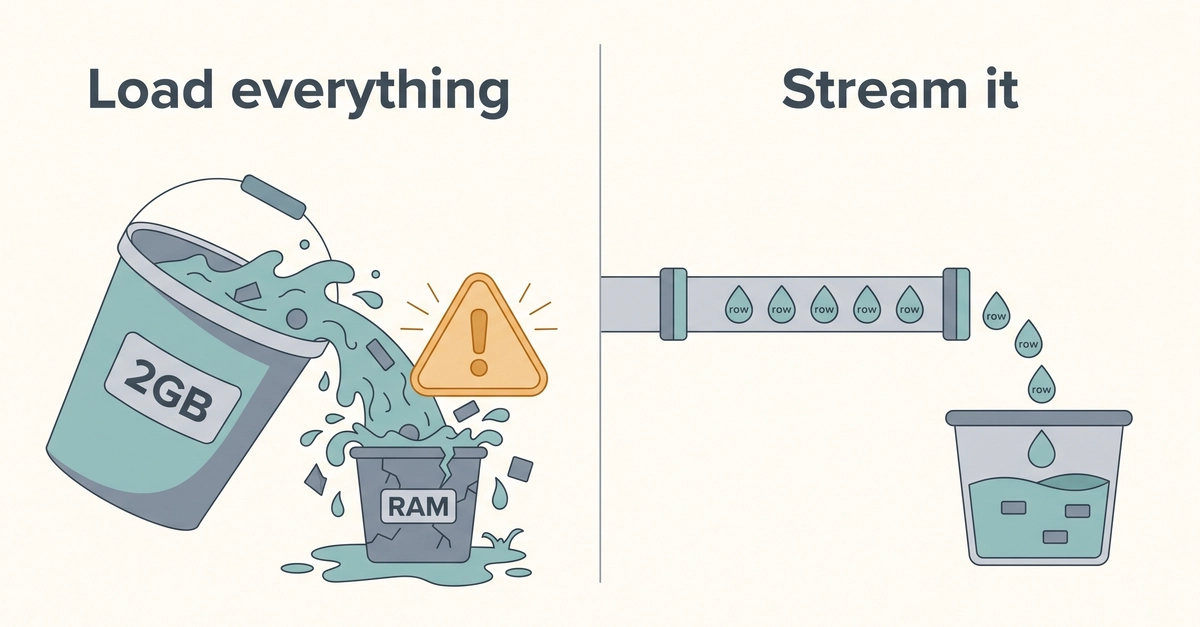
Working with JSON data is a daily task for most backend developers. However, when you start dealing with massive JSON files (think gigabytes of data from API dumps or system logs), using the standard json.load() method can quickly consume all your available RAM and crash your application.
Recently, I had to process a 4GB JSON file containing thousands of nested records. Instead of loading the entire file into memory, I used Python generators to parse and filter the data efficiently.
Here is a quick breakdown of how to handle large JSON datasets without hitting memory limits.
The Memory Problem
Normally, parsing a JSON file in Python looks like this: