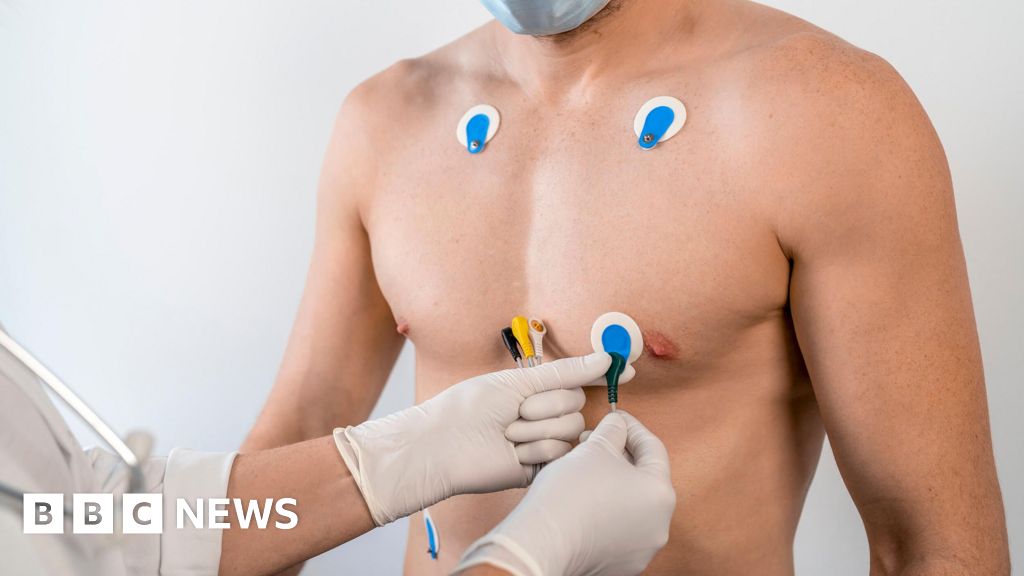
EXCLUSIVE: Research shows artificial intelligence (AI) can now tell in seconds that you probably have heart disease, high blood pressure or diabetes from a routine scan or a five second video of your face17:04, 31 Aug 2026Updated 17:06, 31 Aug 2026Heart diseases and high blood pressure could soon be diagnosed “in the blink of an eye” by AI, new research shows.Breakthrough studies unveiled at the world ’s biggest heart conference suggest artificial intelligence could be “transformative” for the NHS, where patients currently face months of delays.In the UK around 16 million people have hypertension, four million have Type 2 diabetes and over eight million people have heart diseases. Many remain undiagnosed.The first AI programme, which is being trialled in the NHS, could flag who is likely to have heart failure and heart valve disease from a routine ECG (electrocardiogram) which currently cannot detect them.The second AI breakthrough showed that both high blood pressure and diabetes could also be diagnosed from a five-second video of your face, by analysing skin blood-flow patterns and colouring.The studies presented at the European Society of Cardiology (ESC) congress in Munich come as around half a million people in Britain are currently on the NHS cardiology waiting list.Dr Ahmed El-Medany, who led the ECG analysis for Imperial College London, said: “These results suggest there is potentially far more information hidden within a routine ECG than we can recognise by looking at it ourselves.“It is particularly encouraging that this superhuman AI performed well across separate groups of patients. The important next questions are how it performs in NHS patients.”Doctors or nurses carry out millions of quick ECG scans at GP practices, clinics and hospitals to rule out whether someone has had a heart attack or has an abnormal heart rhythm. It uses small sticky electrodes placed on the skin on the arms, legs, and chest to record the electrical signals of the heart every time it beats. The wires connect the sensors to a machine that records them as a graph on paper or a screen for a doctor to review.Until now ECGs could not identify if a patient had heart failure - where the heart is not pumping blood as well as it should - or heart valve disease - where at least one heart valve is not working correctly.Patients suspected of these two conditions due to symptoms such as shortness of breath often face months of waits on the NHS for an echocardiogram ultrasound scan. In the meantime they are at higher risk of stroke and heart attack.The new AI programme, currently being trialled on 600 NHS patients in London and Bristol, has been trained using data from 10.6 million ECG scans and tested on 67,000 patients in the US. It correctly identified 81% of patients who had heart failure and 90% who had heart valve disease.If the NHS trial is also successful it could be rolled out across the health service in the next five years so that patients whose ECG scan indicates signs of these heart diseases can be fast tracked for the ultrasound in a few days.Dr Roy Jogiya, chief medical researcher at Heart Research UK, said AI screening could be “transformative”, adding: “An ECG is one of the simplest and most widely available tests in medicine, but AI is showing us that it may contain far more information than the human eye can recognise.”Small portable ECG scanning devices will now be trialled by the NHS to see if they can pick up enough data for AI to quickly flag heart disease in people in their own home.Dr Sonya Babu-Narayan, clinical director at the British Heart Foundation, said: “It is exciting to see that AI can now deliver a read-out from an ECG in what feels like the blink of an eye. Earlier diagnosis and treatment saves and improves lives.”The second smaller study showed that another AI model was able to remotely diagnose high blood pressure from a facial video alone - without the inflatable cuff that is typically used by medics.Researchers from the University of Tokyo examined videos of 215 participants, who had a recording of their face and palms using a spectroscopic camera. The software could detect both hypertension with more than 90% accuracy and diabetes with more than 80% accuracy from the short clips.Article continues belowResearcher Ryoko Uchida, of the University of Tokyo and Institute of Science, said: “This contactless approach could allow people to be screened in everyday settings without cuffs, blood sampling or a dedicated clinic visit, helping to identify at-risk individuals who would otherwise remain undiagnosed.”Associate Professor Nico Bruining, Editor-in-Chief of the European Heart Journal, said: “It is remarkable that AI-supported technologies are enabling the development of such powerful tools for early disease prevention.“Detecting these conditions early means treatment and lifestyle changes can start sooner, helping to prevent heart attacks, strokes and other cardiovascular diseases.”
AI could diagnose heart disease after five-second face scan
EXCLUSIVE: Research shows artificial intelligence (AI) can now tell in seconds that you probably have heart disease, high blood pressure or diabetes from a routine scan or a five second video of your face
809 words~4 min read